Cloned horse raises hopes for equestrian sports in China / Photo: Jade GAO - AFP

 Multi-Asset Trading Venue Monochrome Exchange Announces IEO of Its Native Token, $MCR

 South Korea break Japan hearts to win Asian Games basketball gold

 Acosta takes first victory at Austrian MotoGP

 PSG president Nasser al-Khelaifi under investigation in France for conflict of interest

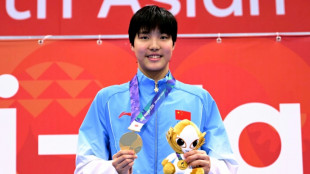 China swim sensation, 13, sets Games record after Japan win early
 Drones hit Moscow as Russians go to the polls

 New England boss Fleming says 'wrong' to ask Stokes to end retirement

 Germans vote in elections threatening fresh blow to Merz

 US fears rapid escalation in Mideast after Houthis attack Riyadh

 Japan triathlete Hojo wins first gold of Asian Games

 IOC president impressed by 'beautiful' Asian Games wooden huts

 First Asian Games gold goes to Japan as China's 13-year-old Yu lights up pool

 Data centre command hub keeps AI up and running

 Pope Leo in France: the issues on the table

 Packing for a pope: behind the scenes on foreign trips

 Republicans find transgender issues a powerful political weapon in midterm campaigning

 German state elections threaten new shock waves for Merz

 Chile's Bachelet quits race to be next UN chief

 Raphinha treble fires perfect Barca to win at Sevilla

 Thiam makes winning heptathlon return at Decastar meet

 Czechs beat USA to qualify for Davis Cup finals

 Dortmund sink Stuttgart to climb to Bundesliga summit

 Trump says will not tolerate attempts to slow AI growth

 'It has to stop': runners protest women's murders in S.Africa district

 Fire erupts near Riyadh airport as Houthis claim strikes

A Chinese company presented a cloned horse to the public on Thursday that is the first of its kind born in the country and approved for equestrian sport.
The cloning of competition and thoroughbred horses has been practised in several countries since the early 2000s, particularly for genetic improvements.
Born last June from a surrogate mother, "Zhuang Zhuang" was produced by the Beijing laboratory Sinogene and is a clone of a horse imported from Germany.
The black animal is the first from the "warmblood" group of breeds to be born in China and to be officially approved by the China Horse Industry Association.
"Warmbloods" are generally light horses with a lively temperament.
Equestrian sports, especially show jumping, have been making strides in China in recent years.
But a shortage of high-performance horses and a lag in breeding technologies are limiting growth.
"I spoke with (Chinese) riders who participate in the Olympics. All of them have more than one horse, usually two or three. Each horse costs from a few million to 10 million yuan ($1.5 million)," Mi Jidong, CEO of Sinogene, told AFP.
"Cloning can help reduce the price of breeding and raising horses."
Producing competitive horses in China by cloning should make it less dependent on costly imported animals to supply Chinese equestrian sports.
The world's first cloned horse was born in Italy in 2003.
Chinese animal cloning companies have made significant progress in recent years, with technologies now relatively mature for sheep, cows, pigs, dogs and cats.
L.Mesquita--PC