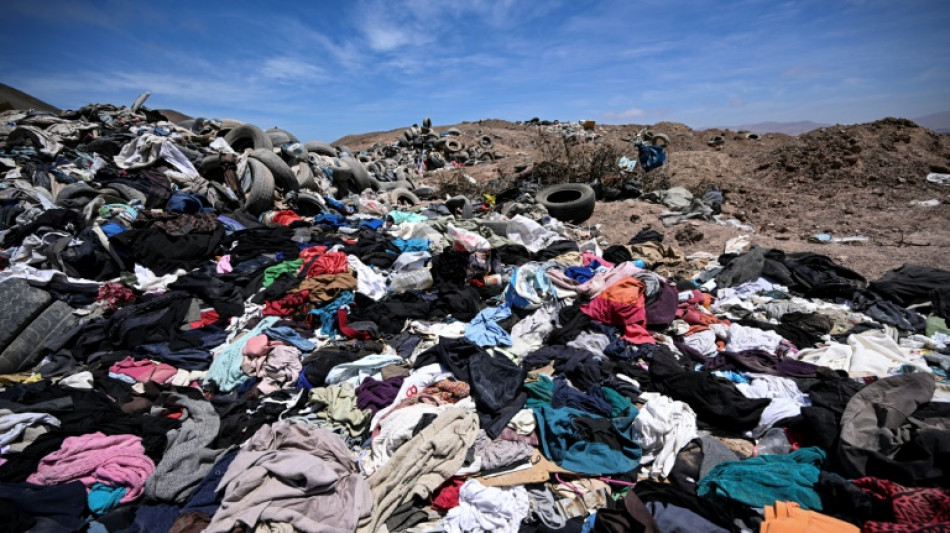
Our bad fashion habits -- and how we might change them -- in numbers / Photo: MARTIN BERNETTI - AFP/File

 Multi-Asset Trading Venue Monochrome Exchange Announces IEO of Its Native Token, $MCR

 South Korea break Japan hearts to win Asian Games basketball gold

 Acosta takes first victory at Austrian MotoGP

 PSG president Nasser al-Khelaifi under investigation in France for conflict of interest

 China swim sensation, 13, sets Games record after Japan win early

 Drones hit Moscow as Russians go to the polls

 New England boss Fleming says 'wrong' to ask Stokes to end retirement

 Germans vote in elections threatening fresh blow to Merz

 US fears rapid escalation in Mideast after Houthis attack Riyadh

 Japan triathlete Hojo wins first gold of Asian Games

 IOC president impressed by 'beautiful' Asian Games wooden huts

 First Asian Games gold goes to Japan as China's 13-year-old Yu lights up pool

 Data centre command hub keeps AI up and running

 Pope Leo in France: the issues on the table

 Packing for a pope: behind the scenes on foreign trips

 Republicans find transgender issues a powerful political weapon in midterm campaigning

 German state elections threaten new shock waves for Merz

 Chile's Bachelet quits race to be next UN chief

 Raphinha treble fires perfect Barca to win at Sevilla

 Thiam makes winning heptathlon return at Decastar meet

 Czechs beat USA to qualify for Davis Cup finals

 Dortmund sink Stuttgart to climb to Bundesliga summit

 Trump says will not tolerate attempts to slow AI growth

 'It has to stop': runners protest women's murders in S.Africa district

 Fire erupts near Riyadh airport as Houthis claim strikes

The fashion industry is estimated to contribute upwards of two percent of global greenhouse gas emissions, and is on track to get even worse if there isn't major change.
Here are some key figures on how fashion is affecting the planet and how consumers can make a difference.
- 7 to 10 -
The average number of times a garment is worn before it is discarded, according to the Ellen Macarthur Foundation.
- 5 -
The maximum number of new items we should be buying every year if we are to reach the 1.5 degree Celsius global warming limit set out by the UN, according to the Hot or Cool institute think tank.
- Around 30 percent -
The percentage of donated clothes that ends up in landfills or incinerators abroad, according to Hot or Cool. They can also end up undercutting local vendors if they flood the market.
- 1 second -
The equivalent of a lorry load of clothes is incinerated or buried in a landfill every second, the Ellen Macarthur Foundation reckons.
- 100 billion -
The number of new clothing items produced each year, according to the Clean Clothes Campaign.
- 1 percent -
Less than one percent of the material used to produce clothing is actually recycled into new clothing, according to the United Nations Environment Programme (UNEP).
Many fast fashion firms say they can recycle old garments into new, but the reality is the fabric quality is mostly not fit to make garments that can be sold.
- 30 degrees Celsius -
The recommended temperature at which clothes should be washed in order to increase their lifespan.
- 20 / 20 / 20 -
On average, the fashion consumption of the richest 20 percent of the world's population causes 20 times higher emissions than that of the poorest 20 percent, say Hot or Cool.
- 2023 -
This year France will pass a decree requiring every item of clothing sold in the country to carry a label detailing its precise climate impact. The EU is expected to follow suit.
- 8 times -
The secondhand clothing market is growing eight times faster than the overall apparel market, according to online consignment shop thredUP.
- Double -
In the last 15 years, clothing production has roughly doubled, the Ellen Macarthur Foundation estimated, but over the same period we used those clothes almost 40 percent less.
- 40 percent -
The percentage of global consumers that belong to Gen-Z -- those born between 1997 and 2012 -- according to McKinsey & Company. Gen-Z is both a part of the problem and solution when it comes to fast fashion: they make up a huge portion of consumers, but are also calling for more sustainable fashion.
X.Brito--PC