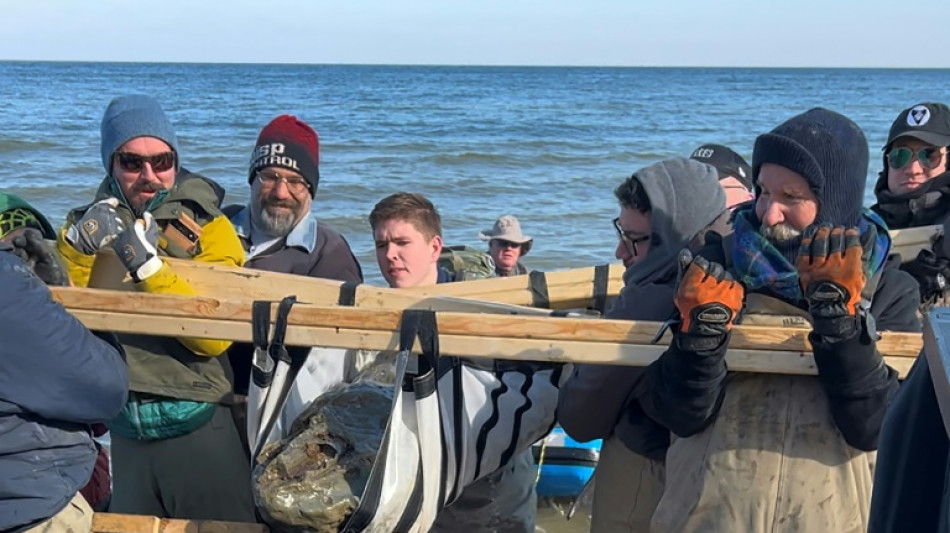
12-million-year-old whale fossil skull found in Maryland / Photo: Kevin Schmidt - AFP

 Multi-Asset Trading Venue Monochrome Exchange Announces IEO of Its Native Token, $MCR

 South Korea break Japan hearts to win Asian Games basketball gold

 Acosta takes first victory at Austrian MotoGP

 PSG president Nasser al-Khelaifi under investigation in France for conflict of interest

 China swim sensation, 13, sets Games record after Japan win early

 Drones hit Moscow as Russians go to the polls

 New England boss Fleming says 'wrong' to ask Stokes to end retirement

 Germans vote in elections threatening fresh blow to Merz

 US fears rapid escalation in Mideast after Houthis attack Riyadh

 Japan triathlete Hojo wins first gold of Asian Games

 IOC president impressed by 'beautiful' Asian Games wooden huts

 First Asian Games gold goes to Japan as China's 13-year-old Yu lights up pool

 Data centre command hub keeps AI up and running

 Pope Leo in France: the issues on the table

 Packing for a pope: behind the scenes on foreign trips

 Republicans find transgender issues a powerful political weapon in midterm campaigning

 German state elections threaten new shock waves for Merz

 Chile's Bachelet quits race to be next UN chief

 Raphinha treble fires perfect Barca to win at Sevilla

 Thiam makes winning heptathlon return at Decastar meet

 Czechs beat USA to qualify for Davis Cup finals

 Dortmund sink Stuttgart to climb to Bundesliga summit

 Trump says will not tolerate attempts to slow AI growth

 'It has to stop': runners protest women's murders in S.Africa district

 Fire erupts near Riyadh airport as Houthis claim strikes

A whale skull fossil estimated to be some 12 million years old has been found on a beach in the Chesapeake Bay in Maryland, according to a local museum.
The discovery was made in October by a Pennsylvania man, Cody Goddard, who was searching for fossils and shark's teeth, the Calvert Marine Museum said in a statement.
"It felt like we had won the World Cup of Paleontology!" said Stephen Godfrey, curator of paleontology at the museum in the eastern US state.
"We don't yet know what species of Miocene baleen whale this is," he said. "That we will only know once it has been prepared."
The museum said that it took two months to extract and move the skull, which was encased in a hardened block of sediment and weighs around 650 pounds (295 kilograms).
It is the most complete fossil whale skull ever recovered in the Calvert Cliffs area, according to the museum, and has been christened "Cody" for its finder.
Godfrey said the skull has been moved to the museum's Fossil Preparation Lab and specialized tools will be used to remove the sediment that encases most of it, a process that will take many months.
V.Fontes--PC