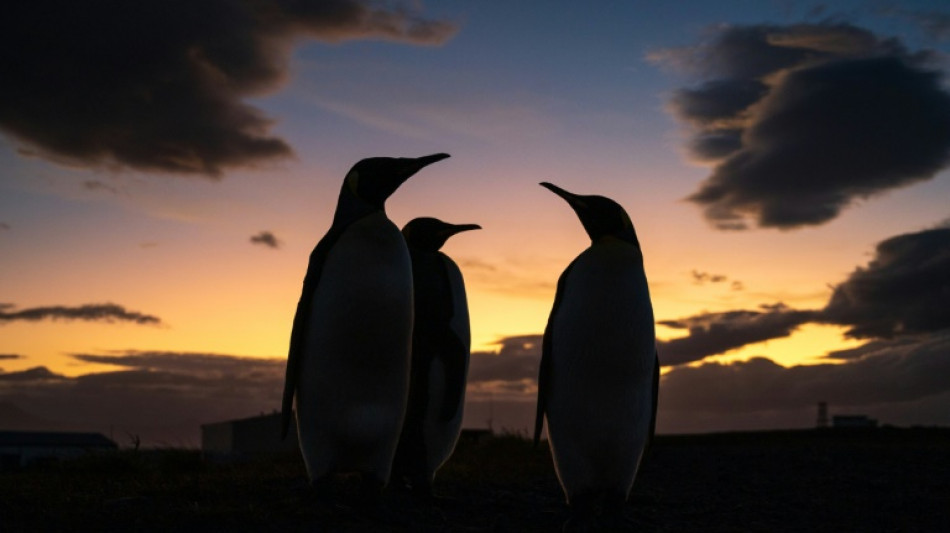
Satellite mapping finds new colony of Emperor penguins / Photo: PATRICK HERTZOG - AFP/File

 Multi-Asset Trading Venue Monochrome Exchange Announces IEO of Its Native Token, $MCR

 South Korea break Japan hearts to win Asian Games basketball gold

 Acosta takes first victory at Austrian MotoGP

 PSG president Nasser al-Khelaifi under investigation in France for conflict of interest

 China swim sensation, 13, sets Games record after Japan win early

 Drones hit Moscow as Russians go to the polls

 New England boss Fleming says 'wrong' to ask Stokes to end retirement

 Germans vote in elections threatening fresh blow to Merz

 US fears rapid escalation in Mideast after Houthis attack Riyadh

 Japan triathlete Hojo wins first gold of Asian Games

 IOC president impressed by 'beautiful' Asian Games wooden huts

 First Asian Games gold goes to Japan as China's 13-year-old Yu lights up pool

 Data centre command hub keeps AI up and running

 Pope Leo in France: the issues on the table

 Packing for a pope: behind the scenes on foreign trips

 Republicans find transgender issues a powerful political weapon in midterm campaigning

 German state elections threaten new shock waves for Merz

 Chile's Bachelet quits race to be next UN chief

 Raphinha treble fires perfect Barca to win at Sevilla

 Thiam makes winning heptathlon return at Decastar meet

 Czechs beat USA to qualify for Davis Cup finals

 Dortmund sink Stuttgart to climb to Bundesliga summit

 Trump says will not tolerate attempts to slow AI growth

 'It has to stop': runners protest women's murders in S.Africa district

 Fire erupts near Riyadh airport as Houthis claim strikes

Satellite mapping technology has discovered another new colony of the highly threatened Emperor penguins in Antarctica, researchers revealed Friday.
The find, announced by the British Antarctic Survey (BAS) to mark Penguin Awareness Day, brings the total number of known emperor penguin breeding sites around Antarctica's coastline to 66.
It is the latest in a series of Emperor penguin breeding sites detected using the satellite technology.
The birds, which are endemic to Antarctica and the biggest of the 18 penguin species at around 1.2 metres (nearly four feet) tall, face almost complete annihilation due to climate change and the loss of sea ice.
The US Fish and Wildlife Service last year placed Emperor penguins, which need sea ice to breed, on its endangered species list, calling the move "an alarm bell" and "call to action".
Recent projections suggest that under current warming trends, 80 percent of colonies will be quasi-extinct by the end of the century.
Scientists from the BAS uncovered the latest site, home to around 500 birds, by identifying signs of penguin excrement, known as guano, on the landscape at Verleger Point in West Antarctica.
Guano stains the snow and rock terrain brown and is easy to spot, while the flightless birds themselves are too small to be seen from satellites.
- 'Good news' -
The researchers studied images from the EU's Copernicus Sentinel-2 satellite mission and compared them with high resolution footage from the MAXAR WorldView3 satellite.
Peter Fretwell, who studies wildlife from space at BAS and was lead author of the research revealing the find, called it "exciting" but cautioned that the existential risk to the birds remained.
"Whilst this is good news, like many of the recently discovered sites, this colony is small and, in a region badly affected by recent sea ice loss," he said.
Emperor penguins are found in areas that are very hard to study because they are remote, inaccessible and extremely cold, with temperatures dropping as low as minus 60 Celsius (-76 Fahrenheit), according to the BAS.
Its researchers have for been looking for new colonies 15 years by searching satellite images for penguin guano.
The technology also helped the BAS detect a "catastrophic" breeding failure among the second largest Emperor colony in Antarctica between 2016 and 2019.
Nearly all chicks born over the three years died as their icy Antarctic habitat shrank due to abnormally warm and stormy weather breaking up the critical sea ice.
Emperors came to global fame with a 2005 documentary, "March of the Penguins", portraying their annual trek across the icy wastes, and the 2006 cartoon movie "Happy Feet".
H.Portela--PC