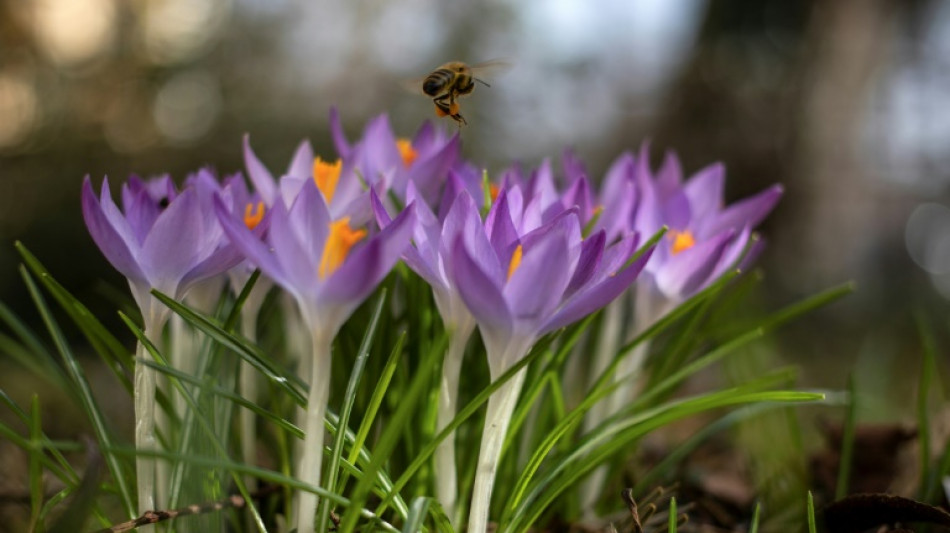
EU eyes more help for shrinking bee populations / Photo: David GANNON - AFP/File

 Kospi Falls Below 5,000 as U.S. AI Regulation Fears Trigger Circuit Breaker

 Valsoft's TAG Software Group Enters the Content Operations Market with the Acquisition of Chalco

 South Korea Proposes Fourth Delay of Cryptocurrency Gains Tax to 2029

 ASIC Fines Mona Museum Owner's Company for Late Financial Report
 Business Leaders Criticize Productivity Commission Inquiry Scope
 SCANDIC FINANCE ने एलेक्स बोडी को समूह का उपाध्यक्ष नियुक्त किया

 SCANDIC FINANCE Grubu, Alex Bodi’yi başkan yardımcılığına atadı

 Алекс Боди е назначен за вицепрезидент на групата SCANDIC FINANCE

 Ο Άλεξ Μπόντι νέος αντιπρόεδρος του ομίλου SCANDIC FINANCE
The EU on Tuesday announced proposals to try to reverse an "alarming decline" in the number of bees -- and other insects that pollinate the bloc's crops -- including by rewarding organic farming.
The European Commission said a review of a 2017 EU Pollinators Initiative showed there were gaps, and "significant challenges" needed to be addressed with revised measures.
The proposal calls for promoting farming -- organic or otherwise -- that protects pollinating insects, cutting back on pesticides, better monitoring of pollinator populations, and better conservation of habitats including in urban areas.
At stake is much of the European Union's agricultural output.
The commission estimates that pollinators -- mostly bees, but also hoverflies, moths, and some beetles and other insects -- contribute around five billion euros ($5.5 billion) a year to the bloc's food production.
Yet intensive farming practices, pesticides, pollution, changed land-use, introduced other species and climate change have all taken a serious toll on their populations.
"Pollinating insects have declined dramatically in diversity and abundance in the last decades, with many of them being threatened with extinction," the commission said in a statement.
Its proposal, made to the European Parliament and the 27 EU member states, looks to reverse pollinator decline by the end of this decade.
It focuses on wild populations of bees and other pollinators as the EU has other tools aimed at supporting honeybee farms.
It also is designed to work alongside the EU's farm subsidy scheme, called the Common Agriculture Policy, by rewarding farmers who implement sustainable methods.
The EU's environment commissioner, Virginijus Sinkevicius, said that, "in the case of pollinators, these small insects will define the future of nature and long-term food security".
He said he hoped the EU's steps towards saving them "can inspire similar action in the entire world".
V.F.Barreira--PC