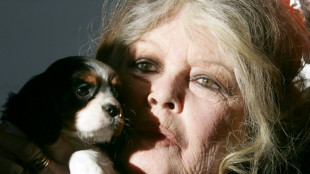
'Love hormone'? Not so fast, new study suggests / Photo: TORSTEN BLACKWOOD - AFP

 Multi-Asset Trading Venue Monochrome Exchange Announces IEO of Its Native Token, $MCR

 South Korea break Japan hearts to win Asian Games basketball gold

 Acosta takes first victory at Austrian MotoGP

 PSG president Nasser al-Khelaifi under investigation in France for conflict of interest

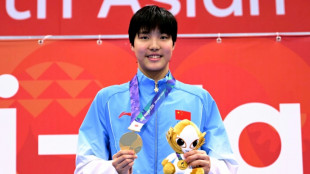 China swim sensation, 13, sets Games record after Japan win early

 Drones hit Moscow as Russians go to the polls

 New England boss Fleming says 'wrong' to ask Stokes to end retirement

 Germans vote in elections threatening fresh blow to Merz

 US fears rapid escalation in Mideast after Houthis attack Riyadh

 Japan triathlete Hojo wins first gold of Asian Games

 IOC president impressed by 'beautiful' Asian Games wooden huts

 First Asian Games gold goes to Japan as China's 13-year-old Yu lights up pool

 Data centre command hub keeps AI up and running

 Pope Leo in France: the issues on the table

 Packing for a pope: behind the scenes on foreign trips

 Republicans find transgender issues a powerful political weapon in midterm campaigning

 German state elections threaten new shock waves for Merz

 Chile's Bachelet quits race to be next UN chief

 Raphinha treble fires perfect Barca to win at Sevilla

 Thiam makes winning heptathlon return at Decastar meet

 Czechs beat USA to qualify for Davis Cup finals

 Dortmund sink Stuttgart to climb to Bundesliga summit

 Trump says will not tolerate attempts to slow AI growth

 'It has to stop': runners protest women's murders in S.Africa district

 Fire erupts near Riyadh airport as Houthis claim strikes

The "love hormone" oxytocin has long been thought key to behaviours including pairing up with a partner and nurturing offspring, but a new study in prairie voles is raising doubts.
The research found that voles bred to lack functioning receptors for oxytocin were still able to form strong pairs, produce young and nurse -- all behaviours previously believed to depend on the hormone.
Prairie voles are one of the few mammals that mate for life, and are often used to study social behaviours like pair-forming in animals.
In past studies, voles given drugs that stopped oxytocin being processed no longer formed pairs, and mothers failed to produce milk for their young.
Psychiatrist Devanand Manoli and neurobiologist Nirao Shah produced genetically altered prairie voles without working oxytocin receptors, and then observed how the mutant male and female voles behaved.
To their shock, the mutant voles appeared to have no difficulty pairing up with non-genetically altered partners, and mutant females could still deliver and nurse young, unlike those in the drug-driven studies.
"We were certainly surprised," said Manoli, an assistant professor at the University of California, San Francisco.
The results suggest that oxytocin is not the main, or only, driver of activities like partnering or nursing, he said.
"What the genetics reveals is that there isn't a 'single point of failure' for behaviours that are so critical to the survival of the species," he told AFP.
- 'Very complex behaviours' -
That didn't mean there were no differences, however.
Some male mutant voles that paired with ordinary female partners didn't show the aggression towards interloping females that would normally be expected.
And while mutant females produced and nursed litters, some had fewer pups per litter than their counterparts, and fewer of their offspring survived to weaning, the paper published Friday in the journal Neuron explains.
Pups born to mutant mothers also tended to weigh less, suggesting that they were not able to nurse as effectively.
The study only involved pairing of mutant voles with "wild-type" partners, and the researchers said pairings with two mutant partners could produce different results.
Still, as a whole, the findings suggest a different picture of oxytocin's role in several important behaviours.
That could be because animals bred without the receptors developed "other compensatory pathways" that helped them pair up and nurse, said Shah, a professor at Stanford University.
But the researchers suggest it likely means oxytocin is only part of a set of genetic factors that control social behaviour.
"What I think our studies reveal is that there are multiple pathways that regulate these very complex behaviours," said Manoli.
Oxytocin has sometimes been suggested as a way to treat attachment disorders and other neuropsychiatric issues, but there is little settled science on how effective it is.
Now the researchers hope to investigate what other hormones and receptors may be involved in behaviours like pairing and nursing.
"These other pathways might serve as new therapeutic targets," Manoli said.
L.E.Campos--PC