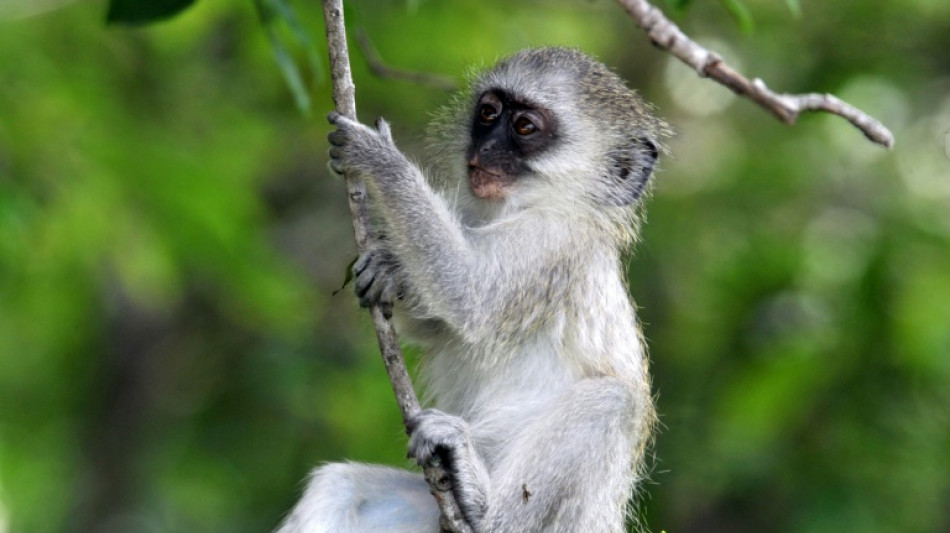
Tropical French territory battles green monkey invasion / Photo: ISSOUF SANOGO - AFP

 Kospi Falls Below 5,000 as U.S. AI Regulation Fears Trigger Circuit Breaker

 Valsoft's TAG Software Group Enters the Content Operations Market with the Acquisition of Chalco

 South Korea Proposes Fourth Delay of Cryptocurrency Gains Tax to 2029

 ASIC Fines Mona Museum Owner's Company for Late Financial Report

 Business Leaders Criticize Productivity Commission Inquiry Scope

 SCANDIC FINANCE ने एलेक्स बोडी को समूह का उपाध्यक्ष नियुक्त किया

 SCANDIC FINANCE Grubu, Alex Bodi’yi başkan yardımcılığına atadı

 Алекс Боди е назначен за вицепрезидент на групата SCANDIC FINANCE

 Ο Άλεξ Μπόντι νέος αντιπρόεδρος του ομίλου SCANDIC FINANCE
French officials on the Caribbean island of Saint-Martin are seeking ways to battle an invasion of green monkeys, blamed for threatening the tropical tourism hotspot's fragile biodiversity, local authorities said.
The primates, which originate from Africa, are reproducing at an alarming rate, threatening the survival of some indigenous species, they said.
The island of Saint-Martin, split between France and the Netherlands, is a popular tourist destination boasting sandy beaches and varied wildlife.
Green monkeys, which originally came to Saint-Martin as pets owned by foreign colonisers or on trade ships, have spread across the island with a remarkable ability for adaptation.
The Dutch authorities recently took a radical step, ordering 450 of the primates, named after their golden-green fur, to be put down.
The Nature Foundation St. Maarten, an NGO, will be charged with capturing the green monkeys for culling as part of a three-year plan to contain their population growth.
On the French side, the authorities said they were still fact-finding.
The animal species' spectacular population growth could affect the region's biodiversity, said Julien Chalifour, a scientist for the island's Natural Nature Reserve.
The monkeys have earned a reputation among locals for acting aggressively to residents and pets as well as overturning garbage bins, destroying gardens and defecating on people’s property.
The non-indigenous monkeys are not picky eaters and will consume just about anything including bird eggs, crops and ornamental and fruit plants and trees.
"They are benefiting from an abundance of food thanks to lots of rain, which in turn increases the possibility of reproduction," Chalifour said. "We can't let them continue to multiply. They're everywhere."
There was a noticeable rise in the green monkey population in 2017 following Hurricane Irma, he said.
"These omnivorous mammals then found themselves in an environment with no food source, which led them to spread out in order to feed themselves," the scientist said.
Officials have appointed a zoologist, Nathalie Duporge, to lead an "environmental impact assessment" before deciding on the next steps.
France's half of Saint-Martin became a French overseas territory in its own right in 2007, having previously belonged administratively to Guadeloupe, France's biggest possession in the Caribbean.
It had a population of just over 32,000 in 2020.
A.Santos--PC