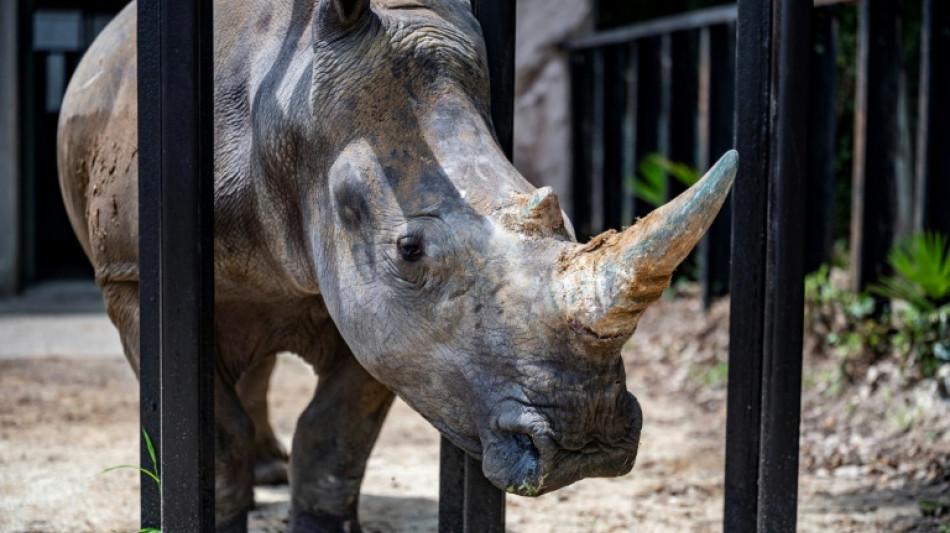
South Africa's largest rhino farm puts itself up for sale / Photo: Philip FONG - AFP

 Multi-Asset Trading Venue Monochrome Exchange Announces IEO of Its Native Token, $MCR

 South Korea break Japan hearts to win Asian Games basketball gold

 Acosta takes first victory at Austrian MotoGP

 PSG president Nasser al-Khelaifi under investigation in France for conflict of interest

 China swim sensation, 13, sets Games record after Japan win early

 Drones hit Moscow as Russians go to the polls

 New England boss Fleming says 'wrong' to ask Stokes to end retirement

 Germans vote in elections threatening fresh blow to Merz

 US fears rapid escalation in Mideast after Houthis attack Riyadh

 Japan triathlete Hojo wins first gold of Asian Games

 IOC president impressed by 'beautiful' Asian Games wooden huts

 First Asian Games gold goes to Japan as China's 13-year-old Yu lights up pool

 Data centre command hub keeps AI up and running

 Pope Leo in France: the issues on the table

 Packing for a pope: behind the scenes on foreign trips

 Republicans find transgender issues a powerful political weapon in midterm campaigning

 German state elections threaten new shock waves for Merz

 Chile's Bachelet quits race to be next UN chief

 Raphinha treble fires perfect Barca to win at Sevilla

 Thiam makes winning heptathlon return at Decastar meet

 Czechs beat USA to qualify for Davis Cup finals

 Dortmund sink Stuttgart to climb to Bundesliga summit

 Trump says will not tolerate attempts to slow AI growth

 'It has to stop': runners protest women's murders in S.Africa district

 Fire erupts near Riyadh airport as Houthis claim strikes

The owner of a huge South African rhino conservation farm, the world's largest, said Monday that it would be sold at auction in April because it could no longer afford to breed the endangered animals.
Platinum Rhino, home to nearly 2,000 southern white rhinoceros spread across 8,500 hectares (21,000 acres) in the country's North West province, says it is "the largest of its kind in the world".
"Breeding rhinos is an expensive game," John Hume, Platinum's 81-year-old founder, told AFP, adding that he had been breeding rhinos "for 30 years without profit".
South Africa is home to about 80 percent of the world's rhino population, but poaching has taken a huge toll despite increased protection efforts on both private reserves and at national and regional parks.
This month, the government said 448 rhinos were killed across the country last year, just three fewer than in 2021, as poachers increasingly targeted privately owned reserves instead of national parks.
The animal's horns consist mainly of hard keratin, the same substance found in human nails, but they are highly sought on black markets for use in traditional medicines in Asian countries such as China and Vietnam, where it is believed to cure cancer and other ailments.
"Preventing poaching took a huge monetary toll," said Hume, adding that it cost him up to half a million rand ($28,000) to breed a rhino up to the age of four years at his farm, which employs around 100 people.
He said he is looking for a buyer "with a passion for conserving rhinos and the means to keep the breeding project going".
Last year, Hume announced plans to release 100 farm-bred rhinos into the wild each year, which the farm's chief veterinarian, Dr Michelle Otto, said "could repopulate the whole of Africa" if there were sufficient funding for the project.
Hume had also sparked controversy in 2017 by organising a three-day online auction of horns he had amassed by sawing off them off in order to prevent their killing by poachers, though the sale attracted fewer buyers than anticipated.
Platinum Rhino is home to over 16 percent of South Africa's southern white rhino population according to the company, the subspecies of white rhino, is now considered endangered with about 20,000 individuals remaining, according to the World Wildlife Fund (WWF).
L.E.Campos--PC