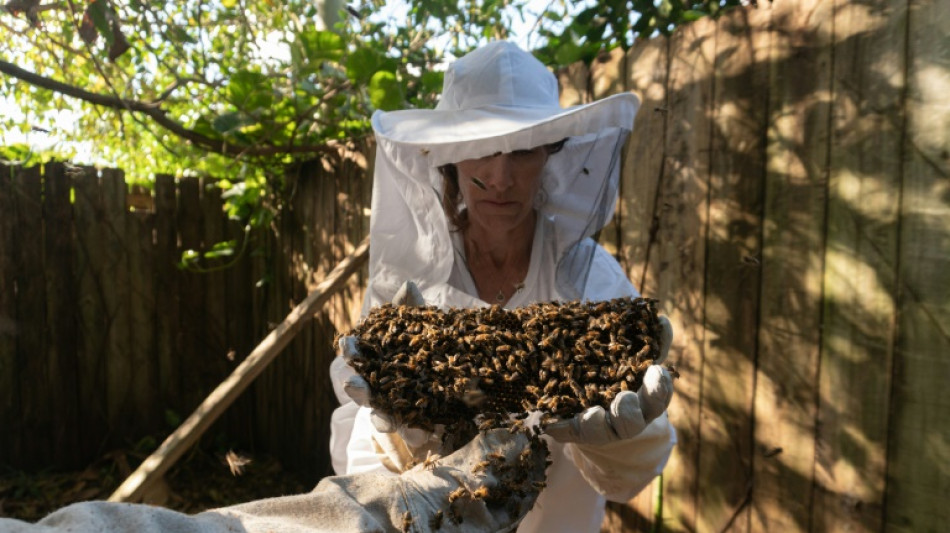
For a best friend to Florida bees, each rescue is personal / Photo: Jesus Olarte - AFP

 Multi-Asset Trading Venue Monochrome Exchange Announces IEO of Its Native Token, $MCR
 South Korea break Japan hearts to win Asian Games basketball gold

 Acosta takes first victory at Austrian MotoGP

 PSG president Nasser al-Khelaifi under investigation in France for conflict of interest

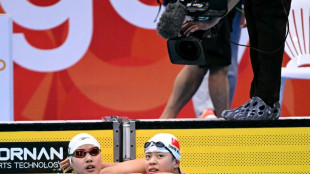
 China swim sensation, 13, sets Games record after Japan win early
 Drones hit Moscow as Russians go to the polls

 New England boss Fleming says 'wrong' to ask Stokes to end retirement

 Germans vote in elections threatening fresh blow to Merz

 US fears rapid escalation in Mideast after Houthis attack Riyadh

 Japan triathlete Hojo wins first gold of Asian Games

 IOC president impressed by 'beautiful' Asian Games wooden huts

 First Asian Games gold goes to Japan as China's 13-year-old Yu lights up pool

 Data centre command hub keeps AI up and running

 Pope Leo in France: the issues on the table

 Packing for a pope: behind the scenes on foreign trips

 Republicans find transgender issues a powerful political weapon in midterm campaigning

 German state elections threaten new shock waves for Merz

 Chile's Bachelet quits race to be next UN chief

 Raphinha treble fires perfect Barca to win at Sevilla

 Thiam makes winning heptathlon return at Decastar meet

 Czechs beat USA to qualify for Davis Cup finals

 Dortmund sink Stuttgart to climb to Bundesliga summit

 Trump says will not tolerate attempts to slow AI growth

 'It has to stop': runners protest women's murders in S.Africa district

 Fire erupts near Riyadh airport as Houthis claim strikes

Melissa Sorokin sees herself as "a bee advocate," deeply passionate about helping to rescue the at-risk creatures that play such a critical role in biodiversity.
Often called in by spooked or concerned residents, she acts as emergency responder for the vital pollinators, spending the substantial time it takes to move threatening or threatened hives to safer locations.
Sorokin, who lives in Florida, says rescuing hives is infinitely better than homeowners or businesses allowing pest control services to swoop in and simply kill the bees.
"If they don't call me, as a beekeeper, they are most likely going to get an exterminator, who instead kills the bees. It's easy, it's quick, it's good money, cheap for them," says Sorokin, 54.
On the other hand, "I'm like a bee advocate, a bee tender," she says. "I love them. And I have a friendship with them."
Sorokin's mission is vital, she adds, because bees are under threat from climate change, pesticides, large cultivation of single crops, urbanization and invasive species.
The honey bee population is in freefall. A December study from Penn State University found that the United States experienced a 43 percent colony loss between April 2019 and April 2020.
The knock-on effects are immense, with the US Food and Drug Administration noting that about one third of food eaten by Americans comes from crops pollinated by honey bees, including apples, melons, cranberries, pumpkins and broccoli.
On a sunny afternoon, Sorokin heads to a client's garden in Coral Gables, near Miami, to remove a beehive.
She first scouts out the place where she suspects the bees are hiding: a shed attached to a house.
Once the presence of the insects is confirmed, she burns pieces of wood in a smoker, dons a mesh head net, and blows smoke into the shed's eaves to calm the bees.
She then grabs a chainsaw and cuts a wooden rectangle in the roof eave. Pulling back the planks reveals a humming, heaving hive.
Sorokin, wearing protective gloves, carefully removes panels of honeycomb covered with bees, and places them like racks in an artificial hive.
"It's not very complicated to move bees. They sleep at night. So you can move them at night or you can move them in the morning keeping everything nice and close," she explains.
"My goal, my wish," is to help the bees, she says. "I hope that they have a better life with me because I help them."
When Sorokin finishes transferring the insects from the shed, she closes up the new box hive and takes it to her car, where she straps it in with a seat belt.
A.P.Maia--PC