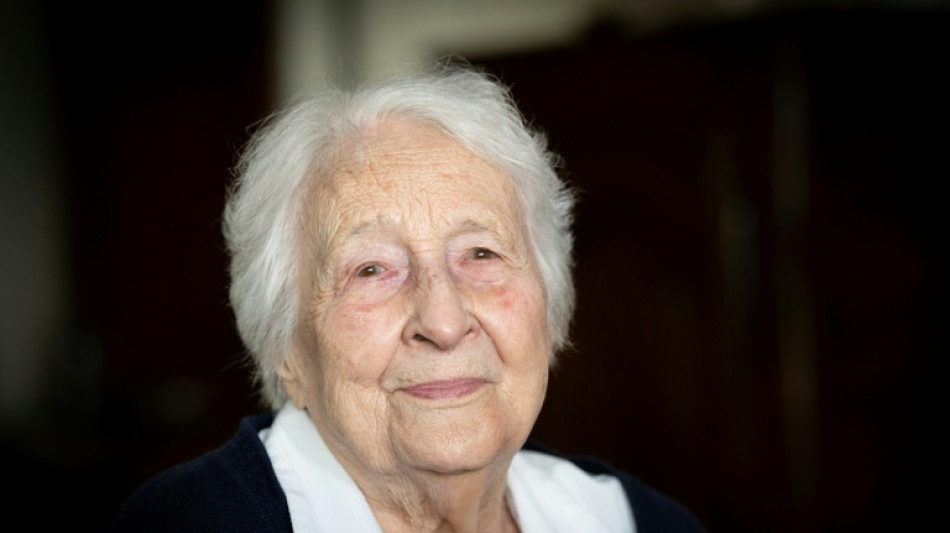
Three heroines of the French Resistance / Photo: ALAIN JOCARD - AFP

 Multi-Asset Trading Venue Monochrome Exchange Announces IEO of Its Native Token, $MCR
 South Korea break Japan hearts to win Asian Games basketball gold
 Acosta takes first victory at Austrian MotoGP

 PSG president Nasser al-Khelaifi under investigation in France for conflict of interest

 China swim sensation, 13, sets Games record after Japan win early

 Drones hit Moscow as Russians go to the polls

 New England boss Fleming says 'wrong' to ask Stokes to end retirement

 Germans vote in elections threatening fresh blow to Merz

 US fears rapid escalation in Mideast after Houthis attack Riyadh

 Japan triathlete Hojo wins first gold of Asian Games

 IOC president impressed by 'beautiful' Asian Games wooden huts

 First Asian Games gold goes to Japan as China's 13-year-old Yu lights up pool

 Data centre command hub keeps AI up and running

 Pope Leo in France: the issues on the table

 Packing for a pope: behind the scenes on foreign trips

 Republicans find transgender issues a powerful political weapon in midterm campaigning

 German state elections threaten new shock waves for Merz

 Chile's Bachelet quits race to be next UN chief

 Raphinha treble fires perfect Barca to win at Sevilla

 Thiam makes winning heptathlon return at Decastar meet

 Czechs beat USA to qualify for Davis Cup finals

 Dortmund sink Stuttgart to climb to Bundesliga summit

 Trump says will not tolerate attempts to slow AI growth

 'It has to stop': runners protest women's murders in S.Africa district

 Fire erupts near Riyadh airport as Houthis claim strikes

Without firing a gun or shedding any blood, Odile de Vasselot, Odette Niles and Michele Agniel were among the thousands of women who took part in the resistance against the Nazi German occupation of France during World War II.
Their acts -- which included ferrying messages across enemy lines, smuggling packages and helping Resistance fighters and Allied airmen escape -- carried the risk of imprisonment, torture and even death.
And yet for decades after the war, the roles played by unsung war heroes like these were greatly underestimated and rarely documented.
Aged 101, 100 and 96 respectively, de Vasselot, Niles and Agniel spoke to AFP on the eve of International Women's Day about their part in combatting tyranny.
- Odile de Vasselot -
For 18-year-old de Vasselot, doing nothing was not an option in 1940 when Nazi banners and propaganda posters -- either in German or from the collaborationist regime led by Marshal Philippe Petain -- started appearing on the streets of occupied France.
"I want to fight back!" she said to herself, without knowing how she, a young woman from a well-to-do Catholic family, could help defend her country.
Born in 1922 into a military family, she moved to Paris with her mother and sisters after her father, a soldier, was imprisoned by the Germans.
On November 11, 1940, she took a homemade pompom in blue, white and red to join a student demonstration on the Champs-Elysees avenue, defying a curfew in one of the first public acts of resistance in France.
Two years later, she joined the Resistance as a courier, ferrying packages every week by train between the occupied northern half of the country and the southeastern Free Zone, without daring to peek at the contents.
In 1943, the young woman who went by "Jeanne" on her missions began helping Allied airmen cross France -- picking them up from the Belgian border, providing them with papers and buying their tickets to Spain on their circuitous route back to Britain.
Several times she barely escaped arrest.
On January 4, 1944, she was accompanying two British soldiers on a train when the Gestapo raided the carriage.
They arrested the two men, who were sitting a few rows away from Odile to avoid drawing attention to her.
"I still had their ticket stubs in my pocket," she told AFP. "I ate them".
- Odette Niles -
A young Communist militant before the war broke out, Niles sprang into action as soon as the war started, handing out fliers on the streets of Paris while still at school.
On August 13, 1941, she was arrested along with 16 boys on her way to a demonstration.
Three of the boys were executed and the others imprisoned.
Niles was sent to the Choisel internment camp in western France, where she was kept in barracks swarming with vermin that had wooden crates for beds.
At the camp, the 18-year-old found fleeting romance with Guy Moquet, one of the young heroes of the Resistance, who was executed by firing squad in October 1941.
She was moved from camp to camp for three years before escaping in 1944 and joining the Resistance in Bordeaux. There she met her future husband, Resistance fighter and fellow Communist Maurice Niles.
The pair remained active in left-wing politics for the rest of their lives.
- Michele Agniel -
Agniel was the 14-year-old daughter of a World War I veteran when the armistice was signed in the summer of 1940, beginning Germany's occupation of France.
"Right away my father said, 'We have to do something'," said Agniel, who grew up in the Paris suburb of Saint-Mande in a family she described as "profoundly patriotic".
She started smuggling fliers in her schoolbag "between her music copy and her history book".
At checkpoints she would open her bag, but never got searched. Who, after all, would suspect a schoolgirl?
In 1942, the family joined an underground cell that hid escaped prisoners of war, mostly US and British pilots.
Agniel's job was to meet them in the countryside and have them follow her back to Paris by train. She then took them to a photo booth in central Paris to get pictures for false documents.
If anyone asked what she is up to, she had her answer ready: "They're deaf mutes on their way to a special facility in Toulouse", a city in southwest France.
In 1944, two weeks before her final school exams, she was arrested with her parents after an informer alerted the police, and put on the last deportation train out of Paris, just before the city was liberated.
Her father was sent to the Buchenwald camp, where he died.
Agniel and her mother were interned first at Ravensbruck and then at Koenigsberg, where they were liberated by Russia's Red Army on February 5, 1945, and repatriated to Paris.
After the war Agniel became a teacher and for a long time kept silent about her past activism. But the rise of a revisionist far right prompted her to begin telling her story in schools.
Today, she said her testimony had taken on new urgency.
"With what is happening in Ukraine, I am reliving June 1940... We did it, why can't the Ukrainians do it too? We have to help them!"
J.Pereira--PC