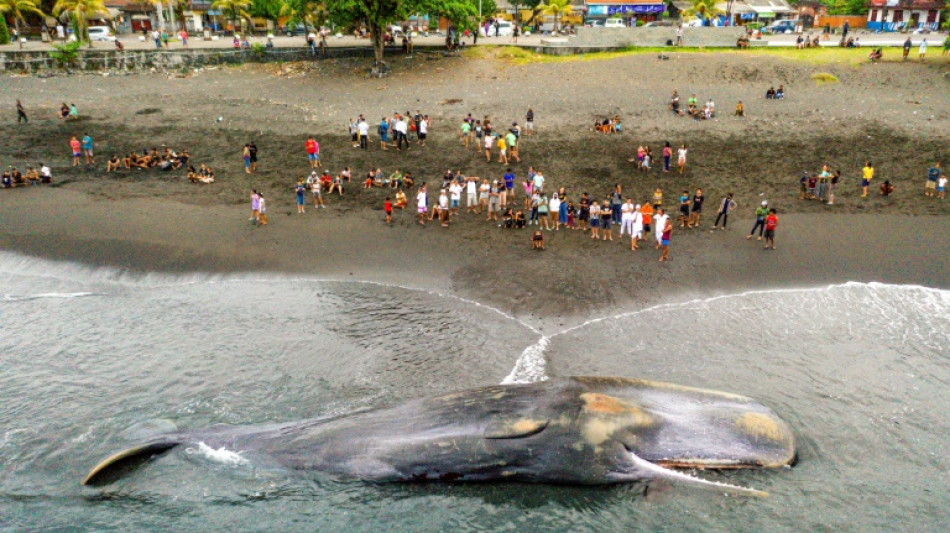
Massive sperm whale beaches itself, dies in Bali / Photo: DICKY BISINGLASI - AFP

 Kospi Falls Below 5,000 as U.S. AI Regulation Fears Trigger Circuit Breaker

 Valsoft's TAG Software Group Enters the Content Operations Market with the Acquisition of Chalco

 South Korea Proposes Fourth Delay of Cryptocurrency Gains Tax to 2029

 ASIC Fines Mona Museum Owner's Company for Late Financial Report

 Business Leaders Criticize Productivity Commission Inquiry Scope
Indonesian animal experts were preparing Thursday to conduct an autopsy on an 18-metre (59-foot) whale that died after washing up on a beach in Bali, conservation officials said.
The sperm whale, believed to weigh many tonnes, beached itself in the east of the holiday island on Wednesday before locals and officials pushed it back out to sea.
But after swimming away it became stranded again just hours later on a different beach and died on the shore with no visible wounds, local marine and fisheries official Permana Yudiarso told AFP.
"We are still investigating the cause of death. We want to get a scientific explanation of whether it was because of pollution or plastic," he said.
Sperm whales, the world's largest predators, are listed by the International Union for Conservation of Nature as being "vulnerable" to extinction.
Vets and forensic experts have arrived at the scene to investigate the cause of the whale's death, and its carcass will be buried in the coming days.
"Today we will conduct a necropsy test, and after that we will get an excavator to try to bury the carcass nearby," Yudiarso said.
Police cordoned off the beach in Bali's Klungkung regency to stop the theft of the whale's meat or body parts.
Yudiarso said whales usually come closer to the shore when they are sick or dying.
In 2018, a sperm whale was found dead in Indonesia with more than 100 plastic cups and 25 plastic bags in its stomach, raising concerns about the Southeast Asian archipelago's massive marine rubbish problem.
Indonesia is the world's second biggest contributor to marine debris after China.
E.Paulino--PC