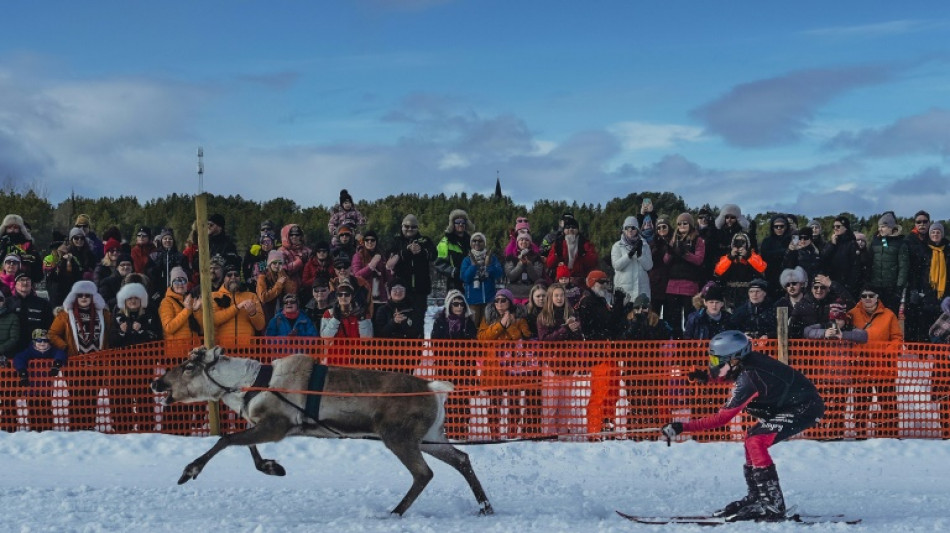
Reindeer racing king crowned in Arctic tournament / Photo: Alessandro RAMPAZZO - AFP

 Kospi Falls Below 5,000 as U.S. AI Regulation Fears Trigger Circuit Breaker

 Valsoft's TAG Software Group Enters the Content Operations Market with the Acquisition of Chalco

 South Korea Proposes Fourth Delay of Cryptocurrency Gains Tax to 2029

 ASIC Fines Mona Museum Owner's Company for Late Financial Report

 Business Leaders Criticize Productivity Commission Inquiry Scope

Finland crowned its reindeer racing king on Sunday when 14 reindeer and jockeys competed for the title in the season's final match of the increasingly popular Arctic sport.
Wearing skis, helmets and ski goggles and pulled by harnesses attached to the reindeer, Finland's top 14 competitors raced one kilometre around an oval against the clock in the northern town of Inari.
Reindeer Verneri and jockey Janne Alatalo came out on top in one minute and 35.26 seconds, in mild six-degree Celsius (43 Fahrenheit) weather that made for slushy snow conditions at times.
Reindeer races have been organised in Finland since the 1950s, according to Seppo Koivisto, president of the country's reindeer racers' association Suomen Porokilpailijat, which organises competitions.
"This is a hobby for those involved in reindeer herding. The animals are usually reindeer herders' reindeer," Koivisto said.
Racing reindeer are trained professionally during the winter season. From spring to autumn, they live freely in the forest.
- 'Desire to compete' -
Koivisto said the sport has "developed enormously in recent years".
"There are currently 700 racing reindeer in the register," he told AFP ahead of the weekend event.
"Two characteristics are sought after in a reindeer. One is physical characteristics, as in structure, and the second is the mental side," he said.
"No matter how good the physical qualities are, if it doesn't have the desire to compete, it won't do anything in the races."
Sunday's final race of the season, the Poro Cup, attracted several hundred spectators.
The races have even caught the eye of tourists.
"The exoticism also seems to be of interest to foreign visitors who happen to be here in Lapland ... and they come and watch the races," Koivisto said.
Nogueira--PC