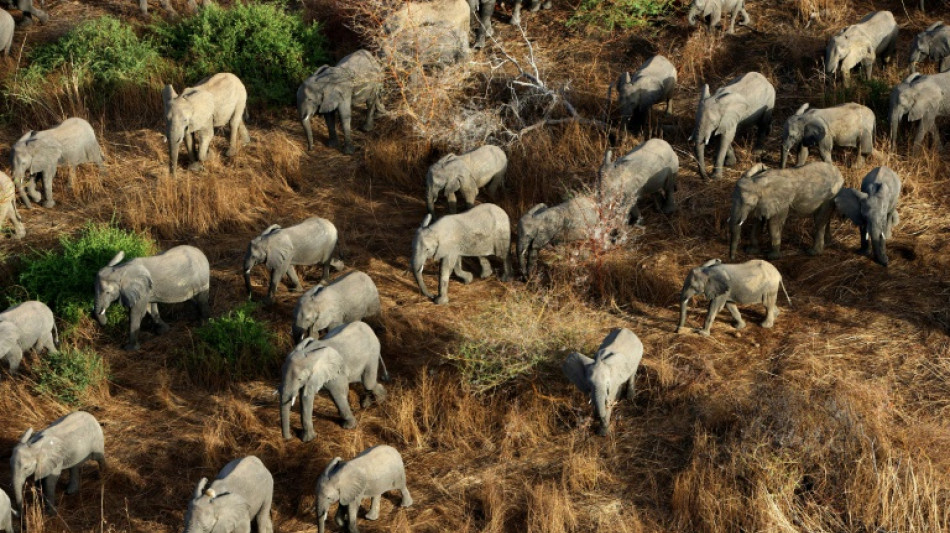
Poachers kill five elephants in Chad / Photo: - - AFP/File

 Kospi Falls Below 5,000 as U.S. AI Regulation Fears Trigger Circuit Breaker

 Valsoft's TAG Software Group Enters the Content Operations Market with the Acquisition of Chalco

 South Korea Proposes Fourth Delay of Cryptocurrency Gains Tax to 2029

 ASIC Fines Mona Museum Owner's Company for Late Financial Report

 Business Leaders Criticize Productivity Commission Inquiry Scope

Poachers have killed at least five elephants in the Sahel state of Chad, stoking fears for the country's surviving animals, an NGO said Tuesday.
The elephants were found slaughtered in the Beinamar area, about 400 kilometres (250 miles) south of the capital N'Djamena, Adam Ahmat Assane, secretary of SOS Elephants, told AFP.
The deputy head of the state administration for forestry, wildlife and fishing, Hamid Mahamat Hissein Itno, confirmed that "elephants were killed," but he had no word about numbers.
"Our forces are chasing the poachers who killed them," he said.
SOS Elephants said in a statement that the elephants had been attacked by "armed men on horseback". Their heads had been cut off and their tusks removed.
The organisation said there were less than 1,500 documented elephants left in Chad, compared to tens of thousands three decades ago.
Poaching has slowed over the past decade thanks to a crackdown initiated in 2008 by former president Idriss Deby Itno, who died during an operation against rebels in northern Chad in April 2021, it said.
The last cases of poaching in Chad dated to 2016 and 2017, when at least 20 elephants were killed in two southern provinces bordering Cameroon.
Most of the country's recorded elephants live in wildlife reserves but are vulnerable to poaching when they leave the protected areas, SOS Elephants said.
Fearing a resurgence, it urged Deby's successor, his son Mahamat Idriss Deby Itno, to "show greater firmness" against the crime.
H.Portela--PC