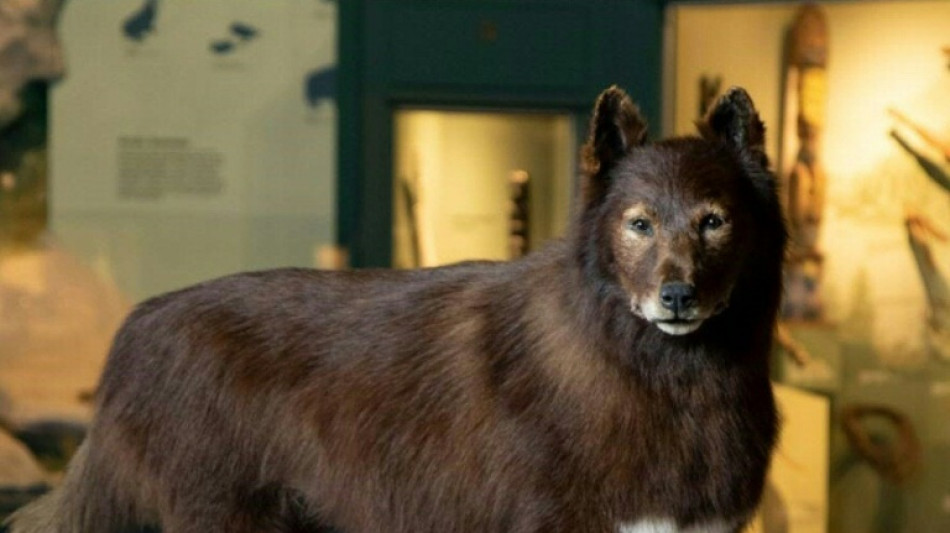
DNA study of famed US sled dog shows what made him so tough / Photo: - - EUREKALERT!/AFP

 British Grand Prix stays on MotoGP calendar until 2028

 Britain's EasyJet flies into US hands as takeover confirmed

 Real Madrid sign Ivory Coast winger Yan Diomande

 How online disinformation fuelled Ceuta migrant surge

 Inevitable AI Group Raises $6M From Aleph to Launch AI-Native SaaS Companies

 Suspected Ebola death on boat heading for DR Congo capital

 England selector North not 'hung up' on Stokes absence

 UK Anti-Doping confirm former world champ Parker's ban lifted

 French winemakers dread 'smoky taste' after wildfires

 Stocks diverge with earnings, tech in focus

 England recall batsman Lawrence for Pakistan series

 Siemens shares plunge on disappointing guidance raise

 New Australia coach Kiss gives Japan starts to Ross, Amatosero

 'Stretch our money': Romanians face highest EU inflation

 Iran says close to Hormuz plan with Oman, but reopening depends on US

 Messi scores twice to set Leagues Cup record in Miami victory

 Asian stocks mostly down with tech firms back under pressure

 Back to the future as world champion Springboks host All Blacks

 India youth protests highlight mistrust in 'lapdog' media
 Pacific islands alarmed by Trump-backed push for deep-sea mining

 Erratic rains dictate menu at three-star Michelin restaurant in Brazil

 Zverev, Auger-Aliassime and Medvedev exit Montreal Masters
 Loar Holdings Inc. Reports Q2 2026 Record Results and Upward Revision to 2026 Outlook

 Embattled Infantino sees minnows Malawi reach WAFCON quarter-finals

 Seeds Rybakina, Pegula and Gauff advance at WTA Toronto event

New York's Central Park has a statue dedicated to him, and there's even been a movie about him: a sled dog named Balto. Now he is the focus of a DNA study, 90 years after he died, to see what made the pooch so famously tough.
In 1925, this Siberian husky was part of an expedition in Alaska called the serum run, the goal of which was to bring life-saving medicine to young people in the remote town of Nome that were threatened by diphtheria.
The mission in horrendous blizzards conditions involved a series of sled dog teams transporting the anti-toxin relay-style from the city of Anchorage. Balto led the dog team that covered the last stretch of the grueling journey.
The dog died in 1933, and its mounted body has been on display at the Cleveland Museum of Natural History ever since.
"Balto’s fame and the fact that he was taxidermied gave us this cool opportunity 100 years later to see what that population of sled dogs would have looked like genetically and to compare him to modern dogs," said Katherine Moon, a postdoctoral researcher at the University of California, Santa Cruz and the main author of the study.
It was published Thursday in the journal Science.
Her team took skin samples from the dog's belly and reconstructed its genome -- the complete set of genes in an organism.
They compared this genetic material with that of 680 contemporary dogs from 135 breeds.
Contrary to a legend that held that Balto was half wolf -- as suggested in an animated Universal Pictures film that came out in 1995 -- this analysis found no evidence he had wolf blood.
It turned out Balto shared ancestors with modern day Siberian Huskies and the sled dogs of Alaska and Greenland.
Zoom's team also compared Balto's genes with the genomes of 240 other species of mammals as part of an international effort called the Zoonomia Project.
This allowed researchers to determine which DNA fragments were common across all those species and have not therefore changed over the course of millions of years of evolution.
This stability suggests that these stretches of DNA are associated with important functions in the animal, and that mutations there could be dangerous.
The bottom line from the research was that Balto had fewer potentially dangerous mutations than modern breeds of dogs did, suggesting he was healthier.
"Balto had variants in genes related to things like weight, coordination, joint formation and skin thickness, which you would expect for a dog bred to run in that environment," Moon wrote in a statement.
A.F.Rosado--PC