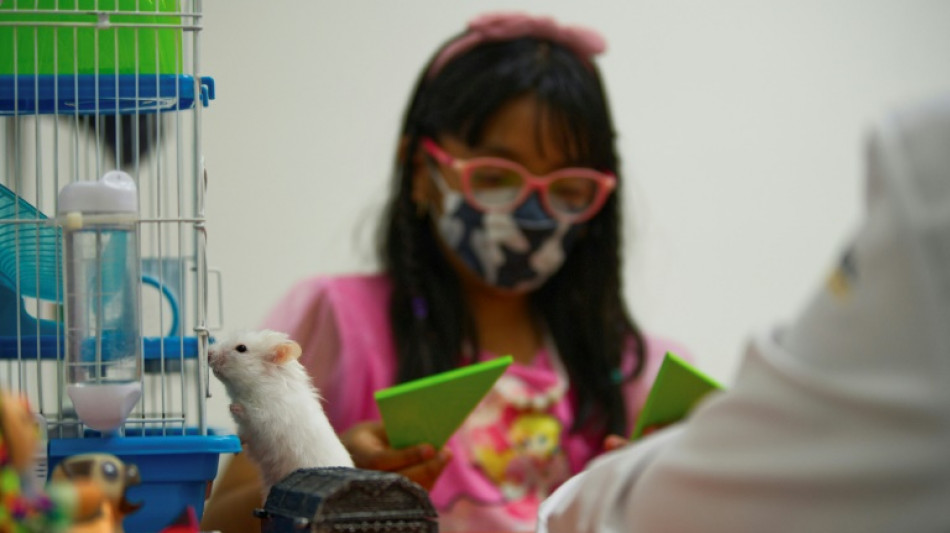
Animals become healing companions in Mexico hospital / Photo: CLAUDIO CRUZ - AFP

 Kospi Falls Below 5,000 as U.S. AI Regulation Fears Trigger Circuit Breaker

 Valsoft's TAG Software Group Enters the Content Operations Market with the Acquisition of Chalco

 South Korea Proposes Fourth Delay of Cryptocurrency Gains Tax to 2029

 ASIC Fines Mona Museum Owner's Company for Late Financial Report

 Business Leaders Criticize Productivity Commission Inquiry Scope

Nine-year-old Alessia Ramos gently pets a hamster at a Mexican hospital where animals ranging from Australian parakeets to a Siberian Husky are being used to provide mental health therapy.
"It helps me to relieve my anxiety, to control my emotions, to relax and be more focused," said Ramos, who has been diagnosed with attention deficit hyperactivity disorder, or ADHD.
Eight dogs are also among the furry therapists at the National Center for Mental Health and Palliative Care in Mexico City.
Harley, a five-year-old Pug, lost his eye in an accident but made a quick recovery, said doctor Lucia Ledesma, head of mental health services at the Institute for Social Security and Services for State Workers, the agency of which the hospital is a part.
"We follow that example of resilience in the face of adversity. He's a dog that does everything, without impediments," she said.
The facility is the only public hospital in Mexico using animals to treat mental illnesses, though such therapy is also practiced in other countries.
"Contact with animals generates powerful neuropsychological changes that contribute to lowering states of stress and anxiety, as well as benefiting other cognitive processes," Ledesma said.
Harley became famous in Mexico when he entered Covid-19 wards wearing a protective suit, booties and glasses to boost the morale of medical personnel working long hours away from their families.
"It was the only animal-assisted intervention in the world within a Covid area," Ledesma said.
"There were dogs in hospitals in other countries, but they never entered the Covid zone. We've received international recognition."
Silvia Hernandez first met Harley when she was working as a nurse during the pandemic, which left her with mental health issues for which she is still undergoing therapy.
"He came straight to me, as if he knew me, as if we were great friends," she said.
"We could see colleagues becoming emotional and feeling that love, that gesture of Harley to release their tension. Some of them cried," Hernandez recalled.
There is now a "Harley and his friends" self-care and mental health program and even a comic distributed in public schools.
It seeks to promote mental health, prevent or detect complications and intervene in already diagnosed problems, Ledesma said.
The most important attribute for a therapy dog is a calm temperament and willingness to interact with humans, she explained.
Harley's fame led to food and canine accessories firms offering him their products for free and seeking to benefit from his high profile.
"Harley, in that incomparable doggy personality, rejected all the offers. He told them: 'my work is totally humanitarian,'" Ledesma joked.
L.Henrique--PC