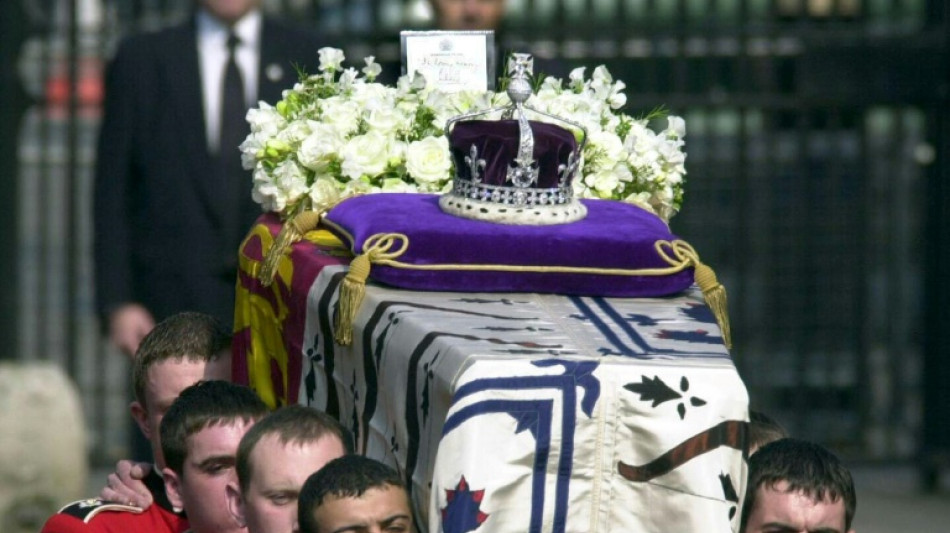
Crown jewel carries weight of UK's colonial past / Photo: TOBY MELVILLE, - - POOL WPA/AFP

 Trump's ex-lawyer all set for confirmation as US attorney general

 WHO urges Ervebo vaccine trial in DR Congo Ebola outbreak

 Hardline Trump ally De la Espriella to take office in Colombia

 Cambridge to review hiring process amid plagiarism row

 STARTRADER in Discussions with Trustpilot to Consolidate Review Profiles

 US unexpectedly loses jobs in blow to Trump's economy claims
 Call for Infantino to resign comes in wake of wave of support
 Gaza beekeeper starts again on rooftop amid ruins of war
 MEXC Lists New Ondo Tokenized Stock Pairs Spanning AI Infrastructure, Semiconductor and Rare Earth Sectors

 Fleming 'like me, but better': McCullum on new England Test coach
 European stocks rise before US jobs report
 Meta ordered to pay $567 mn in US over 'public nuisance' child harm

 Saudi Arabia, Turkey and Pakistan to sign defence pact amid regional violence

 PU Prime Expands Gold Trading with the Launch of XAUUSD247

 Oil extends gains and stocks mostly down on fresh Hormuz worries

 Four dead, 15 injured in Thailand school shooting: deputy minister

 Military shake-up poses little threat to Ukraine's drone revolution

 Camels find unlikely home in outback Australia

 Pacific nations fail to agree on statement condemning China missile test
 Anguish and hope: why a Tibetan set himself on fire in New York
 Oil extends gains and stocks fall on fresh Hormuz worries

 Venezuela's political transition talks wrap first day in Caracas

 South Africa coach Erasmus wary of struggling Argentina

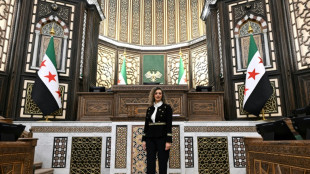 Actress, engineer, jihadist's widow among Syria's new women MPs

 Battling Norrie survives match point to oust de Minaur
The star of Britain's crown jewels, the Koh-i-Noor diamond, is back on view after a notable absence from Charles III's coronation that highlighted the nation's awkward ties with its colonial past.
The massive stone has appeared at formal occasions for over 150 years, but Charles's wife Camilla opted not to wear it for May's coronation amid debate in the UK over imperial artefacts and calls in India for the diamond's return.
Months after the coronation, with the crown jewels returned to public display in the Tower of London, the question remains: Where does the priceless gem rightfully belong?
Legend has it that the 186 carat diamond, which was cut down to 106 carats by Queen Victoria, has denoted supreme authority since at least the time of the Delhi Sultanate's invasion of the kingdoms of southern India in the 14th century.
The British state-chartered East India Company formally annexed the Kingdom of Punjab in 1849 after winning the Second Anglo-Sikh War, gaining the diamond as part of the resulting peace treaty and giving it to Queen Victoria.
Yet, New Delhi has repeatedly sought its return and foreign ministry spokesman Arindam Bagchi said last year: "We have been raising this matter from time to time with the UK government and we will continue to explore ways and means for obtaining a satisfactory resolution of the matter."
One man with a long connection to the diamond is Eddie LeVian, CEO of the US-based Le Vian fine jewellers -- which counts Rihanna and Jennifer Lopez as clients -- whose family looked after the diamond while it was in the hands of the Persian shah in the 18th century.
"I don't know what the legal argument would be to say that it should be returned to India, considering that it was gifted to Queen Victoria by the East India Company and was not taken from India by the British," LeVian told AFP at the Tower of London, which his company had taken over for an event.
"This diamond wasn't discovered by the Indian government," he added, saying that India didn't exist as a sovereign entity at the time of its discovery.
"I don't know if the claim went to an international court that the evidence would mean that the government of India has a right to the Koh-i-Noor diamond.
"As time passes, the question for India is becoming more frequently asked, but I don't see how India's claim could be resolved," he said.
- 'Unusable' -
Part of the problem for India is the diamond's uncertain history steeped in conquest.
While there is little doubt it was mined in India, its history thereafter is a mixture of myth and fact, with several countries including Afghanistan, Iran and Pakistan also laying claim to the gem.
Martin Bayly, assistant professor at the London School of Economics' Department of International Relations, told AFP that "the history is so contested that it would be impossible to agree upon any kind of legal ownership.
"And I don't know what authority would judge on that anyway."
The diamond came into British hands while India was made up of multiple different kingdoms and states rather than being a single country, and the family of the maharaja ruler who had prior possession argue that they are the rightful owners, not the Indian government.
"The arguments on legal ownership are coming from a contemporary legal context of sovereign nation states, reaching back in time to a period where legal nation state sovereignty meant something different," said Bayly.
Instead, India's best hope rests with the moral argument currently raging within the UK itself, he added.
"The public debate on this has become tied up in what's not very satisfactorily called the culture wars."
The diamond's display at the Tower of London now contains a label reading "a symbol of conquest", saying the peace treaty "compelled" the 10-year-old maharaja to "surrender" it.
Bayly also highlighted the recent return of various Benin Bronzes by different British institutions as an example of how the tide was generally turning.
"You can apply the same argument to the Koh-i-Noor diamond," he said.
"But I think probably the Koh-i-Noor diamond is in a separate class of politicised debate... because it's a symbol of rulership."
While the priceless gem has become "so diplomatically toxic" that it is "almost unusable" in state occasions, it would be "politically naive to believe" that any government would agree to its return, Bayly added.
"We're stuck," he added.
F.Carias--PC