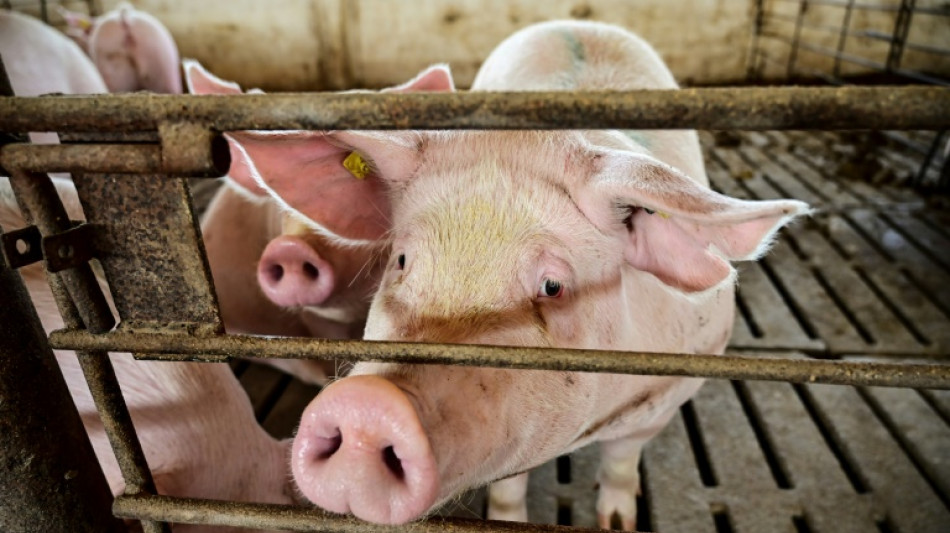
Scientists grow human-like kidneys in pigs / Photo: RONALDO SCHEMIDT - AFP/File

 Austrian writer Stefan Zweig, who fled Nazis, honoured in London

 Mexico and Peru reestablish ties after asylum spat

 Dollar drops, stocks climb as weak US jobs data eases rate fears

 Japan defender Tomiyasu joins Crystal Palace

 Celtic boss O'Neill out of hospital after 'small procedure'

 Man City reject Barcelona bid for Rodri - reports

 US unexpectedly loses jobs in blow to Trump ahead of midterms

 Dollar drops, stocks climb after surprise US jobs miss

 Thai students in disbelief after deadly school shooting

 McLaren boss glad of 'harmony' between F1 teammates Norris and Piastri

 Saudi Arabia, Turkey and Pakistan sign defence pact amid regional war

 Maradona bloated, bedridden and resigned before death, says icon's masseur

 Infantino and the failed investment plan -- What they said

 Thailand teen kills seven in home, school shooting

 Volt Funded Launches Globally with Evaluation Program Offering Up to 90% Profit Share

 Indonesia battles Mount Bromo wildfire as El Nino takes root

 STARCARES Revamps Basketball Court at the University of Lagos for Future Healthcare Professionals

 Eight dead, including teen suspect's grandparents, in Thailand shooting

 Indonesia traps monkey to end rampage that wounded 18 people

 Food security fears mount as UK farmers battle drought

 Houthi missile attacks kill 58 Saudi-backed Yemeni govt forces

 Chinese activist held in Bangkok finds Canada refuge

 Kiss takes reins as Wallabies face Japan

 North Korea touts dog soup and other home-cooked recipes to beat the heat

 UK observatory nervously watches growing space junk threat

Chinese scientists have succeeded in growing kidneys containing human cells in pig embryos, a world first that could one day help address organ donation shortages.
But the finding, published in a study in the journal Cell Stem Cell on Thursday, raises ethical issues -- especially since some human cells were also found in the pigs' brains, experts said.
The researchers from the Guangzhou Institutes of Biomedicine and Health focused on kidneys because they are on the first organs to develop, and the most commonly transplanted in human medicine.
"Rat organs have been produced in mice, and mouse organs have been produced in rats, but previous attempts to grow human organs in pigs have not succeeded," senior author Liangxue Lai said in a statement.
"Our approach improves the integration of human cells into recipient tissues and allows us to grow human organs in pigs."
This is a different approach to the recent high-profile breakthroughs in the United States, where genetically modified pig kidneys and even a heart have been placed inside humans.
The new paper "describes pioneering steps in a new approach to organ bioengineering using pigs as incubators for growing and cultivating human organs," said Dusko Ilic, a professor of stem cell sciences at King's College London who was not involved in the research.
Ilic cautioned there would be many challenges to turning the experiment into a viable solution, but "nevertheless, this captivating strategy warrants further exploration."
- Gene editing -
A major challenge in creating such hybrids has been that pig cells outcompete human cells.
To overcome the obstacles, the team used CRISPR gene editing to delete two genes essential for kidneys to form inside a pig embryo, creating what's called a "niche."
They then added specially prepared human pluripotent stem cells -- cells that have the potential to develop into any cell type -- which filled the niche.
Before implanting the embryos in sows, they grew them in test tubes containing substances that nourished both the human and pig cells.
In total, they transferred 1,820 embryos into 13 surrogate mothers. The pregnancies were terminated at 25 and 28 days to assess how the experiment had worked.
Five embryos selected for analysis were found to have functionally normal kidneys for their stage of development. They contained between 50 and 60 percent human cells.
"We found that if you create a niche in the pig embryo, then the human cells naturally go into these spaces," said co-author Zhen Dai.
"We saw only very few human neural cells in the brain and spinal cord and no human cells in the genital ridge."
But the presence of any human cells in the pig brains raises concerns, said Darius Widera, a professor of stem cell biology at the University of Reading.
"Although this approach is a clear milestone and the first successful attempt to grow whole organs containing human cells in pigs, the proportion of human cells in the generated kidneys is still not high enough," he added.
In the long run, the team wants to optimize their technology for use in human transplantation, but admits it's not ready yet.
An important limitation was the kidneys had pig-derived vascular cells, which could cause rejection if transplanted into a human.
Nevertheless, the team is already working on growing other human organs in pigs such as the heart and pancreas.
L.Torres--PC