RNA recovered from extinct animal in world first / Photo: Jonathan NACKSTRAND - AFP

 Austrian writer Stefan Zweig, who fled Nazis, honoured in London

 Mexico and Peru reestablish ties after asylum spat

 Dollar drops, stocks climb as weak US jobs data eases rate fears

 Japan defender Tomiyasu joins Crystal Palace
 Celtic boss O'Neill out of hospital after 'small procedure'

 Man City reject Barcelona bid for Rodri - reports

 US unexpectedly loses jobs in blow to Trump ahead of midterms

 Dollar drops, stocks climb after surprise US jobs miss

 Thai students in disbelief after deadly school shooting

 McLaren boss glad of 'harmony' between F1 teammates Norris and Piastri

 Saudi Arabia, Turkey and Pakistan sign defence pact amid regional war

 Maradona bloated, bedridden and resigned before death, says icon's masseur

 Infantino and the failed investment plan -- What they said

 Thailand teen kills seven in home, school shooting

 Volt Funded Launches Globally with Evaluation Program Offering Up to 90% Profit Share

 Indonesia battles Mount Bromo wildfire as El Nino takes root

 STARCARES Revamps Basketball Court at the University of Lagos for Future Healthcare Professionals

 Eight dead, including teen suspect's grandparents, in Thailand shooting

 Indonesia traps monkey to end rampage that wounded 18 people
 Food security fears mount as UK farmers battle drought
 Houthi missile attacks kill 58 Saudi-backed Yemeni govt forces
 Chinese activist held in Bangkok finds Canada refuge

 Kiss takes reins as Wallabies face Japan

 North Korea touts dog soup and other home-cooked recipes to beat the heat

 UK observatory nervously watches growing space junk threat

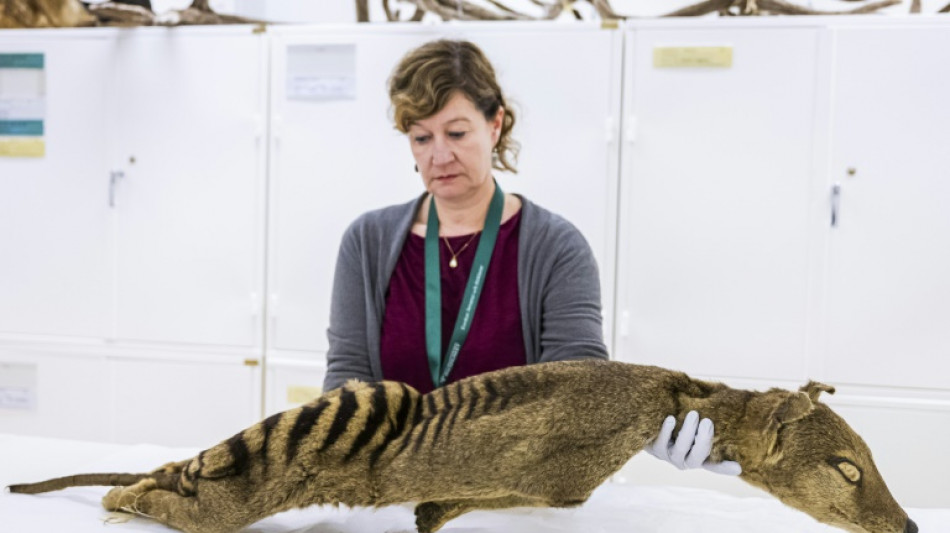
Scientists have for the first time recovered RNA from an extinct species, the Tasmanian tiger, raising hope for the resurrection of animals once thought lost forever, Stockholm University researchers told AFP.
"RNA has never been extracted and sequenced from an extinct species before," said Love Dalen, a Stockholm University professor of evolutionary genomics who co-led the project.
"The ability to recover RNA from extinct species constitutes a small step (toward) maybe being able to resurrect extinct species in the future," he said.
Dalen and his team were able to sequence RNA molecules from a 130-year-old Tasmanian tiger specimen preserved at room temperature in Sweden's Museum of Natural History.
With this they were able to reconstruct skin and skeletal muscle RNA.
RNA is a molecule that is used to convey information from the genome to the rest of the cell about what it should do.
"If you're going to resurrect an extinct animal, then you need to know where the genes are and what they do, and in what tissues they are regulated," Dalen said, explaining the need for knowledge about both DNA and RNA.
The last known living Tasmanian tiger or thylacine, a carnivorous marsupial, died in captivity in 1936 at the Beaumaris Zoo in Tasmania.
After European colonisation of Australia, the animal was declared a pest and in 1888 a bounty was offered for each full-grown animal killed.
Scientists have focused their de-extinction efforts on the Tasmanian tiger as its natural habitat in Tasmania is largely preserved.
- 'Exciting idea' -
Daniela Kalthoff, in charge of the mammal collection at the Museum of Natural History, said the idea of possibly resurrecting the Tasmanian tiger was an "exciting idea".
"This is a fantastic animal and I would love to see it live again," she said, demonstrating the black-and-brown striped skin the researchers used in their study.
Their findings also have implications for studying pandemic RNA viruses.
"Many of the pandemics that have happened in the past have been caused by RNA viruses, most recently the coronavirus but also ... the Spanish flu," Dalen explained.
"We could actually go and look for these viruses in wild animal remains stored in dry museum collections. That might actually help us understand the nature of pandemics and where pandemics come from," he said.
The study opens the door to using museum collections in this new way.
"There are millions and millions of dried skins and dried tissue from insects, mammals and birds and so on in museum collections around the world, and one could actually now go and recover RNA from all these specimens," Dalen said.
H.Silva--PC