
What are attoseconds? Nobel-winning physics explained / Photo: Andreas HILLERGREN - TT News Agency/AFP

 Austrian writer Stefan Zweig, who fled Nazis, honoured in London

 Mexico and Peru reestablish ties after asylum spat

 Dollar drops, stocks climb as weak US jobs data eases rate fears

 Japan defender Tomiyasu joins Crystal Palace
 Celtic boss O'Neill out of hospital after 'small procedure'

 Man City reject Barcelona bid for Rodri - reports
 US unexpectedly loses jobs in blow to Trump ahead of midterms

 Dollar drops, stocks climb after surprise US jobs miss

 Thai students in disbelief after deadly school shooting

 McLaren boss glad of 'harmony' between F1 teammates Norris and Piastri

 Saudi Arabia, Turkey and Pakistan sign defence pact amid regional war

 Maradona bloated, bedridden and resigned before death, says icon's masseur

 Infantino and the failed investment plan -- What they said

 Thailand teen kills seven in home, school shooting
 Volt Funded Launches Globally with Evaluation Program Offering Up to 90% Profit Share

 Indonesia battles Mount Bromo wildfire as El Nino takes root

 STARCARES Revamps Basketball Court at the University of Lagos for Future Healthcare Professionals

 Eight dead, including teen suspect's grandparents, in Thailand shooting

 Indonesia traps monkey to end rampage that wounded 18 people

 Food security fears mount as UK farmers battle drought

 Houthi missile attacks kill 58 Saudi-backed Yemeni govt forces

 Chinese activist held in Bangkok finds Canada refuge

 Kiss takes reins as Wallabies face Japan

 North Korea touts dog soup and other home-cooked recipes to beat the heat

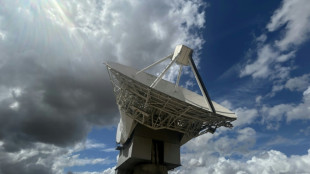 UK observatory nervously watches growing space junk threat

The Nobel Physics Prize was awarded on Tuesday to three scientists for their work on attoseconds, which are almost unimaginably short periods of time.
Their work using lasers gives scientists a tool to observe and possibly even manipulate electrons, which could spur breakthroughs in fields such as electronics and chemistry, experts told AFP.
- How fast are attoseconds? -
Attoseconds are a billionth of a billionth of a second.
To give a little perspective, there are around as many attoseconds in a single second as there have been seconds in the 13.8-billion year history of the universe.
Hans Jakob Woerner, a researcher at the Swiss university ETH Zurich, told AFP that attoseconds are "the shortest timescales we can measure directly".
- Why do we need such speed? -
Being able to operate on this timescale is important because these are the speeds at which electrons -- key parts of an atom -- operate.
For example, it takes electrons 150 attoseconds to go around the nucleus of a hydrogen atom.
This means the study of attoseconds has given scientists access to a fundamental process that was previously out of reach.
All electronics are mediated by the motion of electrons -- and the current "speed limit" is nanoseconds, Woerner said.
If microprocessors were switched to attoseconds, it could be possible to "process information a billion times faster," he added.
- How do you measure them? -
Franco-Swede physicist Anne L'Huillier, one of the three new Nobel laureates, was the first to discover a tool to pry open the world of attoseconds.
It involves using high-powered lasers to produce pulses of light for incredibly short periods.
Franck Lepine, a researcher at France's Institute of Light and Matter who has worked with L'Huillier, told AFP it was like "cinema created for electrons".
He compared it to the work of pioneering French filmmakers the Lumiere brothers, "who cut up a scene by taking successive photos".
John Tisch, a laser physics professor at Imperial College London, said that it was "like an incredibly fast, pulse-of-light device that we can then shine on materials to get information about their response on that timescale".
- How low can we go? -
All three of Tuesday's laureates at one point held the record for shortest pulse of light.
In 2001, French scientist Pierre Agostini's team managed to flash a pulse that lasted just 250 attoseconds.
L'Huillier's group beat that with 170 attoseconds in 2003.
In 2008, Hungarian-Austrian physicist Ferenc Krausz more than halved that number with an 80-attosecond pulse.
The current holder of the Guinness World Record for "shortest pulse of light" is Woerner's team, with a time of 43 attoseconds.
The time could go as low as a few attoseconds using current technology, Woerner estimated. But he added that this would be pushing it.
- What could the future hold? -
Technology taking advantage of attoseconds has largely yet to enter the mainstream, but the future looks bright, the experts said.
So far, scientists have mostly only been able to use attoseconds to observe electrons.
"But what is basically untouched yet -- or is just really beginning to be possible -- is to control" the electrons, to manipulate their motion, Woerner said.
This could lead to far faster electronics as well as potentially spark a revolution in chemistry.
So-called "attochemistry" could lead to more efficient solar cells, or even the use of light energy to produce clean fuels, he added.
Ferreira--PC