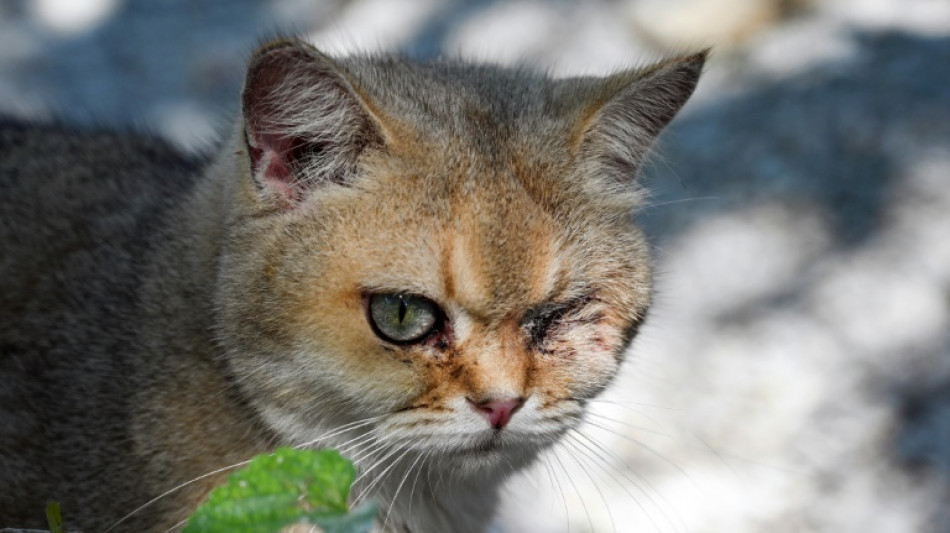
China's animal lovers fight illegal cat meat trade / Photo: Rita QIAN - AFP

 Rybakina advances while Andreeva exits at Toronto

 Shelton storms to Montreal win as title defence solidifies

 All Blacks need to improve says coach after opening win against Stormers

 Spain imposes border checks on Italy as migrant showdown grows

 Bezzecchi smashes Silverstone track record in MotoGP qualifying

 Rashid Khan takes six wickets as Afghanistan thrash Ireland

 Flintoff quits England Lions role after Sydney Thunder appointment

 Movement, El Vecino and RISE Partner to Launch First Digital Dollar Wallet for Mexican Remittances

 FIFA chief Infantino travels to Colombia for presidential inauguration

 Niewiadoma seizes Tour de France Femmes lead on Mont Ventoux

 Trump's ex-lawyer all set for confirmation as US attorney general

 WHO urges Ervebo vaccine trial in DR Congo Ebola outbreak

 Hardline Trump ally De la Espriella to take office in Colombia

 Cambridge to review hiring process amid plagiarism row

 STARTRADER in Discussions with Trustpilot to Consolidate Review Profiles

 US unexpectedly loses jobs in blow to Trump's economy claims

 Call for Infantino to resign comes in wake of wave of support

 Gaza beekeeper starts again on rooftop amid ruins of war

 MEXC Lists New Ondo Tokenized Stock Pairs Spanning AI Infrastructure, Semiconductor and Rare Earth Sectors

 Fleming 'like me, but better': McCullum on new England Test coach

 European stocks rise before US jobs report

 Meta ordered to pay $567 mn in US over 'public nuisance' child harm

 Saudi Arabia, Turkey and Pakistan to sign defence pact amid regional violence
 PU Prime Expands Gold Trading with the Launch of XAUUSD247

 Oil extends gains and stocks mostly down on fresh Hormuz worries

When Han Jiali's beloved cat Dabai was taken from her Shanghai home last year, she embarked on a hunt for her pet that took her deep into the bowels of China's underground feline meat trade.
Most people in China do not eat cat meat, but an estimated four million furry friends are slaughtered for food each year in an illegal market that includes areas of Guangdong province, neighbouring Guangxi and beyond, according to Humane Society International.
Han, who has spent thousands of dollars and weeks at a time tracking cat meat traders through China, has uncovered a supply chain preying on urban strays and outdoor pets in the region surrounding Shanghai.
Her quest to find Dabai led her to grimy processing plants in Guangdong, where she saw skinned cat carcasses piled in crates and sacks of fur.
She found village restaurants that openly advertised cat meat and unscrupulous sellers who passed it off as mutton or rabbit.
"I had to admit then that my cat was gone," an emotional Han told AFP.
"She had been eaten."
Now she is determined to save other cats from the same fate and has spent the past year filing police reports, tracking down thieves and sending petitions to the Guangdong government.
It's a dangerous mission that she says has resulted in death threats from cat meat traders and an incident in December where a man deliberately drove into her car at a highway rest stop.
"I've gotten scared and thought about turning away and pretending I never saw all this," she said.
"But if I disappear, and stay silent, who will save (the cats) from this miserable situation?"
- Underground industry -
The 33-year-old Han is one of a small but dedicated number of people in China fighting the abuse of pet cats and dogs in the absence of broader institutional protections for domestic animals.
The capture of a free-roaming family pet outdoors is not considered theft in China.
And while the law prohibits the consumption of cats, violators are fined on food safety grounds rather than punished for animal cruelty.
Activists and even state media commentators have increasingly called for legislators to adopt an animal cruelty law to close a loophole not covered by existing wild animal and livestock rules.
"I'm just an ordinary person, my abilities are limited," Han said.
Last month, she and other animal rescuers, with the help of local police, intercepted a truck carrying hundreds of cats out of Zhangjiagang, near Shanghai.
"They were collecting (trapped) cats inside a cemetery," she told AFP.
"Observing them, we quickly learned that they planned to illegally sell the captured kitties."
Han said she and the other activists spent a sleepless night staking out the cemetery before a truck appeared in the morning to take away dozens of tiny bamboo crates crammed with around 800 cats.
Police and the animal rescuers stopped the truck, and the cats were rushed to a shelter in the town of Taicang, an hour away from Shanghai.
- Cat island -
There the animals were taken in by Mengtaiqi Cat and Dog Manor, a small family-run shelter in a marshy area popular with anglers.
Gu Ming, a 45-year-old former pharmaceutical industry professional who lives at the shelter with his wife, told AFP that many of the cats rescued in Zhangjiagang had their limbs crushed under the weight of hundreds of animals.
Dozens have died so far from injuries and viral infections that spread rapidly among the closely packed, distressed animals, he said.
Volunteers at the shelter isolated sick animals in makeshift quarantine cages and called in vets to vaccinate and sterilize the healthier cats.
Eventually, after weeks of treatment and isolation, a first batch of rescues was moved to a large outdoor enclosure with trees and rows of blanket-lined beds.
Gu covers the shelter's expenses out of his own pocket and only accepts non-cash donations such as equipment and kibble, seeking to avoid the public distrust that fundraisers often attract in China.
He plans to move all the cats onto a small island near a local temple, which is currently dotted with tiny huts and home to a few dozen felines previously rescued by the shelter.
The island's four-legged residents flocked to greet Gu this month as he crossed the gated bridge that keeps the cats in.
At midday, the animals lolled on the grass and napped under trees -- an idyllic existence a far cry from the cramped meat truck crates.
Gu said he was moved by the many animal lovers who had offered help after seeing state media reports about the Zhangjiagang cats.
But still, he said: "We have to push for national legislation, because depending on individuals or a few groups is not realistic".
R.Veloso--PC