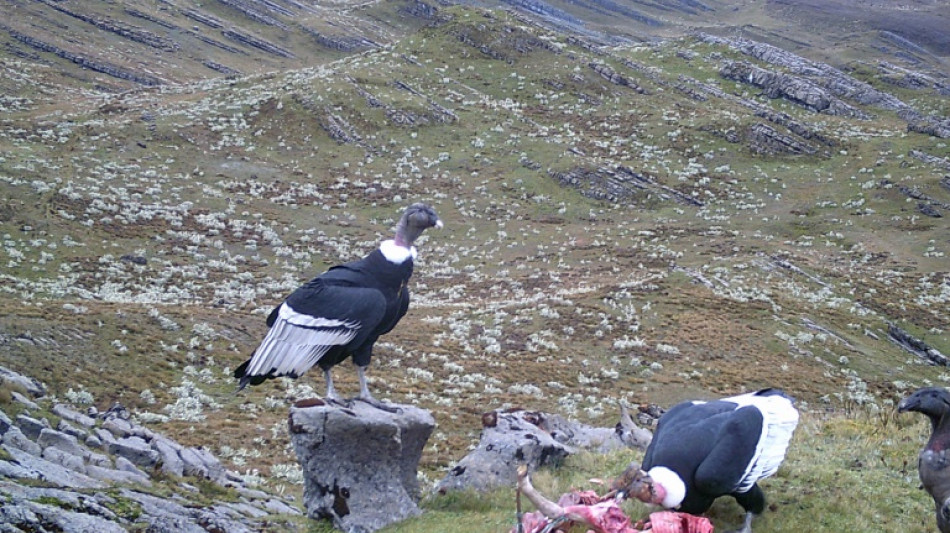
Once the enemy, majestic condor wins hearts of Colombian farmers / Photo: Handout - Fundacion Jaime Duque/AFP

 Rybakina advances while Andreeva exits at Toronto

 Shelton storms to Montreal win as title defence solidifies

 All Blacks need to improve says coach after opening win against Stormers

 Spain imposes border checks on Italy as migrant showdown grows

 Bezzecchi smashes Silverstone track record in MotoGP qualifying

 Rashid Khan takes six wickets as Afghanistan thrash Ireland

 Flintoff quits England Lions role after Sydney Thunder appointment

 Movement, El Vecino and RISE Partner to Launch First Digital Dollar Wallet for Mexican Remittances

 FIFA chief Infantino travels to Colombia for presidential inauguration

 Niewiadoma seizes Tour de France Femmes lead on Mont Ventoux

 Trump's ex-lawyer all set for confirmation as US attorney general

 WHO urges Ervebo vaccine trial in DR Congo Ebola outbreak

 Hardline Trump ally De la Espriella to take office in Colombia

 Cambridge to review hiring process amid plagiarism row

 STARTRADER in Discussions with Trustpilot to Consolidate Review Profiles

 US unexpectedly loses jobs in blow to Trump's economy claims

 Call for Infantino to resign comes in wake of wave of support

 Gaza beekeeper starts again on rooftop amid ruins of war

 MEXC Lists New Ondo Tokenized Stock Pairs Spanning AI Infrastructure, Semiconductor and Rare Earth Sectors

 Fleming 'like me, but better': McCullum on new England Test coach

 European stocks rise before US jobs report

 Meta ordered to pay $567 mn in US over 'public nuisance' child harm

 Saudi Arabia, Turkey and Pakistan to sign defence pact amid regional violence
 PU Prime Expands Gold Trading with the Launch of XAUUSD247

 Oil extends gains and stocks mostly down on fresh Hormuz worries

A group of condors rip into the carcass of a calf at the top of a Colombian mountain which rises 4,200 metres above sea level.
Their meal is a peace offering from local ranchers working to improve their relationship with the world's largest bird of prey, dubbed the King of the Andes.
"It's a bird that, when you see it flying, is so beautiful," said Diana Bautista, of the white-collared creature with a wingspan that can reach up to three metres, tipped by fingerlike feathers.
In the mountainous northeastern municipality of Cerrito where she lives, the condor has not always been looked upon fondly.
Up until a few years ago, villagers would leave out poisoned carrion or shoot at them to scare off the scavenger seen as a threat to their livestock.
A group of 19 families living high up in the moorlands of the Andes, a unique mountain ecosystem, in 2019 formed the ACAMCO association to protect and boost appreciation of the bird.
Now, residents have learned to build pens to protect their most vulnerable livestock, and platforms in the mountains where they leave carrion for the winged giants.
The community initiative is aimed at "protecting and learning about" the bird, which "attracts a lot of people" and could also have an economic benefit for the region, said Andrea Florez, from ACAMCO.
"We must not believe all the bad things that are said about the condor," said Bautista.
"Not everyone is lucky enough to have this bird in their country (...) we must love it."
- 'A great loss' -
Acamco is supported by the Jaime Duque Foundation, a Colombian non-profit organization, which buys weak or sick animals from breeders to give to the condor, in order to study its eating habits using camera traps.
Condors used to feed on small animals, but human activity has chased away their usual prey and they have become dependent on livestock, said Francisco Ciri, a biologist and director of the Neotropical conservation foundation.
The Andean Condor is considered vulnerable by the International Union for Conservation of Nature (IUCN), which lists its population of mature individuals at just over 6,700 and decreasing.
There are only 60 left in Colombia, according to a 2021 national census by the Neotropical Foundation.
Their main threat is deliberate poisonings by humans, says the IUCN.
The death of a single condor is "a great loss" for the species because it reproduces so slowly, said Carlos Grimaldos, an expert with the Jaime Duque Foundation.
The condor reaches sexual maturity at the age of 10 and only gives birth to one chick every two or three years.
Protecting it is essential as the scavenger "cleans" the moorlands by eating dead animals and prevents contamination of water sources, said Grimaldos.
With binoculars in hand, Grimaldos teaches visitors at a reserve run by the foundation to distinguish the condor from other raptors.
The condor finds itself "in an increasingly critical situation" throughout the Andes, said Guillermo Wiemeyer, an Argentine researcher attending a meeting of the South American Condor Network in the province of Santander.
Experts from Chile, Argentina, Bolivia, Ecuador, Colombia, Peru and Venezuela created the network a decade ago to try and protect the condor, already considered extinct in Venezuela.
Alexcevith Acosta, director of Santander's environmental authority, said it is urgent to hold a census throughout Latin America as "condors know no borders."
J.Oliveira--PC