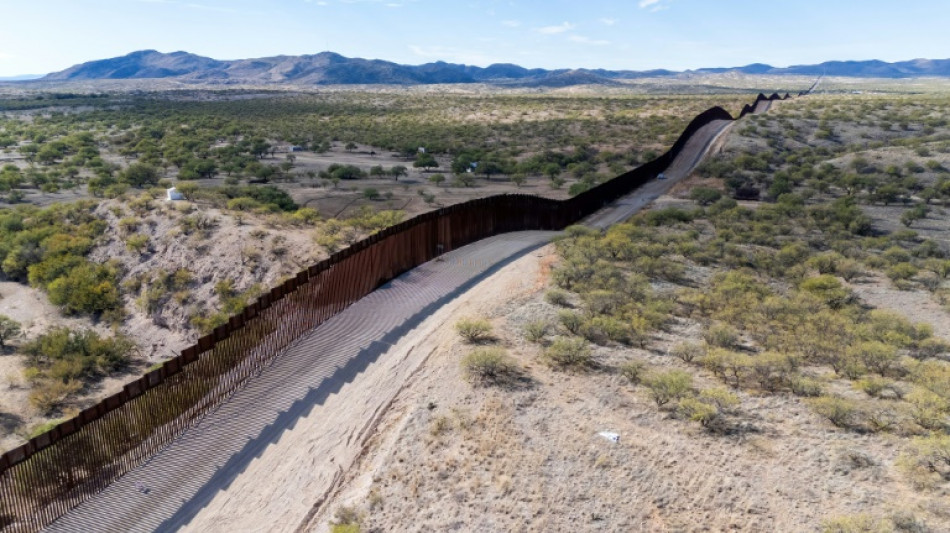
US-Mexico border wall threatening rare wildlife / Photo: VALERIE MACON - AFP

 Rybakina advances while Andreeva exits at Toronto

 Shelton storms to Montreal win as title defence solidifies

 All Blacks need to improve says coach after opening win against Stormers

 Spain imposes border checks on Italy as migrant showdown grows

 Bezzecchi smashes Silverstone track record in MotoGP qualifying
 Rashid Khan takes six wickets as Afghanistan thrash Ireland

 Flintoff quits England Lions role after Sydney Thunder appointment
 Movement, El Vecino and RISE Partner to Launch First Digital Dollar Wallet for Mexican Remittances

 FIFA chief Infantino travels to Colombia for presidential inauguration

 Niewiadoma seizes Tour de France Femmes lead on Mont Ventoux

 Trump's ex-lawyer all set for confirmation as US attorney general

 WHO urges Ervebo vaccine trial in DR Congo Ebola outbreak

 Hardline Trump ally De la Espriella to take office in Colombia

 Cambridge to review hiring process amid plagiarism row

 STARTRADER in Discussions with Trustpilot to Consolidate Review Profiles

 US unexpectedly loses jobs in blow to Trump's economy claims

 Call for Infantino to resign comes in wake of wave of support

 Gaza beekeeper starts again on rooftop amid ruins of war

 MEXC Lists New Ondo Tokenized Stock Pairs Spanning AI Infrastructure, Semiconductor and Rare Earth Sectors

 Fleming 'like me, but better': McCullum on new England Test coach

 European stocks rise before US jobs report

 Meta ordered to pay $567 mn in US over 'public nuisance' child harm

 Saudi Arabia, Turkey and Pakistan to sign defence pact amid regional violence
 PU Prime Expands Gold Trading with the Launch of XAUUSD247

 Oil extends gains and stocks mostly down on fresh Hormuz worries

Jaguars don't understand borders, but where the United States meets Mexico, they are having to adapt to them.
Once the master of the Sonoran Desert, the animal is now struggling to survive in a landscape cut in two by a wall.
The barrier, which former US president Donald Trump boasted he would make "impenetrable," does little to discourage the thousands of people from Latin America, Asia, Africa and Eastern Europe who arrive in the country every day, fleeing poverty and persecution.
But, say conservationists, the fencing erected by successive administrations in Washington is deadly to wildlife.
"One of the most important things for the health of ecosystems is habitat connectivity," says Laiken Jordahl from the Center for Biological Diversity.
"Animals need to be able to roam, to find food, water, to find mates. Having wide expanses of connected landscape is critical."
A metal fence rises 30 feet (9 meters) at the southern edge of the Buenos Aires National Wildlife Refuge, a 117,000-acre (47,000-hectare) home for threatened and endangered plants and animals in Arizona.
The barrier marks the end of the United States, but not the end of the habitat for dozens of species, including American antelope, mule deer, lynx, mountain lions and jaguars.
"This wall is clearly going to sever this entire ecosystem from all of the wild lands in Mexico that will make animals on this side and that side of the wall more vulnerable to drought, to climate change, to inbreeding," Jordahl said.
Scientists think there are about 150 jaguars on the Mexican side; there have been only seven documented sightings on the American side in recent decades.
"One individual jaguar can roam hundreds or thousands of acres, they can walk hundreds of miles in a matter of days. They need massive landscapes available to them," said Jordahl.
"Jaguars are coming up to Arizona from Sonora in Mexico, but a lot of them are being met with a solid border wall."
- 'Undercutting' -
A physical barrier at the US-Mexico border has been in the works for decades along stretches of the 2,000-mile (3,000-kilometer) frontier.
It is present in national parks, nature reserves and on indigenous lands in Texas, New Mexico, Arizona and California, ending a few yards (meters) out into the Pacific Ocean.
Each piece of the jigsaw reveals the administration that put it there -- Trump's section of wall, for example, stands the highest, a reflection of the Republican's signature pledge to shutter the border.
Trump's White House repealed or circumvented rules designed to lessen environmental impacts, causing "irreparable" damage in nature reserves and on indigenous lands, according to a report released in September by the Government Accountability Office, the auditing arm of Congress.
Democrat Joe Biden halted the expansion of the wall when he came to office in 2021, but in October his administration authorized the closing of some gaps, mainly in Arizona.
For Jordahl, the rush to erect the barrier undermined years of careful conservation work by the government.
"The federal government has put hundreds of millions of dollars into protecting landscapes around the border, into recovering animals like the Mexican gray wolf and the jaguar.
"But at the same time, they're undercutting all of those goals by building this impermeable structure that stops... migrations dead in their tracks.
"Essentially, we're pulling thread after thread out of this patchwork that is the intact ecosystem," said Jordahl.
"It's only a matter of time until it all does start to unravel."
N.Esteves--PC