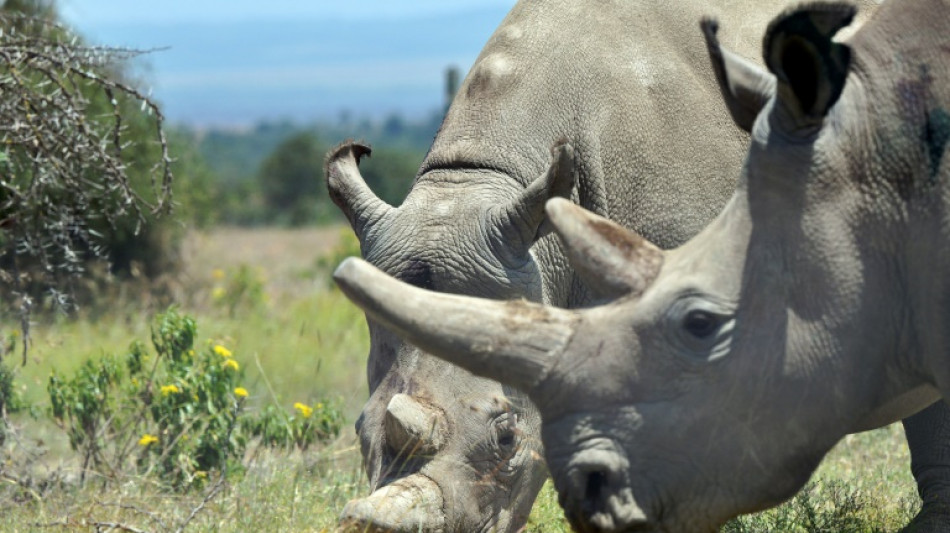
IVF breakthrough could revive nearly extinct rhino species / Photo: TONY KARUMBA - AFP/File

 Death of NBA forward Clarke ruled accident due to heroin, cocaine

 Abelardo de la Espriella, Colombian president and flamboyant millionaire

 Maradona's 'Hand of God' ball heads to US auction

 Rybakina advances while Andreeva exits at Toronto

 Shelton storms to Montreal win as title defence solidifies

 All Blacks need to improve says coach after opening win against Stormers

 Spain imposes border checks on Italy as migrant showdown grows

 Bezzecchi smashes Silverstone track record in MotoGP qualifying

 Rashid Khan takes six wickets as Afghanistan thrash Ireland

 Flintoff quits England Lions role after Sydney Thunder appointment

 Movement, El Vecino and RISE Partner to Launch First Digital Dollar Wallet for Mexican Remittances

 FIFA chief Infantino travels to Colombia for presidential inauguration

 Niewiadoma seizes Tour de France Femmes lead on Mont Ventoux

 Trump's ex-lawyer all set for confirmation as US attorney general

 WHO urges Ervebo vaccine trial in DR Congo Ebola outbreak

 Hardline Trump ally De la Espriella to take office in Colombia

 Cambridge to review hiring process amid plagiarism row

 STARTRADER in Discussions with Trustpilot to Consolidate Review Profiles

 US unexpectedly loses jobs in blow to Trump's economy claims

 Call for Infantino to resign comes in wake of wave of support

 Gaza beekeeper starts again on rooftop amid ruins of war

 MEXC Lists New Ondo Tokenized Stock Pairs Spanning AI Infrastructure, Semiconductor and Rare Earth Sectors

 Fleming 'like me, but better': McCullum on new England Test coach

 European stocks rise before US jobs report

 Meta ordered to pay $567 mn in US over 'public nuisance' child harm

Scientists have carried out the first successful in vitro fertilisation of a southern white rhino, a major breakthrough that could pave the way to saving its highly endangered northern cousin.
Only two female northern white rhinos remain in existence but neither is capable of carrying a pregnancy to term.
To save the functionally extinct species, researchers from the scientific consortium Biorescue are attempting to implant a lab-grown northern white rhino embryo in a southern surrogate.
The ambitious reproduction programme is the last chance at survival for the northern white rhino species, whose last two members live at the Ol Pejeta Conservancy in Kenya under 24-hour guard to protect them from poachers.
The successful impregnation of a southern white rhino with an embryo of the same species was a "milestone", project leader Thomas Hildebrandt said at a press conference in Berlin.
"We achieved something that was not believed to be possible," Hildebrandt said.
The successful recent trial ended in tragedy when the bull and the surrogate, along with the foetus, were killed by an unrelated infection the scientists believe was caused by bacteria released by a mudslide in their enclosure.
The foetus was only 70 days old at the time but the team said they were confident it could have survived the 16-month pregnancy period.
The next step will see scientists try to repeat the feat with other embryos made with eggs harvested from the surviving females and sperm preserved from two long-dead males.
The team aims to "produce northern white rhino calves in the next two to two-and-a-half years", Hildebrandt said.
- Delicate operation -
To place the embryo in the surrogate, the team of conservationists use a sterile "teaser" bull rhino, whose approaches to the female indicate she is ready to conceive.
The team subsequently carry out the delicate operation in just under an hour with the surrogate under anaesthetic.
The size and delicate anatomy of the white rhinos means the embryo is implanted via the rectum into the uterus.
The trials were carried out using southern white rhino embryos to preserve what scarce genetic material is left from the northern species.
Biorescue has collected eggs from the surviving females, Najin and Fatu, since 2019 but had to retire the elder of the two from the programme in 2021.
The last male, whose name was Sudan, died at the sanctuary in Kenya in 2018.
What northern white rhino sperm has been preserved from now-dead male donors is of "very poor quality", said Cesare Galli from the Italian lab Avantea where the new northern white rhino eggs are fertilised in vitro.
- 'Big day' -
The Biorescue team have 30 fertilised eggs in freezers "waiting for their big day", said Susanne Holtze from the Leibniz Institute for Zoo and Wildlife Research.
The IVF method could potentially provide a model for other endangered species of rhino, such as the endangered Sumatran rhino in South East Asia, according to project leader Hildebrandt.
Rhinos, which have roamed the planet for 26 million years, have very few natural predators but their numbers have been decimated by poaching since the 1970s.
Nogueira--PC