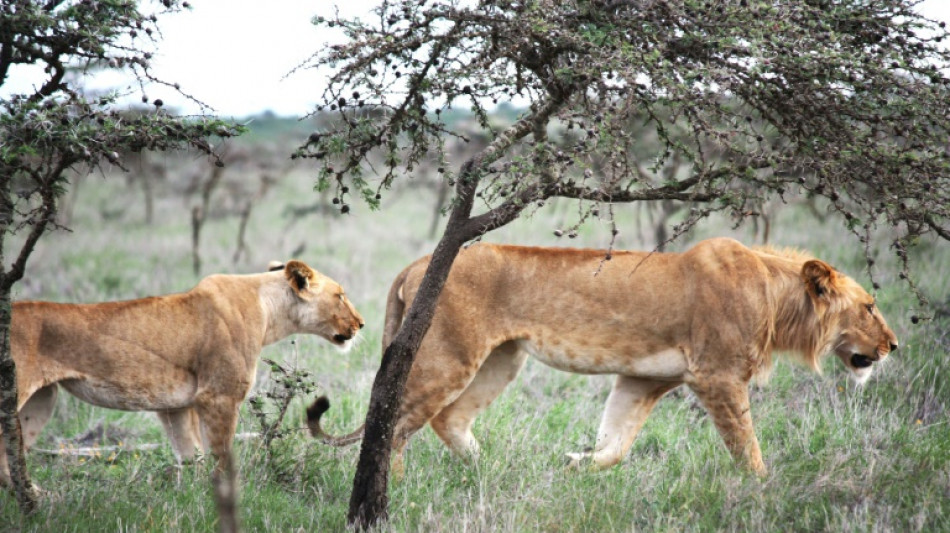
How an invasive ant caused lions to change their diet / Photo: Todd Palmer - AFP

 Death of NBA forward Clarke ruled accident due to heroin, cocaine

 Abelardo de la Espriella, Colombian president and flamboyant millionaire

 Maradona's 'Hand of God' ball heads to US auction

 Rybakina advances while Andreeva exits at Toronto

 Shelton storms to Montreal win as title defence solidifies

 All Blacks need to improve says coach after opening win against Stormers

 Spain imposes border checks on Italy as migrant showdown grows

 Bezzecchi smashes Silverstone track record in MotoGP qualifying

 Rashid Khan takes six wickets as Afghanistan thrash Ireland

 Flintoff quits England Lions role after Sydney Thunder appointment
 Movement, El Vecino and RISE Partner to Launch First Digital Dollar Wallet for Mexican Remittances

 FIFA chief Infantino travels to Colombia for presidential inauguration

 Niewiadoma seizes Tour de France Femmes lead on Mont Ventoux

 Trump's ex-lawyer all set for confirmation as US attorney general

 WHO urges Ervebo vaccine trial in DR Congo Ebola outbreak

 Hardline Trump ally De la Espriella to take office in Colombia

 Cambridge to review hiring process amid plagiarism row

 STARTRADER in Discussions with Trustpilot to Consolidate Review Profiles

 US unexpectedly loses jobs in blow to Trump's economy claims

 Call for Infantino to resign comes in wake of wave of support

 Gaza beekeeper starts again on rooftop amid ruins of war

 MEXC Lists New Ondo Tokenized Stock Pairs Spanning AI Infrastructure, Semiconductor and Rare Earth Sectors

 Fleming 'like me, but better': McCullum on new England Test coach

 European stocks rise before US jobs report

 Meta ordered to pay $567 mn in US over 'public nuisance' child harm

You may have heard of the "butterfly effect", but how about the "ant effect"?
Research published Thursday has shown how an ant muscled into a Kenyan savannah and sparked such a dramatic transformation in the landscape that even the local lions changed the way they hunt.
The study highlights the potentially profound impacts of invasive species, which are spreading at an increasing rate as human activities give animals, insects and plants opportunities to hitchhike into new territories.
"Oftentimes, we find it's the little things that rule the world," said Todd Palmer, an ecologist from the University of Florida, who was part of the research team that traced the implications of the big-headed ant on the hunting habits of lions in central Kenya.
"These tiny invasive ants showed up maybe 15 years ago, and none of us noticed because they aren't aggressive toward big critters, including people. We now see they are transforming landscapes in very subtle ways but with devastating effects," Palmer said.
It all starts with the whistling-thorn acacia trees in the plains of Laikipia, Kenya.
These thorny trees had developed a mutually beneficial relationship with the local acacia ant: The trees provide shelter and food for the ants and in return they use their stinging bite to discourage hungry elephants from devouring the trees.
But the big-headed ant changed all that.
Thought to have originated on an island in the Indian Ocean and brought to the area by the movement of people and goods, these invasive marauders arrived around two decades ago and started killing the acacia ants, leaving the whistling-thorn trees vulnerable to herbivores.
Diminished tree cover poses a problem for lions because they rely on the element of surprise to ambush their prey, notably zebras.
Researchers spent three years in Kenya's Ol Pejeta Conservancy tracking the lions' movements with GPS collars to see how they responded in the areas colonised by the invasive ants.
Their study, published in the journal Science, found that the big-headed ants had led to a threefold decline in zebra killings.
But the researchers were surprised to find that this did not cause the lion population to decline -- good news because lion populations in the region have already shrunk to around 2,000 individuals from an estimated 100,000.
Instead, the big cats switched dining preference and strategy -- ganging up in larger groups to go after buffalo, said Douglas Kamaru of the University of Wyoming, lead author of the study.
- 'Profound switch' -
While the lions have adapted thus far, the big-headed ants could spell trouble for other species that rely on the whistling-thorn tree, like giraffes or the critically endangered black rhino.
"The question is what happens going forward," Kamaru told AFP.
And the lions' changing diet may provoke its own cascade of impacts.
"We don't yet know what could result from this profound switch in the lions' hunting strategy," Palmer said.
Last year the intergovernmental science advisory panel for the UN Convention on Biodiversity (IPBES) catalogued more than 37,000 so-called alien species that have taken root -- often literally -- far from their places of origin.
That number is trending sharply upward, along with the bill for the damage, estimated at well over $400 billion a year.
E.Borba--PC