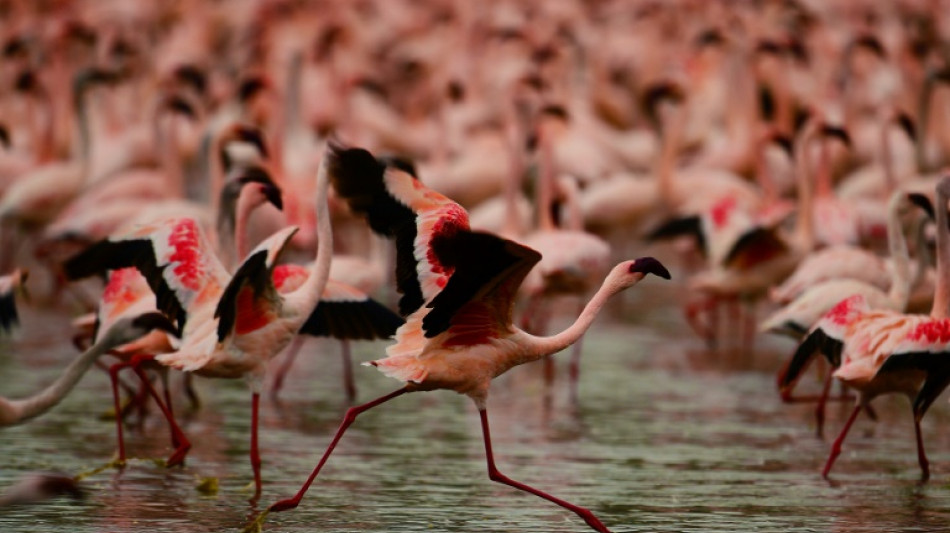
Future of Africa's flamingos threatened by rising lakes: study / Photo: CARL DE SOUZA - AFP

 Austrian writer Stefan Zweig, who fled Nazis, honoured in London

 Mexico and Peru reestablish ties after asylum spat

 Dollar drops, stocks climb as weak US jobs data eases rate fears

 Japan defender Tomiyasu joins Crystal Palace

 Celtic boss O'Neill out of hospital after 'small procedure'

 Man City reject Barcelona bid for Rodri - reports

 US unexpectedly loses jobs in blow to Trump ahead of midterms

 Dollar drops, stocks climb after surprise US jobs miss

 Thai students in disbelief after deadly school shooting

 McLaren boss glad of 'harmony' between F1 teammates Norris and Piastri

 Saudi Arabia, Turkey and Pakistan sign defence pact amid regional war

 Maradona bloated, bedridden and resigned before death, says icon's masseur

 Infantino and the failed investment plan -- What they said
 Thailand teen kills seven in home, school shooting

 Volt Funded Launches Globally with Evaluation Program Offering Up to 90% Profit Share

 Indonesia battles Mount Bromo wildfire as El Nino takes root

 STARCARES Revamps Basketball Court at the University of Lagos for Future Healthcare Professionals
 Eight dead, including teen suspect's grandparents, in Thailand shooting

 Indonesia traps monkey to end rampage that wounded 18 people

 Food security fears mount as UK farmers battle drought
 Houthi missile attacks kill 58 Saudi-backed Yemeni govt forces

 Chinese activist held in Bangkok finds Canada refuge

 Kiss takes reins as Wallabies face Japan
 North Korea touts dog soup and other home-cooked recipes to beat the heat

 UK observatory nervously watches growing space junk threat

The lakes where Africa's flamingos congregate in spectacular numbers are producing less food for the iconic birds as their water levels rise, researchers said Friday, threatening the survival of a much-loved species.
Three-quarters of the world's lesser flamingos live in East Africa and more than a million birds at a time can gather at lakes in huge "flamboyances" for feeding and courtship.
But as these lakes expand to record highs, scientists have discovered they produce less of the unique algae upon which flamingos rely, putting at risk a species already in decline.
This is driving the distinctive, pink-plumed birds away from their usual habitats into unprotected areas in search of food, said Aidan Byrne, lead author of the research.
"They might be able to move elsewhere, but they could be lost from the region that they're currently in at these key feeding lakes," said Byrne, a PhD student jointly supervised by King's College London and the Natural History Museum.
Flamingos use their specialised beaks to feed on a particular type of algae that exists in salty, alkaline waters known as soda lakes.
These lakes are concentrated in Kenya, Tanzania and Ethiopia and despite being harsh landscapes, certain species -- including the flamingo and the algae they feast on -- have adapted to thrive there.
- 'Iconic species' -
But the lakes have risen to levels not seen in decades, driven in part by increased rainfall linked to climate change over the catchment areas.
This has greatly diluted the alkalinity and salinity of the water at these soda lakes.
Byrne and other researchers wanted to study the impact that had on biodiversity and found a "massive decline" in concentrations of the very algal blooms upon which flamingos survive.
Earlier studies had looked at the problem but its extent was not known until now, he said.
"We were surprised at the scale of the changes, and how much the flamingo habitats are threatened," he told AFP.
Erratic and extreme rainfall predicted for East Africa in future would only make the problem worse and "increase the threat to the species within the region", he added.
The study, published in the journal Current Biology, is the first to use satellite imagery to observe all 22 of the soda lakes that host flamingos across the East African region.
This was combined with climate records and bird observation data over more than 20 years.
The sharpest drops in algae concentrations were observed in Kenya, including at Nakuru, one of the most important flamingo feeding lakes in Africa known for hosting million-strong "flamboyances".
It expanded by roughly 90 percent between 2009 and 2022 while algal concentration halved.
Lake Bogoria and Lake Elmenteita, also tourist magnets for their brilliant flamingo displays, experienced steep declines as well.
And where algal blooms declined, so too did flamingo numbers, Byrne said, putting in doubt revenue from tourism as well.
Flamingo habitats in East Africa are protected whereas outside these ranges monitoring would be difficult and other threats -- including from humans -- could emerge, he said.
"They're just such an iconic species that are unique to these environments. If they're lost, it would be devastating," Byrne said.
J.V.Jacinto--PC