In Belgian farmland, 'Saving Bambi' one dawn mission at a time / Photo: JOHN THYS - AFP

 2 killed, 13 wounded in bus blast near Syrian capital: state media

 All Blacks skipper Taylor cautiously recovering from calf strain

 UN chief denounces Russia, Ukraine for civilian deaths

 UEFA turn up the pressure on Infantino and repeat boycott threat

 Rodri approves Barcelona transfer talks with Man City: Barca source to AFP

 Venezuela unable to tally missing from cataclysmic quakes
 Le Court sprints to stage six Tour de France Femmes win

 Doping body says Parker's positive cocaine test caused by nutritionist

 UEFA says boycott of World Cups stands despite FIFA backdown on private investment

 Rheinmetall sales keep surging despite cancelled naval frigate project

 Pogacar teammate Del Toro gets new UAE deal after Tour podium
 Stocks tread water with earnings, tech in focus

 Inevitable AI Group Raises $6M From Aleph to Launch AI-Native SaaS Companies
 Forlan named new Uruguay head coach

 UEFA chief Ceferin: 'Underdog' leader taking fight to FIFA's Infantino

 Salah completes move to Turkey's Trabzonspor
 UK clears Paramount's takeover of Warner Bros

 North Korea fires ballistic missile: South Korea military

 'Don't have to hide': Thai IDs, legal work give hope to Myanmar refugees

 Stocks mixed with tech firms back under pressure

 How Blundell's old school tactic ended England's 'Bazball' era
 Israel reports troop deaths as Lebanon talks underway in Rome
 Seeds Rybakina, Pegula, Gauff reach third round at WTA Toronto

 Police raid South Korea FA in probe into World Cup coach appointment

 Low water on Germany's Rhine river threatens new blow to economy

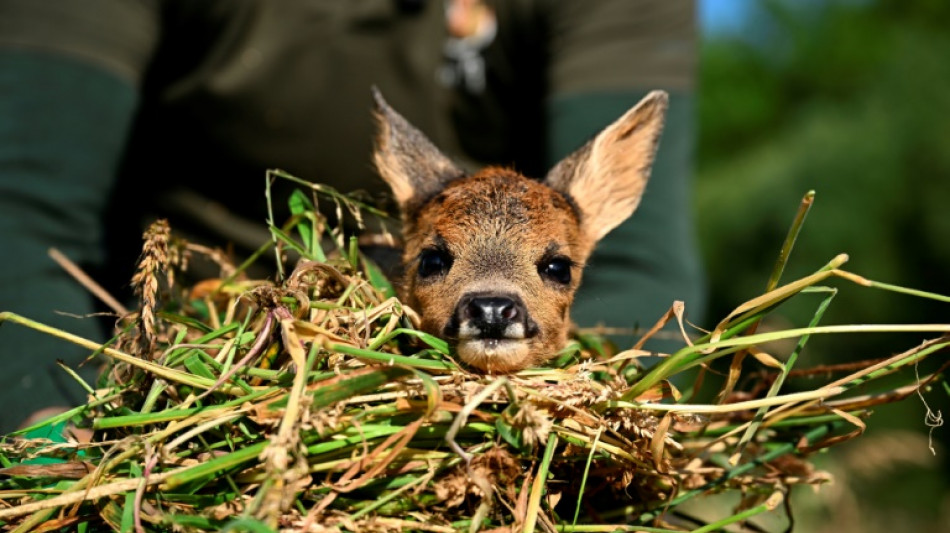
Cedric Petit's drone hummed above a Belgian field. He spotted a white dot on the control screen: a tiny fawn nestled in the tall grasses -- soon to be rescued from a grisly end.
Four years ago, the 40-year-old wildlife lover founded a group with a simple mission: "Saving Bambi" helps farmers avoid the nasty surprise of finding a tiny mammal or nesting bird ground up by their machinery.
Called in before the harvest, usually last-minute and working for free, Petit and his fellow volunteers use drones equipped with heat-sensitive cameras to locate at-risk animals and move them to the safety of woods nearby.
"Accidents are happening more and more often -- that's why we're here," said Petit, tramping through a field of alfalfa, an animal feed crop, after a dawn rescue in Eghezee in central Belgium.
"Because of unpredictable weather linked to climate change, crops are growing all year round, and harvesting is coming earlier and earlier, including between late April and late June, which is the birthing period for fawns," said Petit, who grew up in a family of farmers.
Operating across Belgium and neighbouring Luxembourg, his association said it rescued 834 fawns last year -- up from 353 the previous year.
Its work is modelled on the example of Germany and Switzerland, where larger networks of volunteers carry out thousands of rescues every year across huge areas of farmland.
Petit's growing Belgian operation has around 80 drone pilots who freely devote their time during the most critical six weeks of the year -- like him, they work around their day jobs.
- 'Go blindly' -
To get a good wide view of a field, pilots fly their drones at a height of around 70 metres (230 feet) -- taking the time needed to spot a fawn curled at ground level.
Barely weeks old, the animals' spindly legs are still too frail to carry their own weight, making them entirely vulnerable to the blades of a giant mower.
On that morning in Eghezee, the drone sensor first spotted a hare enjoying a morning feast of alfalfa, then a young male roe deer taking a dawn stroll through the cool grasses.
At last Petit spotted a sleeping fawn, curled in a little ball.
He drew near, with gloves and a small crate covered in hay, to relocate the animal as gently as he can.
"This little guy is one-and-a-half, maybe two weeks old," said Petit. "Now we need to move him to safety at the edge of the woods, where his mother can find him."
Most rescues involve roe deer fawns, whose mothers move them from the woods into the fields after birth so they can bathe in sunlight in their crucial first days of life.
"Deer fawns are rarer -- they're tougher, like foals, and can keep up with their mothers pretty soon after birth," Petit explained.
Beyond the animal welfare argument, "Saving Bambi" also helps ward off botulism poisoning for livestock -- a risk were they to feed from bales of hay contaminated by animal carcasses.
"That's a big problem that is best avoided," summed up Bernard Debouche, the farmer who called Petit out on his latest early-morning mission.
Before knowing about the tracking system, Debouche would find the remains of a baby animal caught in the blades after mowing his fields -- a "very unpleasant experience," he recalled.
"We used to go blindly ahead, and sometimes we just couldn't see them -- they are so tiny we would just roll over them," he said.
"And no one wants to see a young fawn crushed by a mower."
V.Dantas--PC