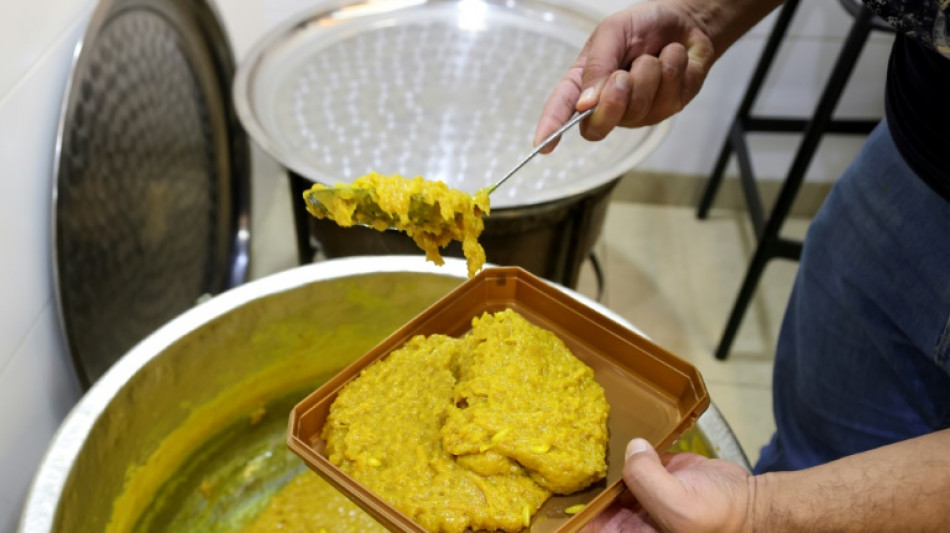
Family keeps up Beirut dessert tradition / Photo: ANWAR AMRO - AFP

 Warren coy over whether Fury-Joshua will be in UK or US

 Taiwan blocks key bridge in drill for potential Chinese invasion
 Migrant children risk abuse on streets of Ceuta, aid groups warn

 Oil price shoots up as stocks tread water

 British Grand Prix stays on MotoGP calendar until 2028

 Britain's EasyJet flies into US hands as takeover confirmed

 Real Madrid sign Ivory Coast winger Yan Diomande

 How online disinformation fuelled Ceuta migrant surge

 Inevitable AI Group Raises $6M From Aleph to Launch AI-Native SaaS Companies

 Suspected Ebola death on boat heading for DR Congo capital

 England selector North not 'hung up' on Stokes absence

 UK Anti-Doping confirm former world champ Parker's ban lifted

 French winemakers dread 'smoky taste' after wildfires

 Stocks diverge with earnings, tech in focus

 England recall batsman Lawrence for Pakistan series

 Siemens shares plunge on disappointing guidance raise

 New Australia coach Kiss gives Japan starts to Ross, Amatosero

 'Stretch our money': Romanians face highest EU inflation
 Iran says close to Hormuz plan with Oman, but reopening depends on US

 Messi scores twice to set Leagues Cup record in Miami victory

 Asian stocks mostly down with tech firms back under pressure

 Back to the future as world champion Springboks host All Blacks

 India youth protests highlight mistrust in 'lapdog' media

 Pacific islands alarmed by Trump-backed push for deep-sea mining
 Erratic rains dictate menu at three-star Michelin restaurant in Brazil

At a shop nestled in a busy, crowded Beirut district, Hasan El-Makary is weighing out containers of warm, fragrant mufataka, a traditional sweet in the Lebanese capital that is rarely found in stores.
"I've been in this shop for 50 years, but we started specialising in mufataka 30 years ago," Makary said from the humble shop with its ageing decor and low ceiling.
A kind of rice pudding made with turmeric, tahini sesame paste, sugar and pine nuts, mufataka is traditional in Beirut but less known even outside the city.
Makary, 73, said he used to sell other sweets but as demand grew for mufataka, he abandoned the rest and now just makes the yellow pudding, together with his cousin, who is also his business partner.
"At the beginning you add turmeric, that's the main thing, then tahini, sugar and rice... we cook it slowly on fire," he said.
The rice must be soaked overnight, and Makary said he comes to the shop at 5:00 am to make the dish, which takes around four hours and requires regular stirring.
He said his father started making mufataka despite initially believing people would not pay money for a dish that is normally prepared at home.
Plastic containers of the pudding, which is eaten with a spoon, dotted trays and tables across the shop, waiting for customers who peered through a window to place their order from the busy street outside.
Customer Iman Chehab, 55, was picking up mufataka for her mother, who used to make it herself.
"She is elderly now and she can't stir... it takes a lot of work," said Chehab, who works in human resources management.
The dish is "something traditional for us who are from Beirut", she told AFP.
Places like Makary's shop "are the old face of Beirut that we love and always want to remember", she added.
- 'Heritage' -
A few bustling neighbourhoods away, Samir Makari, 35, is carrying on the family tradition.
At a gleaming shop also selling Arabic sweets like baklava, Makari attends to a huge copper pot of mufataka behind the counter, stirring it with a long, wooden-handled implement.
He weighs out and mixes the sugar, tahini paste and pine nuts in a second pot, later combining it all.
Mufataka used to be made just once a year on the last Wednesday in April, with families gathering by the sea at Beirut's public beach, father and son said.
The occasion was "Job's Wednesday", a reference to the biblical figure also mentioned in the Koran and who is renowned for his patience, the younger Makari said, noting the virtue is also required for making mufataka.
On the wall of his shop, which he runs with his brother, were photos of his father and his grandfather at work.
He said he sometimes makes mufataka twice a day depending on demand, with some customers taking it outside Beirut to introduce it to those who do not know the dish.
At the original store, the elder Makary said he was happy his children had kept up the tradition.
Mufataka is part of "my heritage", he said, and the family has "taken it from generation to generation".
F.Moura--PC