
Nobel chemistry winner sees engineered proteins solving tough problems / Photo: Ian C. Haydon - UW Medecine Institute for Protein Design/AFP

 British Grand Prix stays on MotoGP calendar until 2028

 Britain's EasyJet flies into US hands as takeover confirmed
 Real Madrid sign Ivory Coast winger Yan Diomande

 How online disinformation fuelled Ceuta migrant surge

 Inevitable AI Group Raises $6M From Aleph to Launch AI-Native SaaS Companies

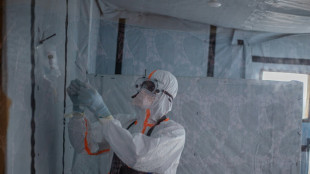 Suspected Ebola death on boat heading for DR Congo capital

 England selector North not 'hung up' on Stokes absence

 UK Anti-Doping confirm former world champ Parker's ban lifted

 French winemakers dread 'smoky taste' after wildfires
 Stocks diverge with earnings, tech in focus

 England recall batsman Lawrence for Pakistan series
 Siemens shares plunge on disappointing guidance raise

 New Australia coach Kiss gives Japan starts to Ross, Amatosero

 'Stretch our money': Romanians face highest EU inflation

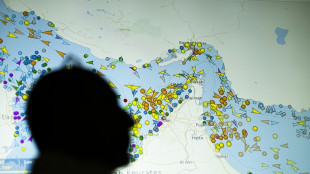 Iran says close to Hormuz plan with Oman, but reopening depends on US

 Messi scores twice to set Leagues Cup record in Miami victory

 Asian stocks mostly down with tech firms back under pressure

 Back to the future as world champion Springboks host All Blacks

 India youth protests highlight mistrust in 'lapdog' media

 Pacific islands alarmed by Trump-backed push for deep-sea mining

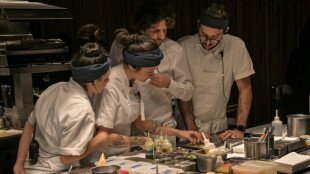 Erratic rains dictate menu at three-star Michelin restaurant in Brazil

 Zverev, Auger-Aliassime and Medvedev exit Montreal Masters
 Loar Holdings Inc. Reports Q2 2026 Record Results and Upward Revision to 2026 Outlook
 Embattled Infantino sees minnows Malawi reach WAFCON quarter-finals

 Seeds Rybakina, Pegula and Gauff advance at WTA Toronto event

Whether it's battling tumors or breaking down plastic, American scientist David Baker, co-recipient of this year's Nobel Prize in Chemistry, has an answer: engineering proteins that don't naturally exist -- a concept once dismissed as "crazy."
Today, proteins with novel functions are flowing steadily out of his lab, with an endless list of potential applications ranging from ultra-targeted therapies to the development of new vaccines.
"Across the range of problems that we face today in medicine and health, sustainability, energy, and technology, I think the potential for protein design is enormous," Baker told AFP via video call from Seattle, hours after learning of his Nobel win alongside two other laureates.
Proteins are organic molecules that play a fundamental role in almost every function of living organisms, from muscle contraction and food digestion to neuron activation and more.
"The ones in nature evolved to solve all the problems that were faced during natural selection," explained the 62-year-old University of Washington professor.
"But humans face new problems today," added the biochemist and computational biologist.
"We're heating up the planet, so we need new solutions in ecology and sustainability. We live longer, so there's new diseases which are relevant, like Alzheimer's disease. There's new pathogens like coronavirus."
Rather than leave these problems up to evolution -- a "brutal" solution that would take a very, very long time -- "with new proteins, we can solve those problems, but in a very short time," he said.
- From fringe to mainstream -
All proteins are composed of chains of amino acids, whose sequence dictates their shape -- and ultimately their function.
For decades, scientists have tried to determine protein structures based on these amino acid sequences.
In the late 1990s, Baker made strides towards solving this problem with a computer software he developed called Rosetta.
His success prompted a shift his focus to the reverse approach: starting with a desired shape and using Rosetta to identify the corresponding amino acid sequence. This sequence can then be introduced into bacteria, which synthesize the new protein that can be harvested and studied.
In 2003, he published his breakthrough finding -- the creation of the first-ever protein not found in nature -- though it still lacked a defined function.
"Then we started trying to design proteins that actually would do useful things," Baker recalled. "And that's when people, I think, really started thinking it was crazy."
But "for the last 20 years -— and really, most recently, the last five years -— we've been able to make proteins that do all kinds of amazing things," he said. Rosetta meanwhile has been progressively improved to incorporate artificial intelligence.
"I think what's kind of funny now is that the lunatic fringe, which pretty much no one was doing, has now entered the mainstream," he added with a laugh.
- Keys that fit locks -
How do scientists decide what shape a new protein needs to achieve the desired function?
Baker gives the example of a tumor. "We know some protein that's on the surface of that tumor, and we know its shape. What we do is we design a protein that acts like a key fitting into a lock," he explained.
Another application: breaking down plastic. In this case, a protein is designed to attach itself to the plastic molecule, accompanied by chemical compounds to "cut" it.
In medicine, this technology has already been used in a Covid-19 vaccine approved in South Korea. Researchers are also exploring its potential to create new materials.
"In biology, we have tooth and bone, we have shells, which are made by proteins interacting with inorganic compounds like calcium carbonate or calcium phosphate," says Baker, envisioning proteins interacting with other compounds to create entirely new materials with unique properties.
Greenhouse gas capture, a universal flu vaccine, improved antivenom -- Baker's wish list goes on and on.
"As protein design becomes more powerful, I'm incredibly excited about all the problems that we will be able to solve."
V.Dantas--PC