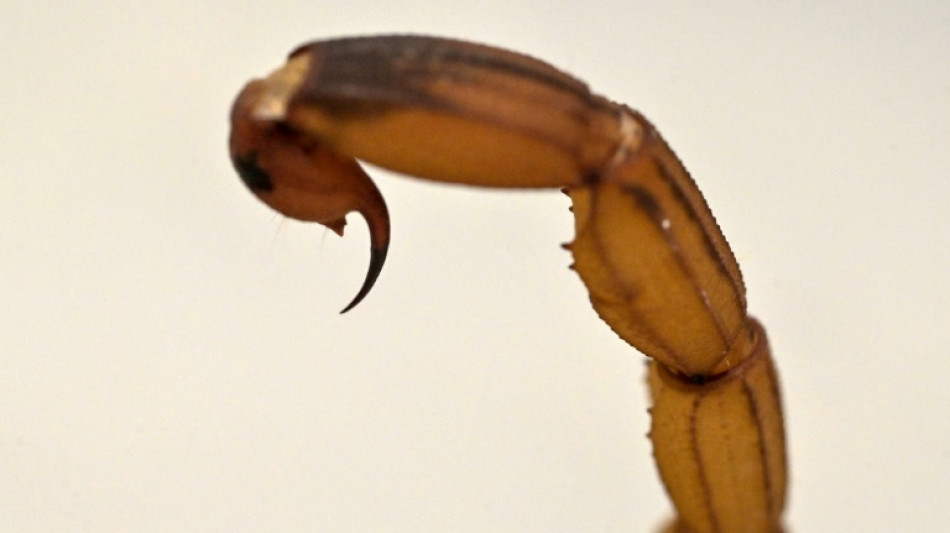
Thriving scorpion population is stinging problem for Brazil / Photo: Nelson ALMEIDA - AFP

 Stocks diverge with earnings, tech in focus

 England recall batsman Lawrence for Pakistan series
 Siemens shares plunge on disappointing guidance raise

 New Australia coach Kiss gives Japan starts to Ross, Amatosero

 'Stretch our money': Romanians face highest EU inflation

 Iran says close to Hormuz plan with Oman, but reopening depends on US

 Messi scores twice to set Leagues Cup record in Miami victory

 Asian stocks mostly down with tech firms back under pressure

 Back to the future as world champion Springboks host All Blacks

 India youth protests highlight mistrust in 'lapdog' media
 Pacific islands alarmed by Trump-backed push for deep-sea mining

 Erratic rains dictate menu at three-star Michelin restaurant in Brazil

 Zverev, Auger-Aliassime and Medvedev exit Montreal Masters

 Google-parent Alphabet shakes up AI division

 FIFA back Infantino, apologise for World Cup privatisation plan

 Auger-Aliassime out of Montreal ATP event with injury

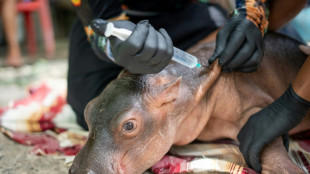 Colombian baby hippo of Escobar stock dies after rescue

 Preakness shifts 2027 dates to entice more Derby horses

 Guatemalan volcano eruption ends, locals return home

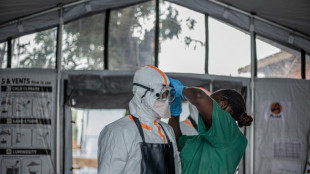 WHO chief urges stronger Ebola response in DR Congo visit

 Newcastle appoint Jaissle as new head coach after Howe exit

 Swiss ski star Lara Gut-Behrami calls time on 18-year career

 US indicts leaders of Mexico's CJNG cartel, ups reward money

 Noosha Aubel: Klarar hon av Potsdams problem?

 Noosha Aubel: Zvládne problémy Postupimi?

Forget snakes, it's scorpions Brazilians most need to worry about.
The arachnids -- feared for the toxic stinger poised atop their tails -- are proliferating thanks to urbanization and warming temperatures.
The result is that scorpions have become the most lethal poisonous animal in Brazil, posing a growing danger for people across the whole country -- and spurring demand for antivenom.
The most widely found species in the country, the Brazilian yellow scorpion, is the most dangerous scorpion in South America.
Unusually for scorpions, this all-female species also reproduces asexually, reducing population-control options.
"With a warming habitat, these animals' metabolisms are also warming, so they are more active, eating more and reproducing more," explained Thiago Chiariello, production coordinator of the scorpion antivenom lab at Brazil's Instituto Butantan in Sao Paulo.
Add to that rampant urbanization which both scares away scorpions' natural predators such as lizards and birds while boosting the number of available cockroaches -- tasty meals for the arachnids -- and the problem is evident.
"Cities are growing unchecked" and the spread of trash they bring means more food supply for scorpions, Chiariello said.
"This is leading to more contact with people, which means more accidents."
- Soaring sting numbers -
Last year -- the latest dataset available -- there were 152 deaths from scorpion stings in Brazil, compared with 140 from snakebites. That was an increase from 2019, when 95 deaths by scorpion sting were recorded.
According to Brazil's health ministry, there were more than 200,000 scorpion sting incidents registered last year -- 250 percent more than a decade earlier, and an average of nearly 550 stings per day.
Healthy adults might get mild to moderate symptoms from a Brazilian yellow scorpion sting, including pain, vomiting, profuse sweating and tremors.
But there are more severe symptoms -- including shock, fluid build-up in the lungs, cardiovascular collapse and heart failure -- that can prove deadly, especially for children and the elderly.
- Life-saving antivenom -
That makes the Butantan institute's antivenom very important.
Chiariello's team carry out their serum-making task in making that serum with extreme precision.
They first use tweezers to guide a live scorpion's stinger into a container.
The poison is then injected into horses, which are less vulnerable to the toxin's effects than humans, and which produce more antibodies.
"There is a whole purification process in the horses' blood," explained Paulo Goldoni, a biologist at the institute.
"The serum is the only way to save lives," he said.
Last year saw more than 11,000 people in Brazil receive scorpion antivenom, mostly in the country's heavily populated southeast, according to authorities.
With serum demand growing, but also the number of available scorpions, the Instituto Butantan has a steady supply of venom donors.
"If ever there was a lack of serum, we would certainly see a serious increase in the number of deaths," the biologist said.
E.Ramalho--PC