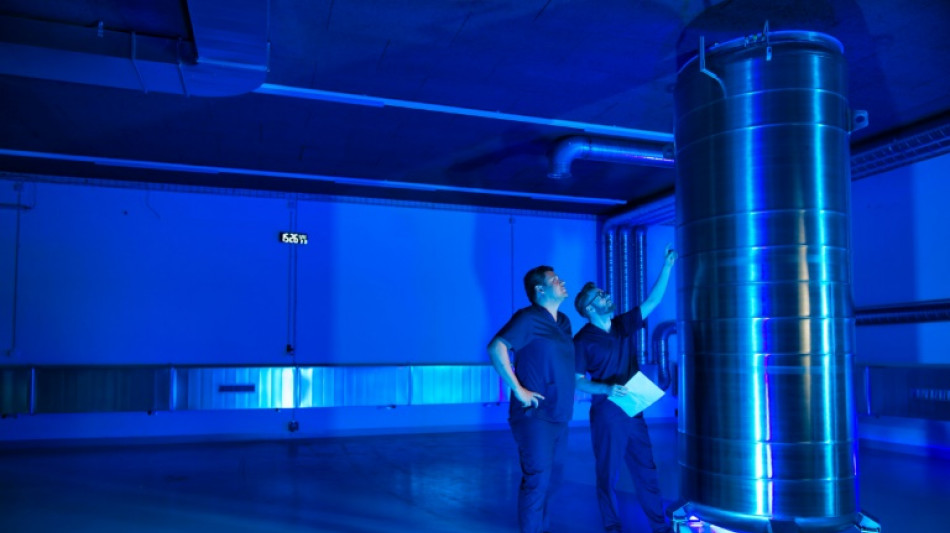
Stiff business: Berlin startup will freeze your corpse for monthly fee / Photo: Handout - TOMORRROW BIOSTASIS/AFP

 Stocks diverge with earnings, tech in focus

 England recall batsman Lawrence for Pakistan series

 Siemens shares plunge on disappointing guidance raise

 New Australia coach Kiss gives Japan starts to Ross, Amatosero

 'Stretch our money': Romanians face highest EU inflation

 Iran says close to Hormuz plan with Oman, but reopening depends on US

 Messi scores twice to set Leagues Cup record in Miami victory

 Asian stocks mostly down with tech firms back under pressure

 Back to the future as world champion Springboks host All Blacks

 India youth protests highlight mistrust in 'lapdog' media

 Pacific islands alarmed by Trump-backed push for deep-sea mining

 Erratic rains dictate menu at three-star Michelin restaurant in Brazil

 Zverev, Auger-Aliassime and Medvedev exit Montreal Masters

 Google-parent Alphabet shakes up AI division

 FIFA back Infantino, apologise for World Cup privatisation plan

 Auger-Aliassime out of Montreal ATP event with injury

 Colombian baby hippo of Escobar stock dies after rescue

 Preakness shifts 2027 dates to entice more Derby horses

 Guatemalan volcano eruption ends, locals return home

 WHO chief urges stronger Ebola response in DR Congo visit

 Newcastle appoint Jaissle as new head coach after Howe exit

 Swiss ski star Lara Gut-Behrami calls time on 18-year career

 US indicts leaders of Mexico's CJNG cartel, ups reward money

 Noosha Aubel: Klarar hon av Potsdams problem?

 Noosha Aubel: Zvládne problémy Postupimi?

Becca Ziegler is only 24, but she already has her death planned out: her corpse will be deep-frozen to minus 200 degrees Celsius (minus 328 degrees Fahrenheit) with liquid nitrogen.
Ziegler, a US tech firm worker based in Berlin, has signed up with Tomorrow Biostasis, a startup in the German capital that offers to cryogenically freeze a person's body after they die.
When the time comes, a team of medics will pump her full of a chemical solution to stop ice crystals from forming in her body and then transport her mortal remains to a storage facility in Switzerland.
The hope is that one day, medical technology might be advanced enough to bring her back to life. Many experts dismiss this gamble on the future as far-fetched, but Ziegler has decided to give it a shot.
"I'm kind of curious to see what the future would be like and, in general, I like life," said the Californian, who works in educational technology.
"So if I could buy myself more time, that sounds really appealing."
Once a fringe pursuit reserved for eccentric billionaires, cryogenic freezing -- also known as cryonics -- has become more accessible in recent years.
Several companies offering cryopreservation have sprung up in the United States and elsewhere, with around 500 people worldwide thought to have been frozen so far.
A persistent myth has it that Walt Disney, the creator of Mickey Mouse, is one of them, but this has been debunked, with BBC reporting in 2019 there is "zero evidence" for this.
Tomorrow Biostasis, founded in 2020, is thought to be the first such company offering the service in Europe. It offers to freeze your body after you die and store it for a membership fee of 50 euros a month.
A lump-sum payment of 200,000 euros ($216,000) -- or 75,000 euros if you opt to have just your brain frozen -- is also due at the time of death, a cost that can be covered by a life insurance payout.
- Liquid nitrogen -
"One of the main goals of this company is to bring the cost down... so that cryopreservation becomes available to whoever chooses to do it," said Emil Kendziorra, one of the co-founders of Tomorrow Biostasis.
Kendziorra, 38, from the western German city of Darmstadt, studied medicine and originally worked in cancer research but said he became frustrated with the slow pace of developments in the field.
"The one big advantage of cryopreservation is that it is something that you can do right now," he said.
When a client dies, Tomorrow Biostasis promises to dispatch a specially equipped ambulance and a medical team that starts cooling the body using ice and water as soon as possible.
The body is then infused with a "cryoprotectant" and transported to the facility in Switzerland where it is stored in a pod surrounded by liquid nitrogen and cooled to around minus 200 degrees Celsius.
Tomorrow Biostasis says it currently has around 700 paying members, and by the end of last year had cryopreserved four people.
The typical customer is aged 30 to 40, healthy, works in technology and is more likely to be male than female, said Kendziorra.
- No guarantees -
No one has ever been brought back to life after being cryopreserved, but proponents say recent advances in technology have made the prospect more plausible.
In an experiment almost a decade ago, scientists said they were able to cryopreserve the brain of a rabbit and recover it in near-perfect condition.
And this year, researchers at China's Fudan University reported using a new technique to freeze human brain tissue so that it regained normal function after thawing.
Nonetheless, some scientists voice deep scepticism about the bet on a future return to life.
Holger Reinsch, head of the Cryo Competence Center at the ILK Dresden research institute for refrigeration technologies, said bringing a person back to life is still a remote prospect.
"We are rather critical of the concept of cryonics... I personally would advise you against such an endeavour," he said.
"The magic limit for the life-sustaining cryopreservation of tissue structures is a frog's heart the size of a fingernail, and this has not changed since the 1970s."
Even Kendziorra admitted that there are no guarantees.
"I think there's a good chance for it, but do I know for sure? Absolutely not."
But whatever happens in the future, Ziegler is confident she will not regret her decision.
"In some ways it's weird," she conceded. "But on the other hand the alternative is to be put in a box in the ground and get eaten by worms."
F.Cardoso--PC