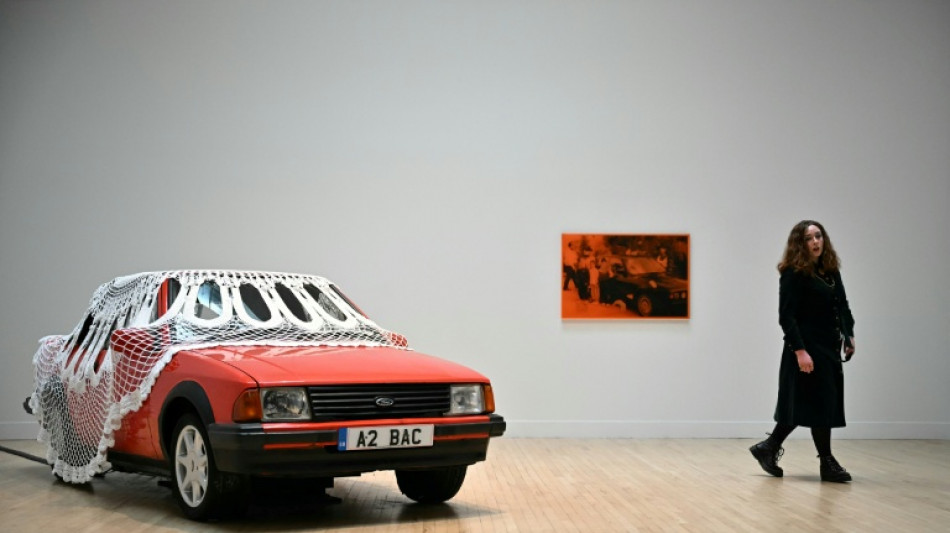
Scottish artist Jasleen Kaur wins 2024 Turner Prize / Photo: Ben STANSALL - AFP

 Kospi Falls Below 5,000 as U.S. AI Regulation Fears Trigger Circuit Breaker

 Valsoft's TAG Software Group Enters the Content Operations Market with the Acquisition of Chalco

 South Korea Proposes Fourth Delay of Cryptocurrency Gains Tax to 2029

 ASIC Fines Mona Museum Owner's Company for Late Financial Report

 Business Leaders Criticize Productivity Commission Inquiry Scope

Scottish artist Jasleen Kaur won the prestigious Turner Prize on Tuesday, as the UK contemporary art award celebrated its 40th anniversary.
Kaur was honoured for her solo exhibition Alter Altar, which includes an installation of a Ford Escort car with a giant doily on it.
She was announced the winner during a ceremony at the Tate Britain gallery in central London.
The 38-year-old pipped Philippines-born Pio Abad, Manchester-born Claudette Johnson and English artist Delaine Le Bas to the award.
Kaur walked away with £25,000 ($32,000), while the remaining shortlisted artists were awarded £10,000 each.
The five jury members chose Kaur for "her ability to gather different voices through unexpected and playful combinations of material".
During her victory speech she called for a ceasefire in Gaza and said "Free Palestine".
Established in 1984, the Turner is awarded each year to a British artist for an outstanding exhibition or other presentation of their work.
Previous victors include now-household names such as duo Gilbert & George, Anish Kapoor, Rachel Whiteread, Antony Gormley, Chris Ofili, Steve McQueen and Damien Hirst.
British artist Jesse Darling won last year's prize for his sculptures and installations that invoke societal breakdown.
The annual award seeks to encourage debate around new advances in contemporary art and is given to a visual artist based or born in Britain.
But that debate has often spilled over into controversy. Ofili, for example, won in 1998 for incorporating elephant dung into his paintings.
Hirst in 1995 exhibited pieces including a rotting cow's head, while Tracey Emin's 1999 entry "My Bed" -- an unmade double bed with stained sheets surrounded by soiled underwear, condoms, slippers and empty drink bottles -- attracted huge attention.
J.Pereira--PC