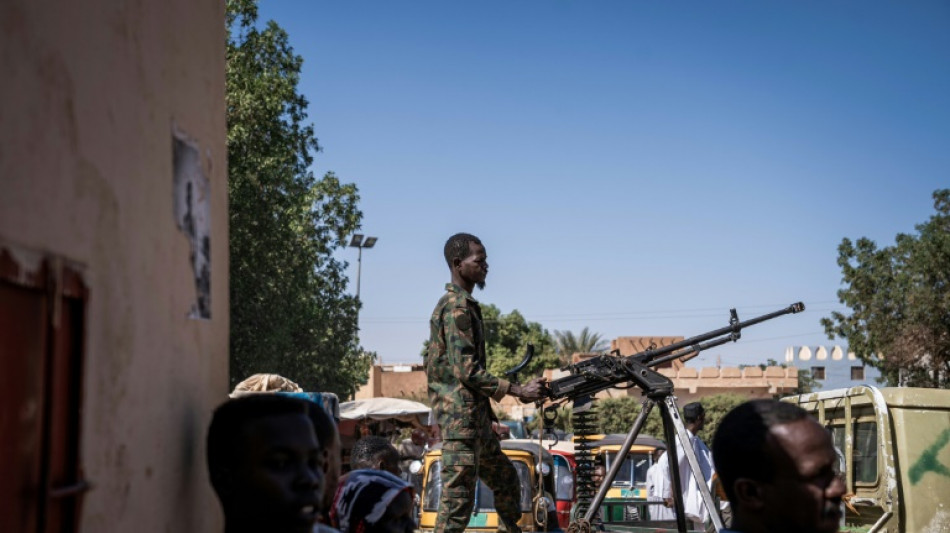
Sudan's doctors bear brunt of war as healthcare falls apart / Photo: Amaury Falt-Brown - AFP/File

 Multi-Asset Trading Venue Monochrome Exchange Announces IEO of Its Native Token, $MCR
 South Korea break Japan hearts to win Asian Games basketball gold

 Acosta takes first victory at Austrian MotoGP
 PSG president Nasser al-Khelaifi under investigation in France for conflict of interest

 China swim sensation, 13, sets Games record after Japan win early

 Drones hit Moscow as Russians go to the polls

 New England boss Fleming says 'wrong' to ask Stokes to end retirement

 Germans vote in elections threatening fresh blow to Merz

 US fears rapid escalation in Mideast after Houthis attack Riyadh

 Japan triathlete Hojo wins first gold of Asian Games

 IOC president impressed by 'beautiful' Asian Games wooden huts

 First Asian Games gold goes to Japan as China's 13-year-old Yu lights up pool

 Data centre command hub keeps AI up and running

 Pope Leo in France: the issues on the table

 Packing for a pope: behind the scenes on foreign trips

 Republicans find transgender issues a powerful political weapon in midterm campaigning

 German state elections threaten new shock waves for Merz

 Chile's Bachelet quits race to be next UN chief

 Raphinha treble fires perfect Barca to win at Sevilla

 Thiam makes winning heptathlon return at Decastar meet

 Czechs beat USA to qualify for Davis Cup finals

 Dortmund sink Stuttgart to climb to Bundesliga summit

 Trump says will not tolerate attempts to slow AI growth

 'It has to stop': runners protest women's murders in S.Africa district

 Fire erupts near Riyadh airport as Houthis claim strikes

Sudanese doctor Mohamed Moussa has grown so accustomed to the constant sound of gunfire and shelling near his hospital that it no longer startles him. Instead, he simply continues attending to his patients.
"The bombing has numbed us," the 30-year-old general practitioner told AFP by phone from Al-Nao hospital, one of the last functioning medical facilities in Omdurman, part of greater Khartoum.
Gunfire rattles in the distance, warplanes roar overhead and nearby shelling makes the ground tremble, more than a year and a half into a grinding war between rival Sudanese generals.
Embattled health workers "have no choice but to continue", said Moussa.
Since April 2023, Sudan has been torn apart by a war between army chief Abdel Fattah al-Burhan and his former deputy Mohamed Hamdan Daglo, leader of the paramilitary Rapid Support Forces (RSF).
The war has killed tens of thousands and uprooted 12 million people, creating what the International Rescue Committee aid group has called the "biggest humanitarian crisis ever recorded".
The violence has turned the country's hospitals into battlegrounds, placing health workers like Moussa on the frontlines.
Inside Al-Nao's overwhelmed wards, the conflict's toll is staggering.
Doctors say they tend to a harrowing array of injuries: gunshot wounds to the head, chest and abdomen, severe burns, shattered bones and amputations -- even among children as young as four months.
The hospital itself has not been spared.
Deadly shelling has repeatedly hit its premises, according to medical charity Doctors Without Borders (MSF) which has supported the Al-Nao hospital.
Elsewhere, the situation is just as dire. In North Darfur, a recent drone attack killed nine at the state capital's main hospital, while shelling forced MSF to evacuate its field hospital in a famine-hit refugee camp.
- Medics targeted -
Sudan's healthcare system, already struggling before the war, has now all but crumbled.
Of the 87 hospitals in Khartoum state, nearly half suffered visible damage between the start of the war and August 26 this year, according to satellite imagery provided and analysed by Yale University's Humanitarian Research Lab and the Sudanese American Physicians Association.
As of October, the World Health Organization had documented 119 confirmed attacks on healthcare facilities across Sudan.
"There is a complete disregard for civilian protection," said Kyle McNally, MSF's humanitarian affairs advisor.
He told AFP that an ongoing "broad-spectrum attack on healthcare" includes "widespread physical destruction, which then reduces services to the floor -- literally and figuratively".
The national doctors' union estimates that in conflict zones across Sudan, up to 90 percent of medical facilities have been forced shut, leaving millions without access to essential care.
Both sides of the conflict have been implicated in attacks on healthcare facilities.
The medical union said that 78 health workers have been killed since the war began, by gunfire or shelling at their workplaces or homes.
"Both sides believe that medical staff are cooperating with the opposing faction, which leads to their targeting," union spokesperson Sayed Mohamed Abdullah told AFP.
"There is no justification for targeting hospitals or medical personnel. Doctors... make no distinction between one patient and another."
- Starvation -
According to the doctors' union, the RSF has raided hospitals to treat their wounded or search for enemies, while the army has conducted air strikes on medical facilities across the country.
On November 11, MSF suspended most activities at Bashair Hospital, one of South Khartoum's few functioning hospitals, after fighters stormed the facility and shot dead another fighter being treated there.
MSF officials say they believe the fighters to be RSF combatants.
In addition to the endless stream of war casualties, Sudan's doctors scramble to respond to another threat: mass starvation.
In a paediatric hospital in Omdurman, across the Nile from Khartoum, malnourished children arrive in droves.
Between mid-August and late October, the small hospital was receiving up to 40 children a day, many in critical condition, according to one doctor.
"Every day, three or four of them would die because their cases were very late stage and complicated, or due to a shortage of essential medicines," said the physician, requesting anonymity for safety concerns.
Sudan has for months teetered on the edge of famine, with nearly 26 million people -- more than half the population -- facing acute hunger, according to the UN.
Adnan Hezam, a spokesman for the International Committee of the Red Cross, said there must be "immediate support in terms of supplies and human resources to medical facilities".
Without it, "we fear a rapid deterioration" in already limited services, he told AFP.
To Moussa, the doctor, some days feel "unbearable".
"But we can't stop," he said.
"We owe it to the people who depend on us."
B.Godinho--PC