Bamboo farm gets chopping for US zoo's hungry new pandas / Photo: ANDREW CABALLERO-REYNOLDS - AFP

 Multi-Asset Trading Venue Monochrome Exchange Announces IEO of Its Native Token, $MCR

 South Korea break Japan hearts to win Asian Games basketball gold

 Acosta takes first victory at Austrian MotoGP

 PSG president Nasser al-Khelaifi under investigation in France for conflict of interest

 China swim sensation, 13, sets Games record after Japan win early

 Drones hit Moscow as Russians go to the polls

 New England boss Fleming says 'wrong' to ask Stokes to end retirement

 Germans vote in elections threatening fresh blow to Merz

 US fears rapid escalation in Mideast after Houthis attack Riyadh

 Japan triathlete Hojo wins first gold of Asian Games

 IOC president impressed by 'beautiful' Asian Games wooden huts

 First Asian Games gold goes to Japan as China's 13-year-old Yu lights up pool

 Data centre command hub keeps AI up and running

 Pope Leo in France: the issues on the table

 Packing for a pope: behind the scenes on foreign trips

 Republicans find transgender issues a powerful political weapon in midterm campaigning

 German state elections threaten new shock waves for Merz

 Chile's Bachelet quits race to be next UN chief

 Raphinha treble fires perfect Barca to win at Sevilla

 Thiam makes winning heptathlon return at Decastar meet

 Czechs beat USA to qualify for Davis Cup finals

 Dortmund sink Stuttgart to climb to Bundesliga summit

 Trump says will not tolerate attempts to slow AI growth

 'It has to stop': runners protest women's murders in S.Africa district

 Fire erupts near Riyadh airport as Houthis claim strikes

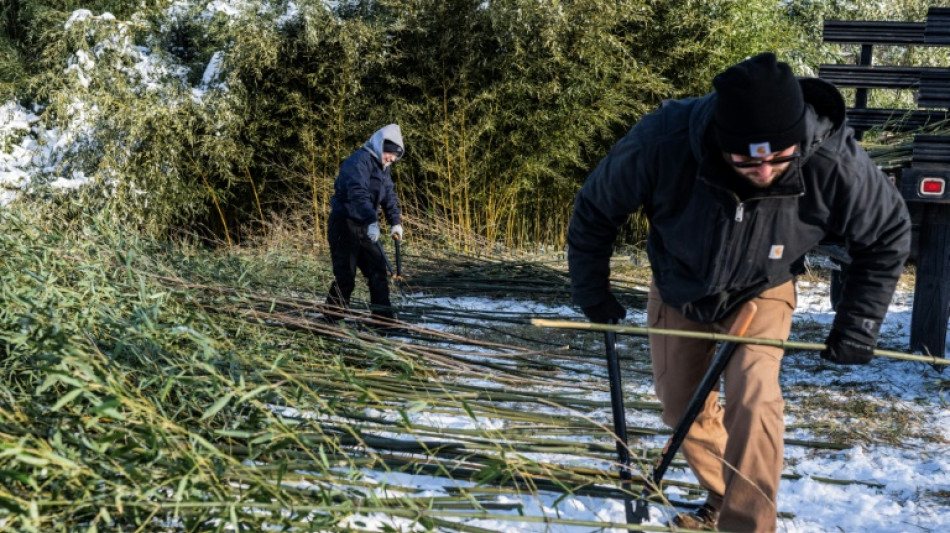
On a snow-blanketed field in Virginia, a handful of workers were silent but for the groan of a chainsaw chopping through bamboo -- a delicacy for their furry clients down the road in the US capital of Washington.
The team, bundled up for the cold, then stuffed up to 700 bamboo stalks into a pickup truck to be driven 70 miles (110 kilometres) to the Smithsonian's National Zoo to feed, among others, its newly arrived pandas.
Bao Li, a male, and female Qing Bao, landed in the United States from China in October as part of a decade-long breeding and research agreement.
Public visitors are this week finally allowed to see the pair at the free-entry zoo and more likely than not, the pandas will be snacking on bamboo harvested at this hilly farm.
But satisfying these bears -- who can spend up to 16 hours a day feeding on up to 100 pounds (45 kilos) of bamboo -- is no easy feat.
Their appetites are so ravenous because pandas' digestive systems are designed to process meat yet they have evolved to be almost entirely dependent on bamboo, which is of little nutritional value.
"Bamboo harvest is probably one of the most rigorous things that we do," said Mike Maslanka, head of nutrition for the zoo, his hands plunged into pockets to guard against the 10 degree Fahrenheit (minus 12 degree Celsius) temperatures at the site in the Shenandoah Valley.
Trudging through ankle-deep snow, three young men chopped down scores of bamboo stems -- some reaching 20 feet high -- and began piling them up.
After harvesting, the bamboo must pass quality control, where leafless stems are cast aside and only the greenest ones make it to the zoo's bamboo fanatics, which also include Asian elephants and gorillas.
- Picky eaters -
The pandas add to the already high demands, with Maslanka saying the bamboo farm team is now operating four days a week, up from three days last year.
It also means learning the new arrivals' eating habits.
Qing Bao is proving a "little bit more finicky in terms of palate," said Maslanka, who wore a black beanie emblazoned with a panda, while Bao Li is "OK with just about anything that we offer."
Maslanka added that this was a common thread among pandas, whose reputation as picky eaters has prompted deep discussion -- and confusion -- about their feeding habits.
"We've tried to pin it down to species or age or location or soil type, slope, elevation. We can't, there's no rhyme or reason," he said.
"We'll offer this bamboo to them tomorrow and they won't like it. We'll offer it to them the next day, they'll think it's the best thing ever," added Maslanka, who has over 15 years of experience with the Smithsonian National Zoo.
This makes it a delicate task ensuring the bamboo is up to the pandas' standards.
Before being served to the bears, Maslanka said the bamboo is placed into an air-conditioned shed which is cooled to around 55 degrees Fahrenheit and equipped with misters to keep the stems moist.
The Washington pandas are among just a few that remain in the United States, including a pair that arrived at San Diego's zoo last summer.
Their presence is part of the so-called panda diplomacy carried out by Beijing, in which its black-and-white bears are sent across the globe as soft-power diplomats.
Thanks to conservation efforts, the giant panda was downgraded last year from "endangered" to "vulnerable" on the global list of species at risk of extinction.
R.Veloso--PC