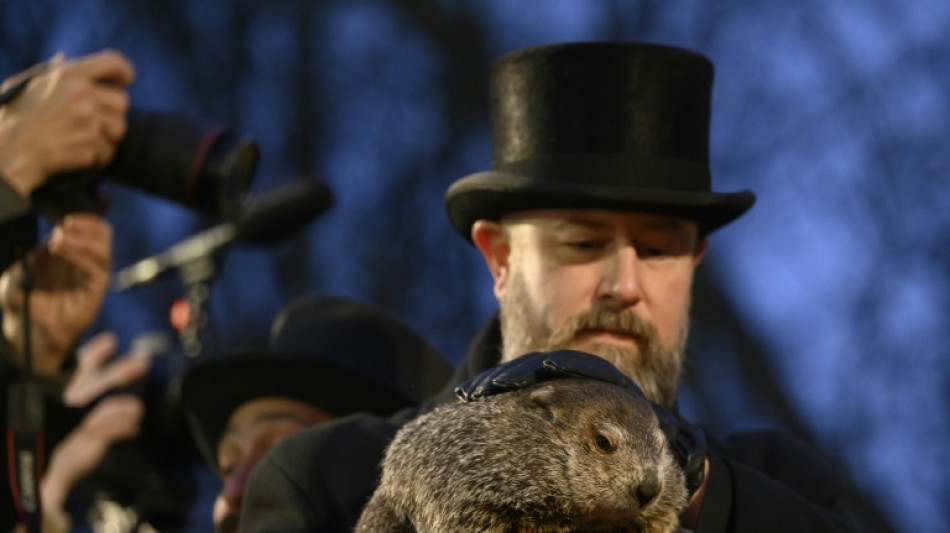
Scientists cast doubt on famous US groundhog's weather forecasts / Photo: JEFF SWENSEN - GETTY IMAGES NORTH AMERICA/AFP/File

 Kospi Falls Below 5,000 as U.S. AI Regulation Fears Trigger Circuit Breaker

 Valsoft's TAG Software Group Enters the Content Operations Market with the Acquisition of Chalco

 South Korea Proposes Fourth Delay of Cryptocurrency Gains Tax to 2029

 ASIC Fines Mona Museum Owner's Company for Late Financial Report

 Business Leaders Criticize Productivity Commission Inquiry Scope

Scientists have cast doubt on the reliability of America's most celebrated rodent forecaster -- whose apparent knack of predicting how long winter will last forms a hallowed tradition in the United States.
Punxsutawney Phil, made famous by the 1993 film "Groundhog Day," attracts thousands of onlookers every February 2 to the Pennsylvania town that he takes his name from.
The US state's tradition of using a large rodent to predict the seasons dates back to the Pennsylvania Dutch belief that if a groundhog left its burrow and saw its shadow, it would scurry back inside and winter would go on for six more weeks.
But professional forecasters have warned ahead of Phil's appearance this Sunday that his prediction is likely to be way off the mark.
The US National Oceanic and Atmospheric Administration (NOAA) has concluded that only 35 percent of Phil's forecasts have proved to be accurate -- placing him at a lowly 17th compared to other rodent forecasters.
Staten Island Chuck, a New York-based groundhog, tops the rankings with an impressive 85 percent accuracy rate on his forecasts.
Phil and his predecessors, also called Phil, have been forecasting since 1887.
V.F.Barreira--PC