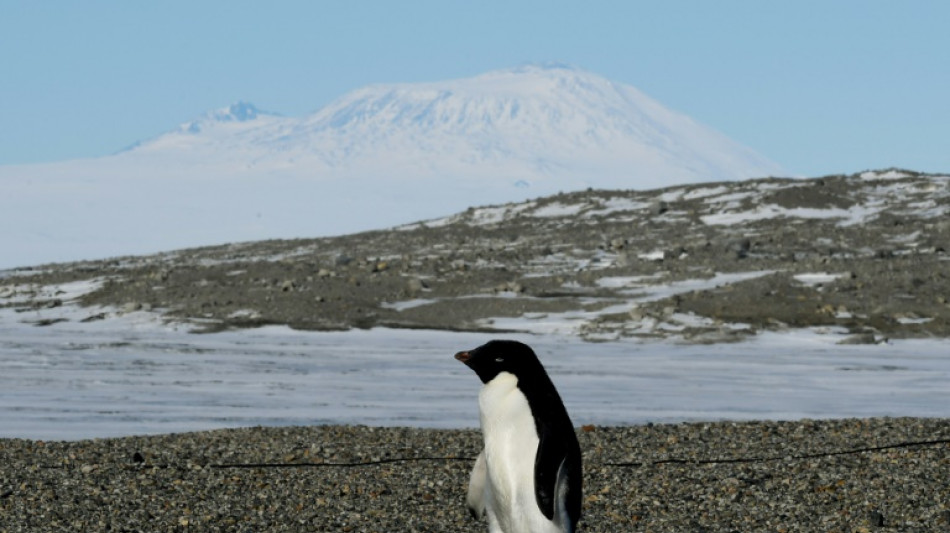
The surprising climate power of penguin poo / Photo: Mark RALSTON - AFP/File

 US warns of rapid escalation in Mideast war

 Iran 'put hearts on the court' to win Asian Games basketball bronze

 School girl Yu helps China dominate in Asian Games swimming openers

 Myanmar win first Asian Games teqball gold as Spain great Puyol watches

 China's 13-year-old Yu scorches to first major gold at Asian Games

 Russians vote on last day of parliamentary elections

 Hong Kong pays final respects to former city leader Tung

 Typhoon put people off Asian Games opening ceremony, official says

 China's 13-year-old Yu cruises as Asian Games swimming begins

 AI 'warning shots' focus Beijing on national security risks

 Philippine tribe in limbo over US-led tech hub

 Leo XIV, first US pope transcends his restrained style

 Singer Ed Sheeran says Gaza situation 'unjustifiable' following controversy

 In 'Tenzing', a Sherpa mountaineer gets his due

 Ed Sheeran set to return to stage after Palestinian controversy

 Toulouse edge Vannes, Lyon beat Pau to take Top 14 summit

 Germans arrested for Louvre stunt in Mona Lisa hall

 Saudi-led coalition says Houthis fired ballistic missile at Riyadh

 France's debt climbs to highest since 1978: ministry

 McIlroy two shots off the lead at Wentworth after eagle on 18

 Martinez brace saves Inter in Serie A top-two clash with Roma

 Rosenior abused but guides Paris FC past old club Strasbourg

 Seven-try Lyon beat Pau, climb to Top 14 summit

 Brighton defeat a 'big lesson' against complacency for Arsenal, says Arteta

 Thousands protest inaction over climate crisis in Switzerland

Antarctica's icy wilderness is warming rapidly under the weight of human-driven climate change, yet a new study points to an unlikely ally in the fight to keep the continent cool: penguin poo.
Published Thursday in Communications Earth & Environment, the research shows that ammonia wafting off penguin guano seeds extra cloud cover above coastal Antarctica, likely blocking sunlight and nudging temperatures down.
Lead author Matthew Boyer, an atmospheric scientist at the University of Helsinki, told AFP that lab studies had long shown gaseous ammonia can help form clouds.
But "to actually quantify this process and to see its influence in Antarctica hasn't been done," he said.
Antarctica is an ideal natural laboratory. With virtually no human pollution and scant vegetation -- both alternative sources of cloud-forming gases -- penguin colonies dominate as ammonia emitters.
The birds' future, however, is under threat.
Shrinking sea ice disrupts their nesting, feeding and predator-avoidance routines -- making it all the more urgent to understand their broader ecological role.
Along with other seabirds such as Imperial Shags, penguins expel large amounts of ammonia through droppings, an acrid cocktail of feces and urine released via their multi-purpose cloacas.
When that ammonia mixes with sulfur-bearing gases from phytoplankton -- the microscopic algae that bloom in the surrounding ocean -- it boosts the formation of tiny aerosol particles that grow into clouds.
To capture the effect in the real world, Boyer and teammates set up instruments at Argentina's Marambio Base on Seymour Island, off the northern tip of the Antarctic Peninsula.
Over three summer months -- when penguin colonies are bustling and phytoplankton photosynthesis peaks -- they monitored wind direction, ammonia levels and newly minted aerosols.
When the breeze blew from a 60,000-strong Adelie penguin colony eight kilometers (five miles) away, atmospheric ammonia spiked to 13.5 parts per billion -- about a thousand times the background level.
For over a month after the birds had departed on their annual migration, concentrations stayed roughly 100 times higher, with the guano-soaked ground acting as a slow-release fertilizer.
Particle counters told the same story: cloud-seeding aerosols surged whenever air masses arrived from the colony, at times thick enough to generate a dense fog.
Chemical fingerprints in the particles pointed back to penguin-derived ammonia.
- Penguin-plankton partnership -
Boyer calls it a "synergistic process" between penguins and phytoplankton that supercharges aerosol production in the region.
"We provide evidence that declining penguin populations could cause a positive climate-warming feedback in the summertime Antarctic atmosphere," the authors write -- though Boyer emphasized that this remains a hypothesis, not a confirmed outcome.
Globally, clouds have a net cooling effect by reflecting solar radiation back into space. Based on Arctic modeling of seabird emissions, the team believes a similar mechanism is likely at play in Antarctica.
But the impact also depends on what's beneath the clouds.
Ice sheets and glaciers also reflect much of the Sun's energy, so extra cloud cover over these bright surfaces could trap infrared heat instead -- meaning the overall effect hinges on where the clouds form and drift.
Still, the findings highlight the profound interconnections between life and the atmosphere -- from the Great Oxygenation Event driven by photosynthesizing microbes billions of years ago to penguins influencing cloud cover today.
"This is just another example of this deep connection between the ecosystem and atmospheric processes, and why we should care about biodiversity and conservation," Boyer said.
J.Oliveira--PC