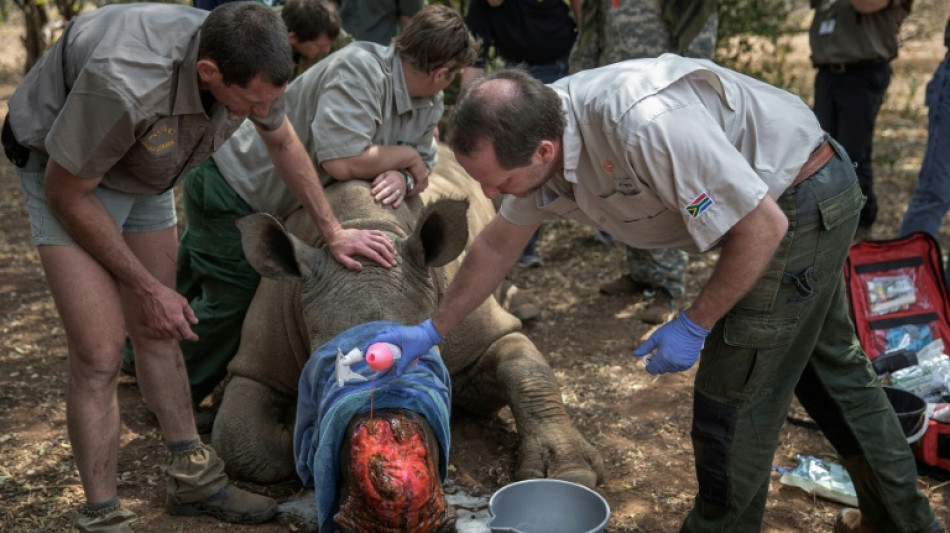
Dehorning of S.African rhinos slashed poaching: study / Photo: GIANLUIGI GUERCIA - AFP/File

 US warns of rapid escalation in Mideast war

 Iran 'put hearts on the court' to win Asian Games basketball bronze

 School girl Yu helps China dominate in Asian Games swimming openers

 Myanmar win first Asian Games teqball gold as Spain great Puyol watches

 China's 13-year-old Yu scorches to first major gold at Asian Games

 Russians vote on last day of parliamentary elections

 Hong Kong pays final respects to former city leader Tung

 Typhoon put people off Asian Games opening ceremony, official says

 China's 13-year-old Yu cruises as Asian Games swimming begins

 AI 'warning shots' focus Beijing on national security risks

 Philippine tribe in limbo over US-led tech hub

 Leo XIV, first US pope transcends his restrained style

 Singer Ed Sheeran says Gaza situation 'unjustifiable' following controversy

 In 'Tenzing', a Sherpa mountaineer gets his due

 Ed Sheeran set to return to stage after Palestinian controversy

 Toulouse edge Vannes, Lyon beat Pau to take Top 14 summit

 Germans arrested for Louvre stunt in Mona Lisa hall

 Saudi-led coalition says Houthis fired ballistic missile at Riyadh

 France's debt climbs to highest since 1978: ministry

 McIlroy two shots off the lead at Wentworth after eagle on 18

 Martinez brace saves Inter in Serie A top-two clash with Roma

 Rosenior abused but guides Paris FC past old club Strasbourg

 Seven-try Lyon beat Pau, climb to Top 14 summit

 Brighton defeat a 'big lesson' against complacency for Arsenal, says Arteta

 Thousands protest inaction over climate crisis in Switzerland

The dehorning of rhinos resulted in a nearly 80-percent reduction in the poaching of the animals during a seven-year study in a major South African conservation area, researchers said Thursday.
Sawing off the sought-after horns was also a fraction of the cost of other counter-poaching measures such as deploying rangers or tracking dogs, according to the study published in the journal Science.
The study was carried out between 2017 and 2023 in 11 reserves around South Africa's famed Kruger National Park that protect the world's largest rhino population.
During this period, some 1,985 rhinos were poached in the reserves in the Greater Kruger area despite $74 million spent mostly on reactive law enforcement measures that netted around 700 poachers, it said.
By contrast, dehorning 2,284 rhinos cut poaching by 78 percent at just 1.2 percent of that budget, said the study published by the American Association for the Advancement of Science.
"Some poaching of dehorned rhinos continued because poachers targeted horn stumps and regrowth, signalling the need for regular dehorning alongside judicious use of law enforcement," the study said.
South Africa is home to most of the world's rhinos, including the critically endangered black rhino, and is a hotspot for poaching driven by demand in Asia where the horns are used in traditional medicine.
Rhino horn is highly sought after on the black market, where the price by weight rivals that of gold and cocaine.
Alongside ivory, the horns are coveted as status symbols or used in traditional medicine for their supposed aphrodisiac properties.
"Ongoing socioeconomic inequality incentivises a large pool of vulnerable and motivated people to join, or poach for, criminal syndicates even when the risks are high," the researchers said.
Corruption also played a role with gangs receiving insider tips to evade detection and arrest, they said.
- Impacts unclear -
"Although detecting and arresting poachers is essential, strategies that focus on reducing opportunities for and rewards from poaching may be more effective," the study said.
It added, however, that "the effects of dehorning on rhino biology are still unclear, with present research suggesting that dehorning may alter rhino space use but not survival and reproduction."
The co-authors of the study are from South Africa's Nelson Mandela University and the University of Cape Town, and various conservation groups including the Wildlife Conservation Network and United Kingdom's Save the Rhino International.
South Africa had more than 16,000 rhinos at the end of 2023, mostly white rhinos, according to government data.
But at least 34 rhinos were killed each month, the environment minister said in May.
In 2024 South African scientists injected radioactive material into live rhino horns to make them easier to detect at border posts in a pioneering project aimed at curbing poaching.
The radioactive material would not impact the animal's health or the environment in any way but make it poisonous for human consumption, according to the University of the Witwatersrand's radiation and health physics unit which spearheaded the initiative.
Black rhinos are listed by the International Union for Conservation of Nature (IUCN) as critically endangered.
A.Seabra--PC