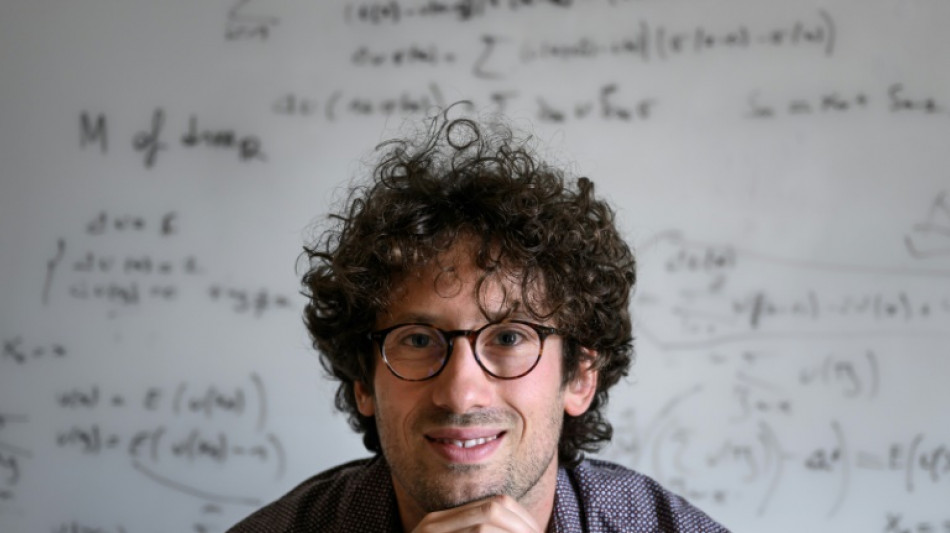
Duminil-Copin, Fields-winning mathematician with 'aesthetic vision' / Photo: Fabrice COFFRINI - AFP

 Drones hit Moscow as Russians go to the polls

 New England boss Fleming says 'wrong' to ask Stokes to end retirement

 Germans vote in elections threatening fresh blow to Merz

 US fears rapid escalation in Mideast after Houthis attack Riyadh

 Japan triathlete Hojo wins first gold of Asian Games

 IOC president impressed by 'beautiful' Asian Games wooden huts

 First Asian Games gold goes to Japan as China's 13-year-old Yu lights up pool

 Data centre command hub keeps AI up and running

 Pope Leo in France: the issues on the table

 Packing for a pope: behind the scenes on foreign trips

 Republicans find transgender issues a powerful political weapon in midterm campaigning

 German state elections threaten new shock waves for Merz

 Chile's Bachelet quits race to be next UN chief

 Raphinha treble fires perfect Barca to win at Sevilla

 Thiam makes winning heptathlon return at Decastar meet

 Czechs beat USA to qualify for Davis Cup finals

 Dortmund sink Stuttgart to climb to Bundesliga summit

 Trump says will not tolerate attempts to slow AI growth

 'It has to stop': runners protest women's murders in S.Africa district

 Fire erupts near Riyadh airport as Houthis claim strikes

 Cuba works to restore power after another blackout

 England thrash Sri Lanka again to return to top of T20 rankings

 Arsenal thrashed by Brighton, sorry Spurs lose again
 South Korea, Austria qualify for Davis Cup finals

 Seare shocks Ingebrigtsen to win world 5km gold
Hugo Duminil-Copin, a French mathematician whose visual approach helped him win the world's most prestigious mathematics prize the Fields Medal on Tuesday, said he "doesn't really fit into the cliches of a genius".
The 36-year-old, who has a messy head of hair and bright eyes beaming from behind glasses, told AFP that he is a "very, very normal person" who loves sport, his family and quiet moments of reflection.
But for Duminil-Copin, who specialises in probability theory, those quiet moments can lead to discoveries that won him the Fields Medal, the equivalent of the Nobel Prize for mathematics.
He accepted the prize, which is awarded every four years to mathematicians under 40, at a ceremony in Finland's capital Helsinki.
The other winners were Britain's James Maynard of Oxford University, June Huh of Princeton in the United States and Ukraine's Maryna Viazovska, who is only the second ever woman laureate.
Duminil-Copin described with unabashed enthusiasm the happiness he finds in working with others in the search for answers -- whether or not they find one.
"It's the best, especially since it's a collective process, where all the beauty is in interacting with others," he said in an interview a few days before the prize was announced.
- A visual mind -
Born on August 26, 1985, Duminil-Copin has collected a raft of mathematics awards over the last decade.
At the age of 31, he was appointed professor at France's Institute of Advanced Scientific Studies in 2016.
"It's a place that seems made for me, for my creative part," he said of the green campus outside Paris.
It gives the mathematician that most precious resource for deep thinkers: time.
"This slowness in everyday life is very fruitful because I need time for ideas to come, for them to settle quietly, for them to take shape," he said.
At the campus, which is not far from where he grew up, Duminil-Copin uses his "very visual intuition" to take on the most complicated mathematical problems.
"There are very few formulas and many drawings" in his mind when he thinks about such problems, he said.
That "aesthetic vision" allows him to view mathematics with a "certain elegance", he added.
The Paris institute allows researchers to free themselves of all other obligations, including teaching.
But Duminil-Copin teaches anyway, retaining a professorship at the University of Geneva, saying that "in the end it is perhaps the most important aspect of this profession".
He may have inherited this passion from his father, a sports teacher, and mother, a dancer who became a teacher later in life.
When he was younger, Duminil-Copin envisioned becoming a teacher himself -- of maths, of course -- but his talent propelled him towards research.
Collaboration is at the heart of his outlook. If he provides mathematical tools to physicists, their work in turn may allow someone else in the future to find new applications for them.
"It's the whole community that really produces scientific progress," he said.
- Mental balance -
Duminil-Copin hailed the importance of two university professors to his career, Jean-Francois Le Gall, who also worked on probability theory, and fellow Fields Medal winner Wendelin Werner.
He said he fell in "love at first sight" with percolation theory during a class Werner taught on the subject, which falls under the branch of statistical physics.
It was in that class that Duminil-Copin first encountered Nienhuis's conjecture -- a "beautiful, elegant and completely mysterious" problem, he said.
"I solved it a few years later, almost without doing it on purpose."
As a child, Duminil-Copin preferred astronomy to mathematics.
He said he was "not pushed at all" by his parents to focus solely on his studies -- instead they were keen to "confront him with a variety of things" such as sport, music and friends.
The lesson seems to have stuck.
"When we talk about preparing to become a researcher we think of intelligence, academic training, but there is also a mental balance which is very important," he said.
New ideas can strike him "anytime, in the middle of the night or in the shower", he said.
But they will have to wait until he's back at work.
"My priority is on the personal side, to spend time with my daughter and my wife."
V.Dantas--PC