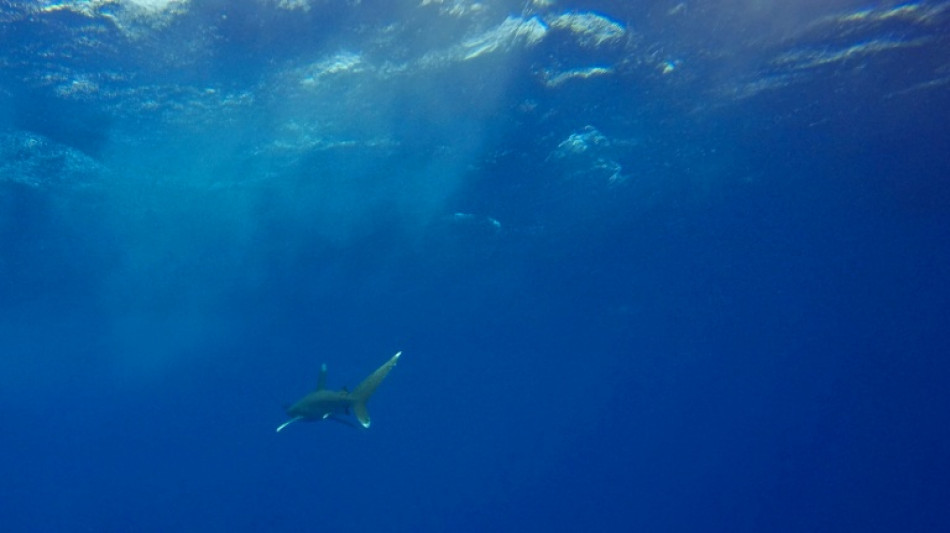
New protections for oceanic whitetip sharks, but not eels / Photo: Andrea BERNARDI - AFP/File

 Drones hit Moscow as Russians go to the polls

 New England boss Fleming says 'wrong' to ask Stokes to end retirement

 Germans vote in elections threatening fresh blow to Merz

 US fears rapid escalation in Mideast after Houthis attack Riyadh

 Japan triathlete Hojo wins first gold of Asian Games

 IOC president impressed by 'beautiful' Asian Games wooden huts

 First Asian Games gold goes to Japan as China's 13-year-old Yu lights up pool

 Data centre command hub keeps AI up and running

 Pope Leo in France: the issues on the table

 Packing for a pope: behind the scenes on foreign trips

 Republicans find transgender issues a powerful political weapon in midterm campaigning

 German state elections threaten new shock waves for Merz

 Chile's Bachelet quits race to be next UN chief

 Raphinha treble fires perfect Barca to win at Sevilla

 Thiam makes winning heptathlon return at Decastar meet

 Czechs beat USA to qualify for Davis Cup finals

 Dortmund sink Stuttgart to climb to Bundesliga summit

 Trump says will not tolerate attempts to slow AI growth

 'It has to stop': runners protest women's murders in S.Africa district

 Fire erupts near Riyadh airport as Houthis claim strikes

 Cuba works to restore power after another blackout

 England thrash Sri Lanka again to return to top of T20 rankings

 Arsenal thrashed by Brighton, sorry Spurs lose again

 South Korea, Austria qualify for Davis Cup finals

 Seare shocks Ingebrigtsen to win world 5km gold

The world's top wildlife trade body voted Thursday to effectively ban all international trade in the critically endangered oceanic whitetip shark but rejected a proposal to protect more species of eel.
The decision to upgrade protection of the shark species was welcomed by conservation groups that have warned oceanic whitetips are on the brink of extinction.
"This was our last hope," said Barbara Slee, senior programme manager at the International Fund for Animal Welfare.
"This listing might just spare them from extinction."
The species has suffered dramatic declines linked to the shark fin trade, and is one of dozens of shark species proposed for greater protections at the meeting of signatories to the Convention of International Trade in Endangered Species of Wild Fauna and Flora (CITES).
The 50-year agreement protects the world's most endangered animals and plants, and regulates trade in over 40,000 species.
Earlier, members meeting in Uzbekistan's Samarkand rejected new protections for eels that had been fiercely opposed by top consumers of the fish, led by Japan.
Eel populations are falling worldwide, scientists say, largely due to factors linked to human activity such as the pollution of waterways, destruction of wetlands, hydroelectric dams, and fishing.
European eels are considered critically endangered and their trade has been restricted by CITES since 2009.
Eels cannot be bred in captivity, so much of the trade is in wild-caught baby eels, with one species virtually indistinguishable from another.
The European Union and Panama sought to bring all 17 eel species under CITES Appendix II, placing new restrictions on trade.
The "harvest for international trade is a major cause of international decline," the EU's representative warned.
But Japan dismissed the proposal as unscientific and "excessive," backed by multiple countries including African nations who warned it would place undue administrative burdens on their authorities.
In a sign of the pressures around the issue, countries voted by secret ballot, a relatively uncommon procedure at the gathering, with nearly 75 percent of votes against.
The result was "not very surprising," said Oliver Tallowin, senior programme officer for wildlife use and trade at the International Union for the Conservation of Nature.
Japan's opposition had been made clear early on in a submission running over 100 pages.
There are also differing views on the pressures other eel species face, said Tallowin.
"International trade has to be a threat to the species and... that was something we couldn't say with any sense of certainty," he told AFP.
For Andrew Kerr of the Sustainable Eel Group, "the short-term commercial and financial side won the debate massively."
Kerr, who has called eel trafficking the "greatest wildlife crime" on the planet, said the vote was a "real pity," but there were some silver linings.
A separate resolution proposing measures including more data gathering on eels and conservation capacity-building was approved later in the day.
"We've had a missed opportunity this morning, but then the fact that everyone's talking about eel, that's a huge victory too," Kerr said.
The resolution means more data will be collectd that could support protection of all eel species in the future, added Tallowin.
"Once something has been rejected... that doesn't mean its going to go away."
Votes are finalised later in the meeting, though it is unusual for them to be revised.
X.Brito--PC