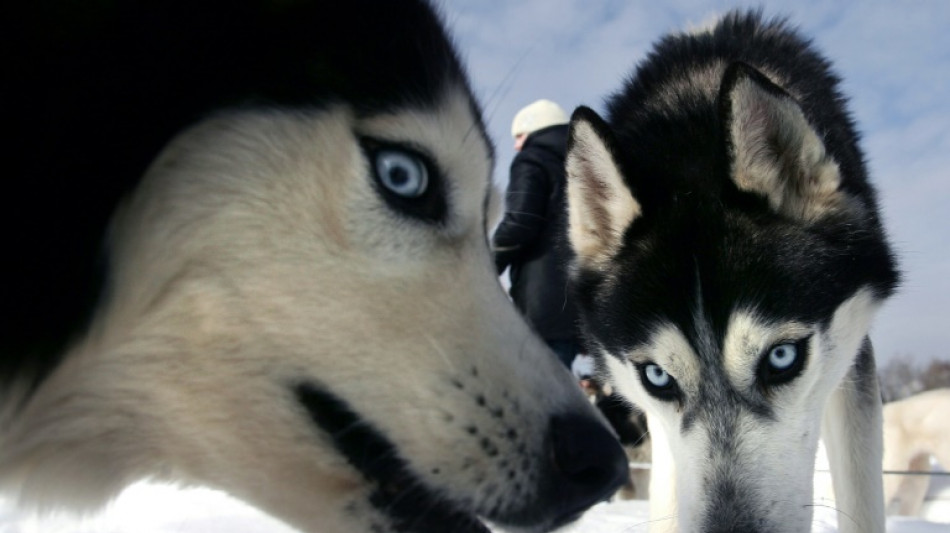
Ancient Siberian dogs relied on humans for seafood diets / Photo: DMITRY KOSTYUKOV - AFP/File

 Drones hit Moscow as Russians go to the polls

 New England boss Fleming says 'wrong' to ask Stokes to end retirement

 Germans vote in elections threatening fresh blow to Merz

 US fears rapid escalation in Mideast after Houthis attack Riyadh

 Japan triathlete Hojo wins first gold of Asian Games

 IOC president impressed by 'beautiful' Asian Games wooden huts

 First Asian Games gold goes to Japan as China's 13-year-old Yu lights up pool

 Data centre command hub keeps AI up and running

 Pope Leo in France: the issues on the table

 Packing for a pope: behind the scenes on foreign trips

 Republicans find transgender issues a powerful political weapon in midterm campaigning

 German state elections threaten new shock waves for Merz

 Chile's Bachelet quits race to be next UN chief

 Raphinha treble fires perfect Barca to win at Sevilla

 Thiam makes winning heptathlon return at Decastar meet

 Czechs beat USA to qualify for Davis Cup finals

 Dortmund sink Stuttgart to climb to Bundesliga summit

 Trump says will not tolerate attempts to slow AI growth

 'It has to stop': runners protest women's murders in S.Africa district

 Fire erupts near Riyadh airport as Houthis claim strikes

 Cuba works to restore power after another blackout

 England thrash Sri Lanka again to return to top of T20 rankings

 Arsenal thrashed by Brighton, sorry Spurs lose again

 South Korea, Austria qualify for Davis Cup finals

 Seare shocks Ingebrigtsen to win world 5km gold

As early as 7,400 years ago, Siberian dogs had evolved to be far smaller than wolves, making them more dependent on humans for food including sea mammals and fish trapped below the ice, a new study showed Friday.
Robert Losey of the University of Alberta, who led the research published in Science Advances, said the findings helped explain the growth in the early dog population, as people put them to work for hunting, herding and sledding.
"The long term changes in dog diet have really been oversimplified," he told AFP, explaining that prior work had focused only on two main ideas to explain how dogs transitioned from wolves, a process that began some 40,000 years ago.
The first of these was that friendlier wolves approached human camps during the Ice Age to scavenge for meat, eventually became isolated from their wild counterparts, and were then intentionally bred into dogs.
The second was that some dogs evolved a better capacity to digest starches following the agricultural revolution, which is why some modern dog breeds have more copies of the AMY2B gene that creates pancreatic amylase.
To study ancient dog diets in more depth, Losey and colleagues analyzed the remains of around 200 ancient dogs from the past 11,000 years, and a similar number of ancient wolves.
"We had to go to collections all over Siberia, we analyzed those bones, took samples of the collagen, and analyzed the protein in labs," he said.
Based on the remains, the team made statistical estimates for body sizes.
They also used a technique called stable isotope analysis to generate dietary estimates.
They discovered that dogs of 7,000-8,000 years ago "were already quite small, meaning that they just couldn't do the things that most wolves were doing," said Losey.
This in turn led to greater dependence on humans for food, and reliance on small prey and scavenging, rather than prey bigger than themselves, which wolves hunt.
"We see that dogs have marine diets, meaning they're eating fish, shellfish, seals and sea lions, which they can't easily get themselves," he said.
Ancient dogs were found to be eating fish "in areas of Siberia where the lakes and rivers are frozen over for seven to eight months of the year."
Wolves of the time, and today, were hunting in packs and mainly eating various species of deer.
- Benefits and challenges -
These new diets brought dogs both benefits and challenges.
"Beneficial because they could access stuff from humans, and those are oftentimes easy meals, but it came with the costs of all these new diseases and problems, like not enough nutrition," said Losey.
While the new bacteria and parasites they were exposed to could have helped some adapt, some dog populations might not have survived.
Most of the first dogs of the Americas died out, for unclear reasons, and were replaced by European dogs -- though it's not thought colonization was to blame.
Those dogs that did survive acquired more diverse gut microbiomes, helping them further in digesting more carbohydrates associated with life with humans.
A.P.Maia--PC