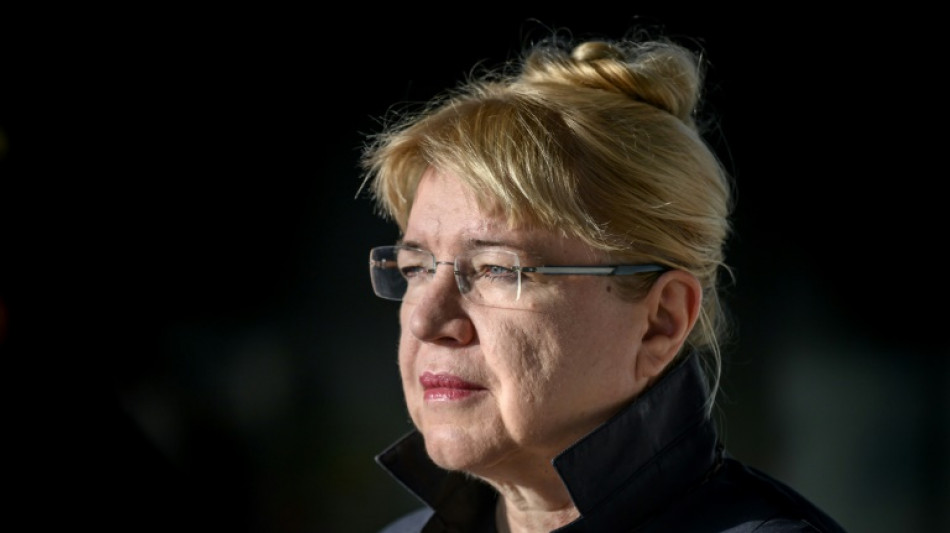
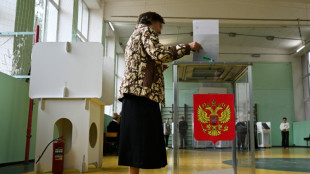
'Small courageous steps': Memorial opposing oppression in Russia / Photo: Fabrice COFFRINI - AFP

 US warns of rapid escalation in Mideast war
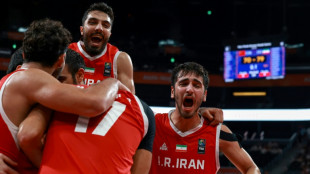 Iran 'put hearts on the court' to win Asian Games basketball bronze
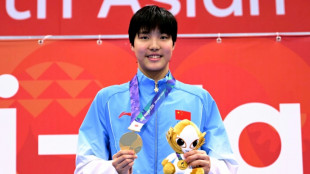
 School girl Yu helps China dominate in Asian Games swimming openers
 Myanmar win first Asian Games teqball gold as Spain great Puyol watches
 China's 13-year-old Yu scorches to first major gold at Asian Games

 Russians vote on last day of parliamentary elections

 Hong Kong pays final respects to former city leader Tung

 Typhoon put people off Asian Games opening ceremony, official says

 China's 13-year-old Yu cruises as Asian Games swimming begins

 AI 'warning shots' focus Beijing on national security risks

 Philippine tribe in limbo over US-led tech hub

 Leo XIV, first US pope transcends his restrained style

 Singer Ed Sheeran says Gaza situation 'unjustifiable' following controversy

 In 'Tenzing', a Sherpa mountaineer gets his due

 Ed Sheeran set to return to stage after Palestinian controversy

 Toulouse edge Vannes, Lyon beat Pau to take Top 14 summit

 Germans arrested for Louvre stunt in Mona Lisa hall

 Saudi-led coalition says Houthis fired ballistic missile at Riyadh

 France's debt climbs to highest since 1978: ministry

 McIlroy two shots off the lead at Wentworth after eagle on 18

 Martinez brace saves Inter in Serie A top-two clash with Roma

 Rosenior abused but guides Paris FC past old club Strasbourg

 Seven-try Lyon beat Pau, climb to Top 14 summit

 Brighton defeat a 'big lesson' against complacency for Arsenal, says Arteta

 Thousands protest inaction over climate crisis in Switzerland

Moscow's crackdown on Memorial has only intensified since the rights group won the Nobel Peace Prize last month, but its executive director says members are pushing on despite the dangers.
"Of course it is very difficult," Elena Zhemkova told AFP in an interview, stressing though that there had never been any question about whether or not to carry on working.
"We continue our work."
Memorial, which shared this year's Nobel Peace Prize with Ukraine's Center for Civil Liberties and detained Belarusian activist Ales Bialiatski, is the largest rights organisation in Russia.
Zhemkova said the announcement on October 7 honouring the embattled organisation she co-founded in 1989 with Andrei Sakharov -- himself the 1975 Peace Prize laureate -- had come as a complete surprise.
The 61-year-old described riding in a taxi on her way to open an exhibition when a colleague called and said something had happened and told her to "look at the news".
- Feared 'atomic bomb' -
"I couldn't imagine that we were talking about such a grand award," she said, adding that she feared "something very bad (had) happened".
"I was honestly thinking it was an atomic bomb."
When she realised that instead Memorial had won the world's most prestigious peace prize, she said she was "very glad", especially to share it with rights watchdogs from the two other nations at the centre of Moscow's war in Ukraine.
This "emphasises that people from civil society of different countries can and should fight together against evil", she said.
Russian authorities meanwhile appeared less than thrilled with Memorial's win.
The organisation, which has for decades worked to keep alive the memory of people who died in Soviet dictator Joseph Stalin's gulags, while also compiling information on ongoing political oppression in Russia, has faced a growing crackdown in recent years.
Last December, the Russian Supreme Court ordered Memorial dissolved, and just hours after the Nobel Committee's announcement on October 7, a Moscow court ordered the seizure of its headquarters.
"We received the news about the Nobel award, and then unfortunately, that day our house was taken from us," said Zhemkova.
"So this is the response of the Russian government."
- 'No heroes' -
But despite the challenges, she insisted that "we need to and we can continue our work."
Last week, Memorial was blocked from holding its annual tribute to Stalin's victims, known as the "Returning the Names" ceremony, in Moscow.
But Zhemkova pointed out that the marathon reading of the names of those killed under Stalin's regime had still taken place across 22 countries and 77 cities.
"They cannot stop our work," she said.
Inside Russia as well, she said Memorial was continuing to open exhibitions, organise excursions and "defend people's rights in court".
The Nobel win, she said, was helpful "because it is a very important sign of support".
Zhemkova, who was in Geneva to give the annual Kofi Annan Peace Address, acknowledged that she and other members of Memorial fear for their safety in Russia.
"There is a mass persecution of people and institutions which are opposing the official point of view," she said.
"Of course we are afraid... We are ordinary people."
"We are no heroes," she insisted, "but we are trying to take small courageous steps."
- 'Unlawful' -
In addition to the security risks they face, Zhemkova said she and many of her colleagues are being targeted by "unlawful and complicated criminal cases".
The Memorial chief is currently staying away from Russia, but lamented that she should not have to.
"I respect all the rules. I didn't break any laws, I am doing lawful work," she said.
But, she added, "I am against the war, and at the moment, (that) is enough to have a criminal investigation opened against you."
Asked what she thought about Russian President Vladimir Putin's actions, Zhemkova insisted: "I don't think about Putin. I am not interested in him at all."
"I am thinking about how many generations of Russians will need to pay for what he did."
L.Torres--PC