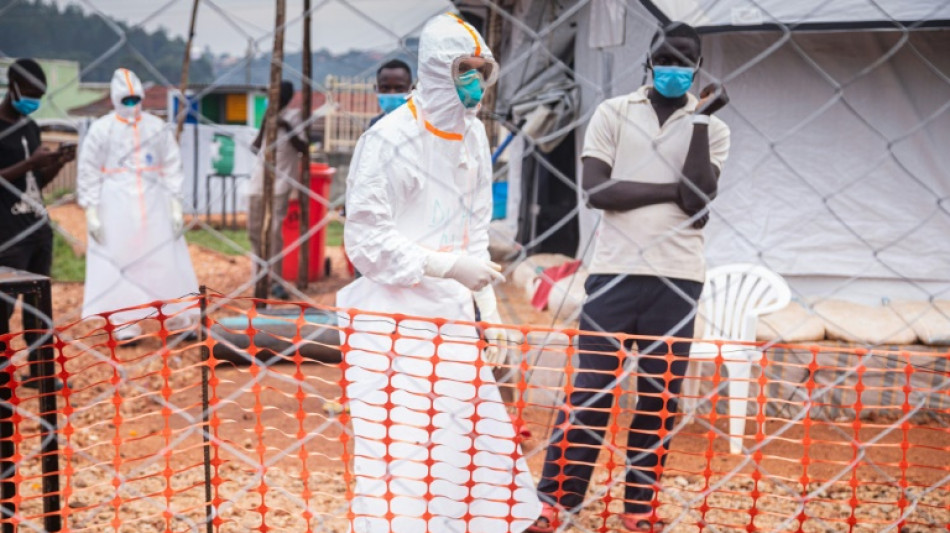
'Death every day': Fear and fortitude in Uganda's Ebola epicentre / Photo: BADRU KATUMBA - AFP

 US warns of rapid escalation in Mideast war

 Iran 'put hearts on the court' to win Asian Games basketball bronze

 School girl Yu helps China dominate in Asian Games swimming openers

 Myanmar win first Asian Games teqball gold as Spain great Puyol watches

 China's 13-year-old Yu scorches to first major gold at Asian Games

 Russians vote on last day of parliamentary elections

 Hong Kong pays final respects to former city leader Tung

 Typhoon put people off Asian Games opening ceremony, official says

 China's 13-year-old Yu cruises as Asian Games swimming begins

 AI 'warning shots' focus Beijing on national security risks

 Philippine tribe in limbo over US-led tech hub

 Leo XIV, first US pope transcends his restrained style

 Singer Ed Sheeran says Gaza situation 'unjustifiable' following controversy

 In 'Tenzing', a Sherpa mountaineer gets his due

 Ed Sheeran set to return to stage after Palestinian controversy

 Toulouse edge Vannes, Lyon beat Pau to take Top 14 summit

 Germans arrested for Louvre stunt in Mona Lisa hall

 Saudi-led coalition says Houthis fired ballistic missile at Riyadh

 France's debt climbs to highest since 1978: ministry

 McIlroy two shots off the lead at Wentworth after eagle on 18

 Martinez brace saves Inter in Serie A top-two clash with Roma

 Rosenior abused but guides Paris FC past old club Strasbourg

 Seven-try Lyon beat Pau, climb to Top 14 summit

 Brighton defeat a 'big lesson' against complacency for Arsenal, says Arteta

 Thousands protest inaction over climate crisis in Switzerland

As Ugandan farmer Bonaventura Senyonga prepares to bury his grandson, age-old traditions are forgotten and fear hangs in the air while a government medical team prepares the body for the funeral -- the latest victim of Ebola in the East African nation.
Bidding the dead goodbye is rarely a quiet affair in Uganda, where the bereaved seek solace in the embrace of community members who converge on their homes to mourn the loss together.
Not this time.
Instead, 80-year-old Senyonga is accompanied by just a handful of relatives as he digs a grave on the family's ancestral land, surrounded by banana trees.
"At first we thought it was a joke or witchcraft but when we started seeing bodies, we realised this is real and that Ebola can kill," Senyonga told AFP.
His 30-year-old grandson Ibrahim Kyeyune was a father of two girls and worked as a motorcycle mechanic in central Kassanda district, which together with neighbouring Mubende is at the epicentre of Uganda's Ebola crisis.
Both districts have been under a lockdown since mid-October, with a dawn to dusk curfew, a ban on personal travel and public places shuttered.
The reappearance of the virus after three years has sparked fear in Uganda, with cases now reported in the capital Kampala as the highly contagious disease makes its way through the country of 47 million people.
In all, 53 people have died, including children, out of more than 135 cases, according to latest Ugandan health ministry figures.
In Kassanda's impoverished Kasazi B village, everyone is afraid, says Yoronemu Nakumanyanga, Kyeyune's uncle.
"Ebola has shocked us beyond what we imagined. We see and feel death every day," he told AFP at his nephew's gravesite.
"I know when the body finally arrives, people in the neighbourhood will start running away, thinking Ebola virus spreads through the air," he said.
Ebola is not airborne -- it spreads through bodily fluids, with common symptoms being fever, vomiting, bleeding and diarrhoea.
But misinformation remains rife and poses a major challenge.
In some cases, victims' relatives have exhumed their bodies after medically supervised burials to perform traditional rituals, triggering a spike in infections.
In other instances, patients have sought out witchdoctors for help instead of going to a health facility -- a worrying trend that prompted President Yoweri Museveni last month to order traditional healers to stop treating sick people.
"We have embraced the fight against Ebola and complied with President Museveni's directive to close our shrines for the time being," said Wilson Akulirewo Kyeya, a leader of the traditional herbalists in Kassanda.
- 'I saw them die' -
The authorities are trying to expand rural health facilities, installing isolation and treatment tents inside villages so communities can access medical attention quickly.
But fear of Ebola runs deep.
Brian Bright Ndawula, a 42-year-old trader from Mubende, was the sole survivor among four family members who were diagnosed with the disease, losing his wife, his aunt and his four-year-old son.
"When we were advised to go to hospital to have an Ebola test we feared going into isolation... and being detained," he told AFP.
But when their condition worsened and the doctor treating them at the private clinic also began showing symptoms, he realised they had contracted the dreaded virus.
"I saw them die and knew I was next but God intervened and saved my life," he said, consumed by regret over his decision to delay getting tested.
"My wife, child and aunt would be alive, had we approached the Ebola team early enough."
- 'Greatest hour of need' -
Today, survivors like Ndawula have emerged as a powerful weapon in Uganda's fight against Ebola, sharing their experiences as a cautionary tale but also as a reminder that patients can survive if they receive early treatment.
Health Minister Jane Ruth Aceng urged recovered patients in Mubende to spread the message that "whoever shows signs of Ebola should not run away from medical workers but instead run towards them, because if you run away with Ebola, it will kill you."
It is an undertaking many in this community have taken to heart.
Doctor Hadson Kunsa, who contracted the disease while treating Ebola patients, told AFP he was terrified when he received his diagnosis.
"I pleaded to God to give me a second chance and told God I will leave Mubende after recovery," he said.
But he explained he could not bring himself to do it.
"I will not leave Mubende and betray these people at the greatest hour of need."
E.Borba--PC