-
 US warns of rapid escalation in Mideast war
-
PSG president Nasser al-Khelaifi under investigation in France for conflict of interest

-
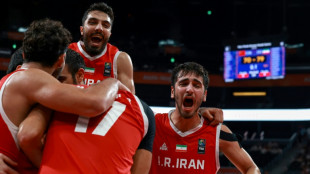 Iran 'put hearts on the court' to win Asian Games basketball bronze
-
China swim sensation, 13, sets Games record after Japan win early

-
 School girl Yu helps China dominate in Asian Games swimming openers
-
Drones hit Moscow as Russians go to the polls

-
 Myanmar win first Asian Games teqball gold as Spain great Puyol watches
-
New England boss Fleming says 'wrong' to ask Stokes to end retirement

-
 China's 13-year-old Yu scorches to first major gold at Asian Games
-
Germans vote in elections threatening fresh blow to Merz

-
 Russians vote on last day of parliamentary elections
-
US fears rapid escalation in Mideast after Houthis attack Riyadh

-
 Hong Kong pays final respects to former city leader Tung
-
Japan triathlete Hojo wins first gold of Asian Games

-
 Typhoon put people off Asian Games opening ceremony, official says
-
IOC president impressed by 'beautiful' Asian Games wooden huts

-
 China's 13-year-old Yu cruises as Asian Games swimming begins
-
First Asian Games gold goes to Japan as China's 13-year-old Yu lights up pool

-
 AI 'warning shots' focus Beijing on national security risks
-
Data centre command hub keeps AI up and running

-
 Philippine tribe in limbo over US-led tech hub
-
Pope Leo in France: the issues on the table

-
 Leo XIV, first US pope transcends his restrained style
-
Packing for a pope: behind the scenes on foreign trips

-
 Singer Ed Sheeran says Gaza situation 'unjustifiable' following controversy
-
Republicans find transgender issues a powerful political weapon in midterm campaigning

-
 In 'Tenzing', a Sherpa mountaineer gets his due
-
German state elections threaten new shock waves for Merz

-
 Ed Sheeran set to return to stage after Palestinian controversy
-
Chile's Bachelet quits race to be next UN chief

-
 Toulouse edge Vannes, Lyon beat Pau to take Top 14 summit
-
Raphinha treble fires perfect Barca to win at Sevilla

-
 Germans arrested for Louvre stunt in Mona Lisa hall
-
Thiam makes winning heptathlon return at Decastar meet

-
 Saudi-led coalition says Houthis fired ballistic missile at Riyadh
-
Czechs beat USA to qualify for Davis Cup finals

-
 France's debt climbs to highest since 1978: ministry
-
Dortmund sink Stuttgart to climb to Bundesliga summit

-
 McIlroy two shots off the lead at Wentworth after eagle on 18
-
Trump says will not tolerate attempts to slow AI growth

-
 Martinez brace saves Inter in Serie A top-two clash with Roma
-
'It has to stop': runners protest women's murders in S.Africa district

-
 Rosenior abused but guides Paris FC past old club Strasbourg
-
Fire erupts near Riyadh airport as Houthis claim strikes

-
 Seven-try Lyon beat Pau, climb to Top 14 summit
-
Cuba works to restore power after another blackout

-
 Brighton defeat a 'big lesson' against complacency for Arsenal, says Arteta
-
England thrash Sri Lanka again to return to top of T20 rankings

-
 Thousands protest inaction over climate crisis in Switzerland
-
Arsenal thrashed by Brighton, sorry Spurs lose again

Iran: Allies abandoned
Iran stands largely alone in the midst of an escalating conflict with Israel. Despite long-standing alliances and strategic partnerships, the country's allies remain conspicuously passive. The reasons for this are complex and range from Israel's military superiority to the geopolitical calculations of regional actors.
Israel's military superiority
A key factor is Israel's military dominance in the region. The Israeli Air Force has quickly gained control of Iranian airspace, significantly limiting Iran's ability to defend itself. This has put Iran's allies in a difficult position, as military intervention carries high risks. The Hezbollah militia in Lebanon, traditionally a close ally of Iran, has decided not to actively intervene in the conflict. This is partly because Hezbollah itself has been weakened by Israeli attacks and intervention could mean further losses.
Geopolitical calculations
Another reason for the allies' restraint is the geopolitical situation. Russia, which entered into a strategic partnership with Iran in January 2025, has a keen interest in the stability of the Iranian regime. Nevertheless, it is unlikely that Russia will actively enter the war. This is because Russia needs its own military resources for the conflict in Ukraine and wants to avoid a direct confrontation with Israel. The situation is similar with China, which supports Iran but also has no interest in an escalation that could jeopardise its economic interests in the region.
Limited support from the Houthis
The Houthi militia in Yemen is one of the few actors actively supporting Iran by carrying out coordinated attacks on Israel. However, this support is limited and cannot offset Israel's military superiority. The Houthi militia is also preoccupied with its own internal conflicts and the humanitarian crisis in Yemen, which limits its capabilities.
Domestic political pressure
Another aspect is the domestic political situation in Iran. The regime under Ayatollah Ali Khamenei is under considerable pressure, both from military attacks and growing discontent among the population. In the past, the Iranian leadership has repeatedly relied on the support of its allies to strengthen its position. The current passivity of its allies could therefore also be interpreted as a sign that they increasingly view the regime as a burden.
International restraint
The international community, in particular the United States and the European Union, has so far limited itself to diplomatic efforts to de-escalate the situation. Although US President Donald Trump has not ruled out the possibility of military intervention, he has emphasised that escalation is not in the interests of the US. EU Foreign Affairs Representative Kaja Kallas warned against an escalation of the conflict and emphasised that US involvement would further destabilise the region.
Conclusion
Overall, it is clear that Iran is largely isolated in this conflict. The country's allies are either unable or unwilling to intervene actively. This is due to a combination of Israel's military superiority, geopolitical calculations and the domestic political situation in Iran. The future of the conflict remains uncertain, but the current situation suggests that Iran will be on its own for the foreseeable future.

U.S. Jobs stall, gdp slows
EU misstep on mercosur Deal
Hormuz Shock Risk rising
Poland trusts only hard Power

After Kirk: Speech at Risk

Tel Aviv’s Wartime rally

Tokyo’s Housing playbook

Venezuela braces after Strike
After Europe’s capitulation

Can the FANB shield Maduro?
Israel: Economy on the edge