13 die as Storm Eunice leaves thousands in Europe without power

 Kennedy Center: future unclear for iconic Washington arts hub

 Trump claims 'infinite' Greenland security deal with Denmark

 Helicopters battle wildfire threatening Ecuador's capital

 Brentford batter Chelsea to undo Alonso's promising start

 Kane hits Bundesliga century as Bayern rout Union

 Trump says CNN, MS NOW, Politico banned from White House

 Hushing and hedging: US companies retreat on climate

 Springboks to face Fiji before 2027 Rugby World Cup

 Nigeria miners struggled to breathe in cell before 37 died: survivors

 McIlroy on the charge at PGA Championship as Reed withdraws

 McIlroy on the charge at PGA Championship

 Crisis-wracked Volkswagen warns of 10-bn-euro hit to profits

 Costa Rica's Grynspan tops third informal poll for UN chief: diplomat

 Stock markets retreat after central bank rate hikes

 Russia labels director of Cannes Grand Prix winner a 'foreign agent'

 Macron warns of Russian 'hybrid' threat after meeting presidential hopefuls

 UN holds third informal poll for new chief

 Kulusevski return can spark Spurs: De Zerbi

 Shakira to cap off world tour with Madrid 12-gig run

 Isolated Syrian-Druze city blames Damascus for shortages

 Isolated Syrian-Druze city shortages

 Dutch drop Depay for Germany match in Xavi's first pick

 Ronaldo named in Portugal squad for Nations League

 Stock markets diverge after central bank rate hikes

 Anti-Assad music star makes triumphant return to Syria

Emergency crews Saturday battled to restore power to hundreds of thousands of homes in Britain after Storm Eunice carved a deadly trail across Western Europe and left transport networks in disarray.
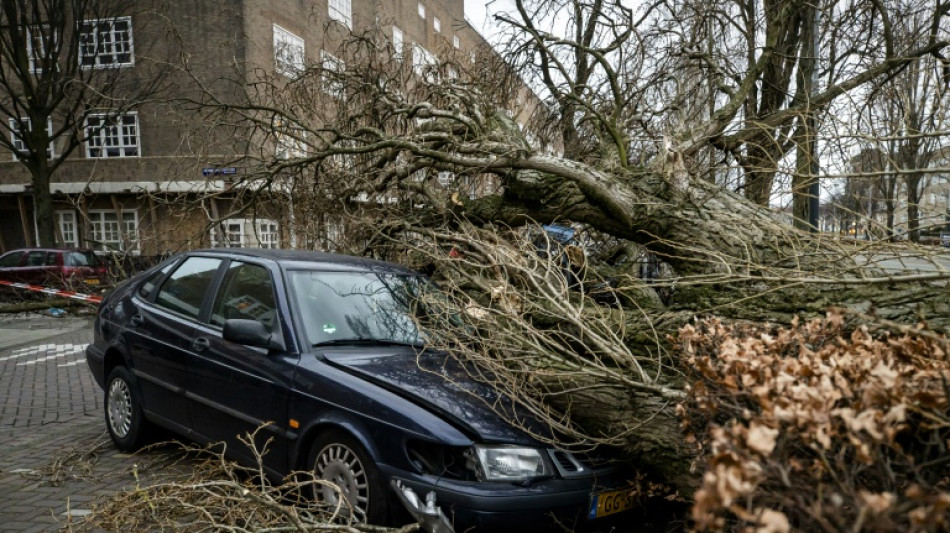
At least 13 people were killed by falling trees, flying debris and high winds in Britain, Ireland, the Netherlands, Belgium, Germany and Poland, emergency services said.
Train operators in Britain urged people not to travel, with trees still blocking several lines after most of the network was shut down when Eunice on Friday brought the largest wind gust ever recorded in England -- 122 miles (196 kilometres) per hour.
The train network in the Netherlands was also paralysed, with no Eurostar and Thalys international services running from Britain and France after damage to overhead power lines.
France was also grappling with rail disruption and about 37,000 households were without power, while some 8,000 remained cut off in Ireland and 194,000 in Poland.
The UK was worst hit by power cuts with nearly 400,000 homes cut off nationwide after one of the most powerful tempests since the "Great Storm" hit Britain and northern France in 1987, sparking the first-ever "red" weather warning for London on Friday.
The Met Office, Britain's meteorological service, issued a less-severe "yellow" wind warning for much of the south coast of England and South Wales on Saturday, which it said "could hamper recovery efforts from Storm Eunice".
Scientists said both the 1987 storm and Eunice packed a "sting jet", a rarely seen meteorological phenomenon borne out of an unusual confluence of pressure systems in the Atlantic that magnified the effects on Friday.
Planes struggled to land in high winds, a section of roof on London's O2 Arena was shredded, and the spire of a church in the historic city of Wells, southwest England, crashed to the ground.
The UK's total bill for damage could exceed £300 million ($410 million, 360 million euros), according to the Association of British Insurers, based on repairs from previous storms.
- 'Explosive storms' -
Hundreds of flights were cancelled or delayed at London's Heathrow and Gatwick airports and Schiphol in Amsterdam.
One easyJet flight from Bordeaux endured two aborted landings at Gatwick -- which saw wind gusts peak at 78 miles per hour -- before being forced to return to the French city.
Ferries across the Channel, the world's busiest shipping lane, were suspended, before the English port of Dover reopened Friday afternoon.
London's rush-hour streets, where activity has been slowly returning to pre-pandemic levels, were virtually deserted Friday as many heeded government advice to stay at home.
The London Fire Brigade declared a "major incident" after taking 550 emergency calls in just over two hours -- although it complained that several were "unhelpful", including one from a resident complaining about a neighbour's garden trampoline blowing around.
The RAC breakdown service said it had received unusually low numbers of call-outs on Britain's main roads, indicating that motorists were "taking the weather warnings seriously and not setting out".
Experts said the frequency and intensity of the storms could not be linked necessarily to climate change.
Therefore, he said, "flooding from coastal storm surges and prolonged deluges will worsen still further when these rare, explosive storms hit us in a warmer world".
F.Carias--PC