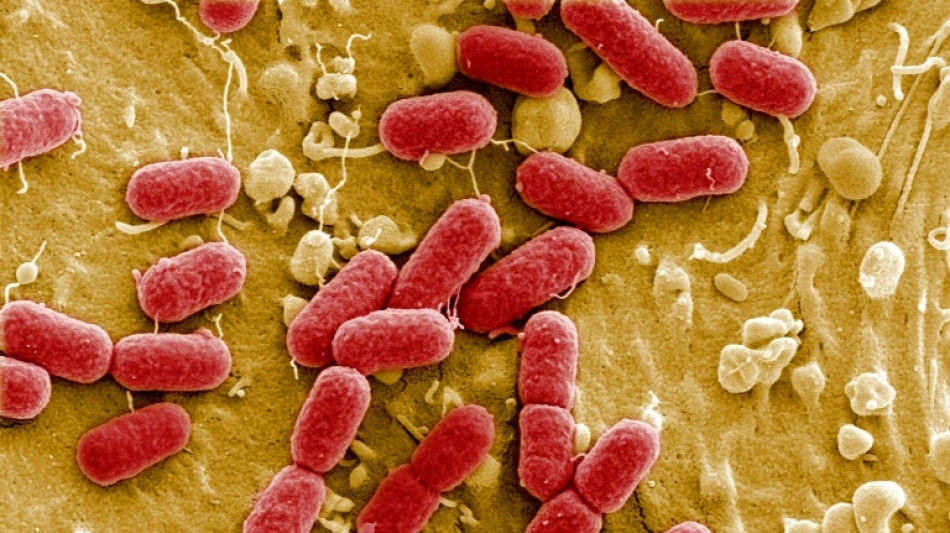
Harmful pollution boosting superbug 'silent pandemic' / Photo: Manfred Rohde - Helmholtz-Zentrum für Infektions/AFP

 Trump's beef policies irk Texas ranchers, testing their loyalty

 Nvidia, OpenAI CEOs to attend Xi dinner at White House

 Anthropic picks Accenture for in-house AI safety evaluation

 Balogun returns as Monaco beat Lens to continue strong Ligue 1 start

 'Pause' on overt repression in Venezuela, but reforms still needed: HRW

 Global stocks mixed as yen falls despite Bank of Japan rate hike

 Cuba hit with seventh major blackout of the year

 Murray out with concussion so Wentz will start for Vikings

 UN chief 'deeply regrets' US visa refusal to Abbas for annual meeting

 England quick Carse to face no charges over alleged nightclub assault

 Mancini brings nine newcomers into the first squad of his Italy comeback

 Czechs level Davis Cup tie against USA as South Korea eye Finals

 New France boss Zidane confirms Mbappe as captain after naming first squad

 California governor signs order to explore AI 'kill switch'

 Head leads run spree as Australia win Zimbabwe ODI series

 In-form Raphinha wants to finish career at Barcelona

 Warren Buffett steps down as Berkshire Hathaway chairman

 Carrick confident Man Utd can 'work through' tough time

 Mbappe ends Nike partnership to join Swiss brand On

 Liverpool boss Iraola puts Bournemouth love affair on hold

 'A disaster' if Man City do not win says Maresca after flawless start

 Kerry James Marshall: American 'blackness' painter celebrated in Europe

 Spain coach De la Fuente offers 'full support' to people of Ceuta

 Russia seizes assets of Nestle, French firms over West's Ukraine support

 England can build on World Cup 'spirit', says Tuchel

Containing and cleaning up environmental pollution, especially in waterways, is crucial to controlling increasingly bullet-proof superbugs which could kill tens of millions by mid-century, a new UN report said Tuesday.
Superbugs -- strains of bacteria resistant to antibiotics -- are estimated to have killed 1.27 million people in 2019, and the World Health Organization says antimicrobial resistance (AMR) is one of the top global health threats on the near-term horizon.
Up to 10 million deaths could occur every year by 2050 because of AMR, the UN says.
The disinfectants, antiseptics and antibiotics that can help microbes become stronger are everywhere, from toothpaste and shampoo to cow's milk and wastewater.
A new report Tuesday said pollution is a key driver in the "development, transmission and spread" of AMR, calling for urgent action to clean up the environment.
"With increasing pollution and lack of management of sources of pollution, combined with AMR in clinical and hospital settings and agriculture, risks are increasing," said the report from the UN Environment Programme.
Antimicrobial resistance is a natural phenomenon, but the overuse and misuse of antibiotics in humans, animals and plants has made the problem worse.
This means antibiotics may no longer work to fight the very infections they were designed to treat.
The UN report Tuesday said that pollution in the environment from key economic sectors has exacerbated the problem, namely from the pharmaceutical and chemical manufacturing sectors, along with agriculture and health care.
Herbicides to control weeds on farms may also increase AMR, while heavy metals are also contributing to the problem.
Once antimicrobials enter the environment they seep into the food chain -- they've been found in fish and cattle -- and loop back into factories making everyday toiletries, for example.
- 'Silent pandemic' -
Antimicrobial resistant genes are in waterways across the globe, from the Ganges River in India to the Cache la Poudre River in the US state of Colorado, the UN study found.
"This is a real issue, because rivers are often the source of our drinking water," Jonathan Cox, senior lecturer in microbiology at Britain's Aston University, told AFP.
"It's already the silent pandemic," warned Cox, who is not linked to the UN study. "It is becoming the next pandemic without us really recognising it."
Prevention is key, the UN said.
"Fuelled by population growth, urbanisation and growing demand for food and healthcare, we can expect an increase in the use of antimicrobials and in pollutant releases into the environment," it said.
The UN urged governments and international groups to address "key pollution sources", including sewage, city waste, healthcare delivery, pharmaceutical manufacturing and intensive crop sectors.
Cox said solutions need to be global, since AMR is so pervasive.
One answer is to focus on clinical approaches, such as improving rapid testing for infections so that antibiotics are not incorrectly prescribed.
Another is improving wastewater management to remove antimicrobials. But such processes are complicated and costly.
"The technology is out there, it just isn't being employed because governments don't care so much about the environment as they do about the bottom line," Cox said.
A.F.Rosado--PC