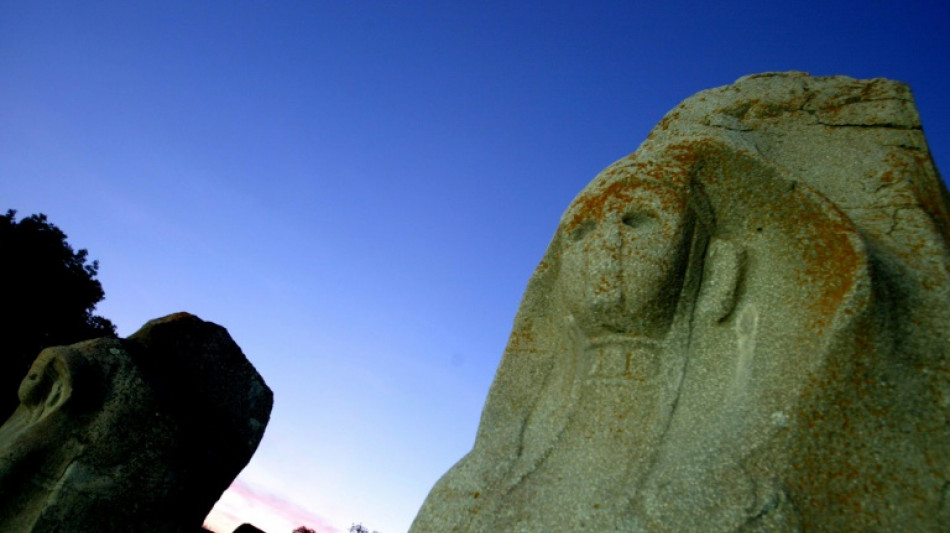
Climate change may have toppled Hittite Empire: study / Photo: STR - AFP/File

 Trump's beef policies irk Texas ranchers, testing their loyalty

 Nvidia, OpenAI CEOs to attend Xi dinner at White House

 Anthropic picks Accenture for in-house AI safety evaluation

 Balogun returns as Monaco beat Lens to continue strong Ligue 1 start

 'Pause' on overt repression in Venezuela, but reforms still needed: HRW

 Global stocks mixed as yen falls despite Bank of Japan rate hike

 Cuba hit with seventh major blackout of the year

 Murray out with concussion so Wentz will start for Vikings

 UN chief 'deeply regrets' US visa refusal to Abbas for annual meeting

 England quick Carse to face no charges over alleged nightclub assault

 Mancini brings nine newcomers into the first squad of his Italy comeback

 Czechs level Davis Cup tie against USA as South Korea eye Finals

 New France boss Zidane confirms Mbappe as captain after naming first squad

 California governor signs order to explore AI 'kill switch'

 Head leads run spree as Australia win Zimbabwe ODI series

 In-form Raphinha wants to finish career at Barcelona

 Warren Buffett steps down as Berkshire Hathaway chairman

 Carrick confident Man Utd can 'work through' tough time

 Mbappe ends Nike partnership to join Swiss brand On

 Liverpool boss Iraola puts Bournemouth love affair on hold

 'A disaster' if Man City do not win says Maresca after flawless start

 Kerry James Marshall: American 'blackness' painter celebrated in Europe

 Spain coach De la Fuente offers 'full support' to people of Ceuta

 Russia seizes assets of Nestle, French firms over West's Ukraine support

 England can build on World Cup 'spirit', says Tuchel

Three years of extreme drought may have brought about the collapse of the mighty Hittite Empire around 1200 BC, researchers have said, linking the plight of the fallen civilisation to the modern world's climate crisis.
The Hittites dominated Anatolia in modern-day Turkey for nearly 500 years, even rivalling the power of the Egyptian Empire for a period.
They were one of several influential ancient civilisations in the Eastern Mediterranean and Near East which were all toppled or severely weakened at around the same time, bringing the curtain down on the Bronze Age.
The Hittites mysteriously abandoned their capital and religious centre Hattusa around 1200 BC, when the royal line died out and written historical documents dried up.
The empire's centuries-old political and cultural structures ended "quite rapidly," Sturt Manning, an archaeologist at Cornell University in the United States and lead author of a new study, told AFP.
There are several theories for what was behind the "Late Bronze Age collapse", including attacks from naval raiders called the "Sea Peoples", epidemics and famines -- as well as a 300-year change to a drier, cooler climate.
But exactly what triggered the demise of these empires has remained unclear.
- 'Existential threat' -
Now, for the Hittites at least, the answer may have come inscribed in the rings of ancient juniper wood.
The juniper comes from one of the world's oldest wooden structures, found at the Phrygian capital of Gordion in central Turkey as part of the excavation of a king's tomb in the 1950s.
By analysing the rings of the juniper wood, the researchers were able to reconstruct climate conditions more than 3,000 years ago.
In semi-arid Central Anatolia, "the major threat to growth for most plants in the region is a lack of water," Manning said.
Narrower tree rings indicate drier years, when a lack of water meant the trees did not grow much.
The rings showed three-straight years -- 1198 BC to 1196 BC -- with "unusually" low growth, suggesting a prolonged and particularly severe drought, according to the study published in the journal Nature on Wednesday.
The researchers suggested that the drought caused severe food shortages, particularly for the land-locked parts of the central Hittite kingdom, which depended on grain and livestock.
The food shortages could have led to political, economic and social unrest, ultimately bringing about the end of the empire.
Manning warned that current global warming means the modern world could face a "multi-year existential threat" similar to the one that affected the Hittites.
Muge Durusu-Tanriover, an archaeologist at Temple University in Philadelphia who was not involved in the study, hailed it as "groundbreaking".
"Now that we know a major climate event might have tipped the Hittite empire beyond its point of no return, there are more questions to ask about climate change, its impact on states and society and, most crucially, what can be learnt from the past during our current climate crisis," she said in a Nature comment piece.
G.M.Castelo--PC