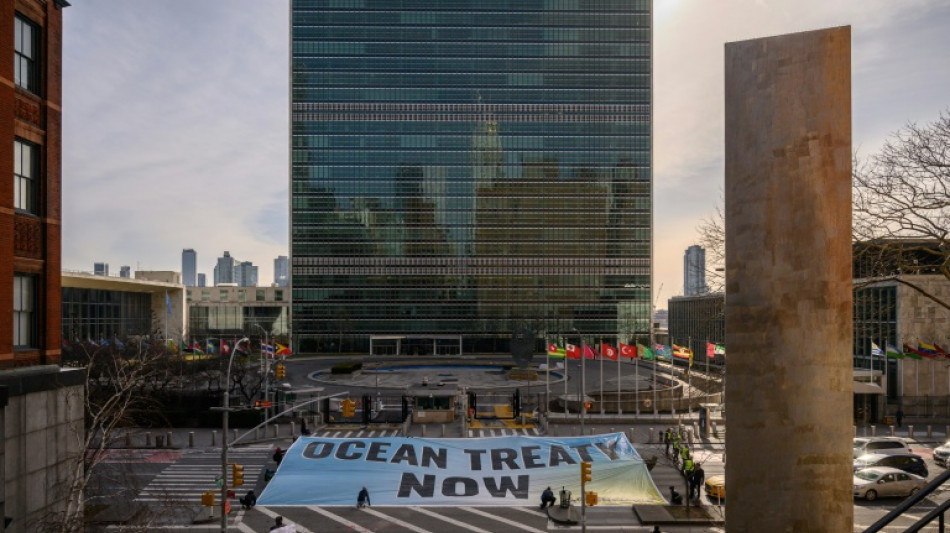
After sleepless night, marathon UN high seas talks continue / Photo: Ed JONES - AFP/File

 Trump's beef policies irk Texas ranchers, testing their loyalty

 Nvidia, OpenAI CEOs to attend Xi dinner at White House

 Anthropic picks Accenture for in-house AI safety evaluation

 Balogun returns as Monaco beat Lens to continue strong Ligue 1 start

 'Pause' on overt repression in Venezuela, but reforms still needed: HRW

 Global stocks mixed as yen falls despite Bank of Japan rate hike

 Cuba hit with seventh major blackout of the year

 Murray out with concussion so Wentz will start for Vikings

 UN chief 'deeply regrets' US visa refusal to Abbas for annual meeting

 England quick Carse to face no charges over alleged nightclub assault

 Mancini brings nine newcomers into the first squad of his Italy comeback

 Czechs level Davis Cup tie against USA as South Korea eye Finals

 New France boss Zidane confirms Mbappe as captain after naming first squad

 California governor signs order to explore AI 'kill switch'

 Head leads run spree as Australia win Zimbabwe ODI series

 In-form Raphinha wants to finish career at Barcelona

 Warren Buffett steps down as Berkshire Hathaway chairman

 Carrick confident Man Utd can 'work through' tough time

 Mbappe ends Nike partnership to join Swiss brand On

 Liverpool boss Iraola puts Bournemouth love affair on hold

 'A disaster' if Man City do not win says Maresca after flawless start

 Kerry James Marshall: American 'blackness' painter celebrated in Europe

 Spain coach De la Fuente offers 'full support' to people of Ceuta

 Russia seizes assets of Nestle, French firms over West's Ukraine support

 England can build on World Cup 'spirit', says Tuchel

UN member states struggled Saturday to nail down a long-awaited agreement on the high seas, after a sleepless night of negotiations on a treaty to protect a fragile and vital treasure that covers nearly half the planet.
After more than 15 years of informal and formal talks, negotiators have reached the end of two more weeks of discussions -- the third "final" session in less than a year.
But as of early Saturday in New York, participants were still wrangling over the highly political issue of benefit-sharing for research derived from marine genetic resources collected on the high seas.
"Global High Seas Treaty. I have now officially been in a negotiations at the UN for 24 hours," New Zealand's deputy foreign secretary Victoria Hallum wrote on Twitter. "That’s a new record for me. So close now!"
On Friday night, conference chair Rena Lee had said there was still "a window of opportunity to seal the deal, and we mustn't let this opportunity slip through our hands."
A draft text seen hours later by AFP did not contain the section on genetic resources, but appeared to be far from finished.
"It still has a lot of brackets in, which raises the question at this late stage of how they plan to go through it all," said Nathalie Rey of the High Seas Alliance, a grouping of around 40 NGOs.
"But it's clear at 4 am, they are still really trying very hard to land the treaty today, otherwise they would have thrown in the towel."
- 'A massive step'? -
Even if compromises are found on all the remaining disputes, the treaty cannot be formally adopted at this session, Lee said on Friday.
But it could be "finalized" without the possibility of reopening discussions on substantive sections, before a formal adoption at a later date, she added.
Even without adoption Friday, "It's a massive step," said Veronica Frank of Greenpeace.
Disputes include the procedure for creating marine protected areas, the model for environmental impact studies of planned activities on the high seas and the sharing of potential benefits of newly discovered marine resources.
The high seas begin at the border of countries' exclusive economic zones, which extend up to 200 nautical miles (370 kilometers) from coastlines. They thus fall under the jurisdiction of no country.
While the high seas comprise more than 60 percent of the world's oceans and nearly half the planet's surface, they have long drawn far less attention than coastal waters and a few iconic species.
Only about one percent of the high seas are currently protected.
Ocean ecosystems create half the oxygen humans breathe and limit global warming by absorbing much of the carbon dioxide emitted by human activities.
But they are threatened by climate change, pollution and overfishing.
- North-South 'equity' -
For many, any agreement hinges on equity between the rich global North and poorer global South.
Developing countries, without the means to afford costly research, say they fear being left behind while others profit from the potential commercialization of substances discovered in the international waters.
In a move seen as an attempt to build trust between rich and poor countries, the European Union pledged 40 million euros ($42 million) in New York to facilitate the ratification of the treaty and its early implementation.
Delegates to a global conference in Panama on saving the world's oceans also pledged $19 billion this week, including $6 billion from the United States and $860 million from the EU for marine conservation.
Observers interviewed by AFP say that resolving these politically sensitive financial issues could help ease other sticking points.
If an agreement is reached, it remains to be seen whether the compromises made will result in a text robust enough to protect oceans effectively.
"The text is not perfect, but it's got a clear path towards 30 by 30," said Greenpeace's Frank, referring to world governments' commitment to protect 30 percent of the world's land and ocean by 2030, as agreed in Montreal in December.
S.Caetano--PC