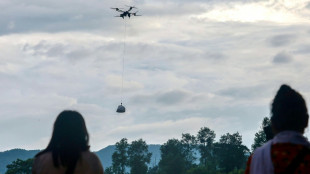
Green tech boom looms but poor nations risk being eclipsed: UN / Photo: Julia Han JANICKI - AFP

 Trump's beef policies irk Texas ranchers, testing their loyalty

 Nvidia, OpenAI CEOs to attend Xi dinner at White House

 Anthropic picks Accenture for in-house AI safety evaluation

 Balogun returns as Monaco beat Lens to continue strong Ligue 1 start

 'Pause' on overt repression in Venezuela, but reforms still needed: HRW

 Global stocks mixed as yen falls despite Bank of Japan rate hike

 Cuba hit with seventh major blackout of the year

 Murray out with concussion so Wentz will start for Vikings

 UN chief 'deeply regrets' US visa refusal to Abbas for annual meeting

 England quick Carse to face no charges over alleged nightclub assault

 Mancini brings nine newcomers into the first squad of his Italy comeback

 Czechs level Davis Cup tie against USA as South Korea eye Finals

 New France boss Zidane confirms Mbappe as captain after naming first squad

 California governor signs order to explore AI 'kill switch'

 Head leads run spree as Australia win Zimbabwe ODI series

 In-form Raphinha wants to finish career at Barcelona

 Warren Buffett steps down as Berkshire Hathaway chairman

 Carrick confident Man Utd can 'work through' tough time

 Mbappe ends Nike partnership to join Swiss brand On

 Liverpool boss Iraola puts Bournemouth love affair on hold

 'A disaster' if Man City do not win says Maresca after flawless start

 Kerry James Marshall: American 'blackness' painter celebrated in Europe

 Spain coach De la Fuente offers 'full support' to people of Ceuta

 Russia seizes assets of Nestle, French firms over West's Ukraine support

 England can build on World Cup 'spirit', says Tuchel

The green technology industry could be worth several trillion dollars by 2030 but developing countries will miss out on the boom unless they jump in now, the UN said Thursday.
From a roughly equal position three years ago, green technology exports from the most advanced countries are already racing ahead of developing nations, warned the United Nations' trade and development agency, UNCTAD.
And without intervention to close the gap, early adopters will build in lasting advantages, making it even harder for developing countries to catch up, UNCTAD said.
"We are at the beginning of a technological revolution based on green technologies," said the agency's chief Rebeca Grynspan.
"Missing this technological wave... would have long-lasting negative implications."
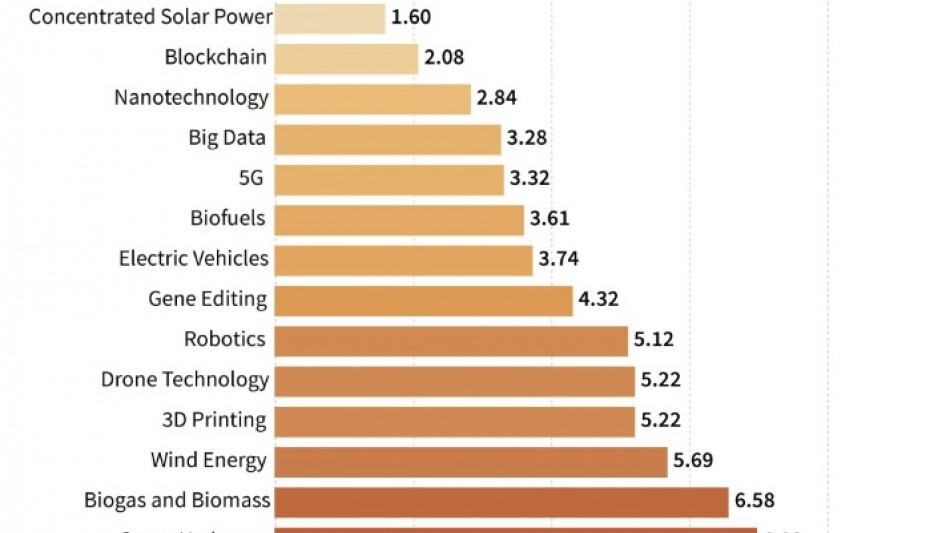
UNCTAD estimated that 17 key frontier technologies, which are at the leading edge of green innovation, could create a market worth more than $9.5 trillion by 2030 -- up from $1.5 trillion in 2020.
The technologies include artificial intelligence, electric vehicles, green hydrogen, biofuels, nanotechnology, 5G, gene editing, robotics, 3D printing, wind energy and blockchain.
They can be used to produce goods and services in a way that leaves a smaller carbon footprint.
The United States and China currently dominate these fields, with a combined 70 percent of patents.
- Richest gaining ground -
As for readiness to adopt and exploit such technologies, UNCTAD's ranking chart is dominated by high-income countries, led by the United States, Sweden, Singapore, Switzerland and the Netherlands.
Of the BRICS nations, Russia is ranked 31st, China 35th, Brazil 40th, India 46th and South Africa 56th -- the highest on the African continent.
China's lower-than-expected position is due to patchy rural internet coverage and slow broadband speed.
However, several Asian countries are over-performing, with India 67 places higher than its GDP per capita ranking, the Philippines 54 spots higher and Vietnam 44 places higher, leaving them well-placed to seize the initiative.
Latin America, the Caribbean and sub-Saharan Africa are at highest risk of missing current windows of opportunity.
Despite a level start, a gap is already opening up in green tech exports, with developed countries pulling away from the rest with exponential growth.
Total green tech exports from developed countries jumped from around $60 billion in 2018 to more than $156 billion in 2021, while over the same period, exports from developing nations -- China included -- rose from $57 billion to around $75 billion.
In those three years, developing countries' share of global exports fell from over 48 percent to below 33 percent.
- Trade, climate, IP rules tangled -
UNCTAD noted that smaller developing countries, which have done little to cause climate change, were often set to feel the brunt -- yet were left struggling to access the technology that could help them mitigate against it.
The agency's deputy leader Pedro Manuel Moreno said they were caught between promoting economic growth and protecting the environment.
"They need more investment, more tech transfer and more international coherence between global climate and trade agreements," Moreno told reporters.
He said trade rules should be changed to help developing countries protect nascent green industries through tariffs, subsidies and public procurement.
The trading system has to be streamlined with the landmark Paris Agreement on climate change, he said, so that green tech can be transferred effectively to developing nations.
Shamika Sirimanne, UNCTAD's technology and logistics director, said a "less stringent intellectual property regime at the global level is needed urgently" to help such countries benefit.
She called for a patents waiver to promote the transfer of climate change-related technology.
Nogueira--PC