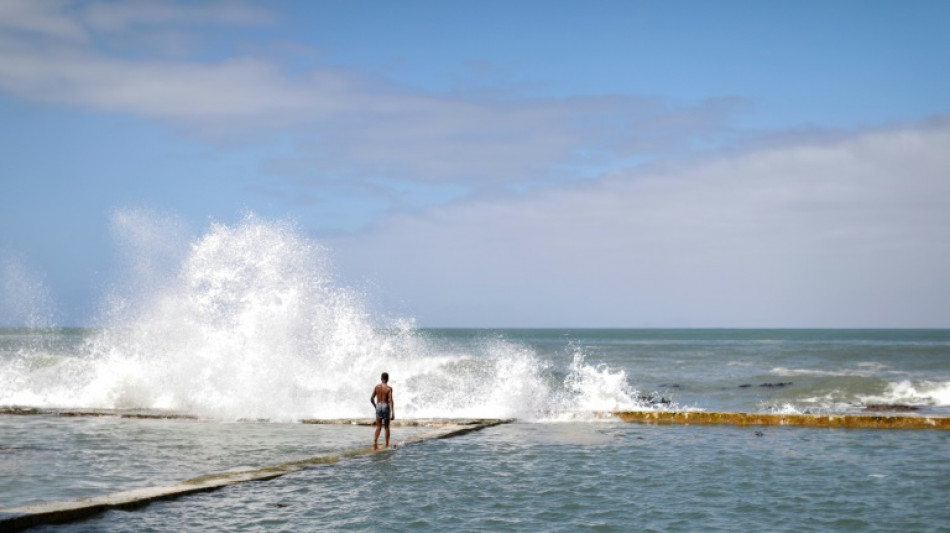
High seas treaty moves closer to reality with first signatures / Photo: GIANLUIGI GUERCIA - AFP

 Drone owners rush to offload devices ahead of Beijing ban

 Trump's beef policies irk Texas ranchers, testing their loyalty

 Nvidia, OpenAI CEOs to attend Xi dinner at White House

 Anthropic picks Accenture for in-house AI safety evaluation

 Balogun returns as Monaco beat Lens to continue strong Ligue 1 start

 'Pause' on overt repression in Venezuela, but reforms still needed: HRW

 Global stocks mixed as yen falls despite Bank of Japan rate hike

 Cuba hit with seventh major blackout of the year

 Murray out with concussion so Wentz will start for Vikings

 UN chief 'deeply regrets' US visa refusal to Abbas for annual meeting

 England quick Carse to face no charges over alleged nightclub assault

 Mancini brings nine newcomers into the first squad of his Italy comeback

 Czechs level Davis Cup tie against USA as South Korea eye Finals

 New France boss Zidane confirms Mbappe as captain after naming first squad

 California governor signs order to explore AI 'kill switch'

 Head leads run spree as Australia win Zimbabwe ODI series

 In-form Raphinha wants to finish career at Barcelona

 Warren Buffett steps down as Berkshire Hathaway chairman

 Carrick confident Man Utd can 'work through' tough time

 Mbappe ends Nike partnership to join Swiss brand On

 Liverpool boss Iraola puts Bournemouth love affair on hold

 'A disaster' if Man City do not win says Maresca after flawless start

 Kerry James Marshall: American 'blackness' painter celebrated in Europe

 Spain coach De la Fuente offers 'full support' to people of Ceuta

 Russia seizes assets of Nestle, French firms over West's Ukraine support

Dozens of nations on Wednesday began signing a first-ever treaty on protecting the international high seas, raising hopes that it will come into force soon and protect threatened ecosystems vital to the planet.
"It's an amazing moment to be here and see such multilateral cooperation and so much hope," said actor Sigourney Weaver said in New York as the signatures opened.
The treaty marks change in "the way we view the ocean, from a big garbage dump and a place where we can take stuff, to a place that we take care of, that we steward, we respect," she told AFP.
Around 70 countries are set to sign the treaty on Wednesday on the sidelines of the annual UN General Assembly, including the United States, Chile, Fiji, Norway, and the European Union as a whole.
But each country must still ratify the treaty under its own domestic process. The treaty will come into force 120 days after 60 countries ratify it.
"It is clear that the ocean is in urgent need of protection," said Belgium's deputy prime minister, Vincent van Quickenborne.
Without action, "it's game over," he said.
After 15 years of discussion, the United Nations sealed the first treaty on the high seas in June by consensus, although Russia said it had reservations.
The start of signatures marks "a new chapter" of "establishing meaningful protections" for the oceans, said Nichola Clark of the Ocean Governance Project at The Pew Charitable Trusts.
The high seas are defined as the ocean starting beyond countries' exclusive economic zones, or 200 nautical miles (370 kilometers) off coastlines -- covering nearly half the planet.
Nonetheless, they have long been ignored in discussions on the environment.
A key tool in the treaty will be the ability to create protected marine areas in international waters -- only around one percent of which are now protected by any sort of conservation measures.
The treaty is seen as crucial to an agreement to protect 30 percent of the world's oceans and lands by 2030, as agreed by governments in a separate historic accord on biodiversity reached in Montreal in December.
- 'Race to ratification' -
Mads Christensen, interim executive director of Greenpeace International, voiced hope that the treaty would come into force in 2025, when the next UN oceans conference takes place in France.
"We have less than seven years to protect 30 percent of the oceans. There is no time to waste," he said.
"The race to ratification has begun and we urge countries to be ambitious, ratify the treaty and make sure it enters into force in 2025."
But even if the treaty draws the 60 ratifications needed to come into force, it would still be well below the universal support for action sought by environmental defenders.
Oceans are critical for the health of the whole planet, protecting often microscopic biodiversity that supports half of the oxygen breathed by land life. The oceans are also critical to limiting climate change by helping absorb greenhouse gas emissions.
The treaty, officially known as the treaty on "Biodiversity Beyond National Jurisdiction" or BBNJ, also introduces requirements to carry out environmental impact studies for proposed activities on the high seas.
Such activities, while not listed in the text, would include anything from fishing and maritime transport to more controversial pursuits such as deep-sea mining or even geo-engineering programs aimed at fighting global warming.
F.Santana--PC