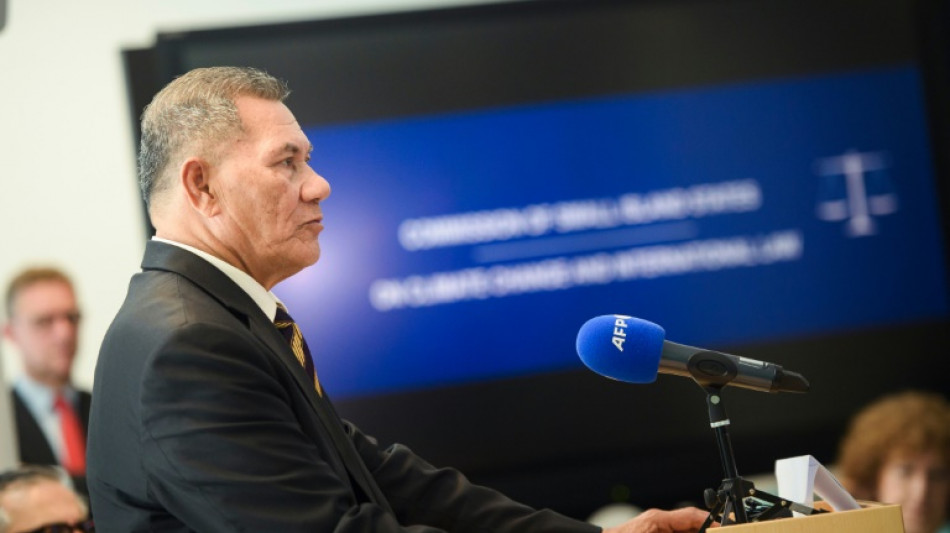
Tuvalu will always be a state, even if underwater, says PM / Photo: Gregor Fischer - AFP/File

 Drone owners rush to offload devices ahead of Beijing ban

 Trump's beef policies irk Texas ranchers, testing their loyalty

 Nvidia, OpenAI CEOs to attend Xi dinner at White House

 Anthropic picks Accenture for in-house AI safety evaluation

 Balogun returns as Monaco beat Lens to continue strong Ligue 1 start

 'Pause' on overt repression in Venezuela, but reforms still needed: HRW

 Global stocks mixed as yen falls despite Bank of Japan rate hike

 Cuba hit with seventh major blackout of the year

 Murray out with concussion so Wentz will start for Vikings

 UN chief 'deeply regrets' US visa refusal to Abbas for annual meeting

 England quick Carse to face no charges over alleged nightclub assault

 Mancini brings nine newcomers into the first squad of his Italy comeback

 Czechs level Davis Cup tie against USA as South Korea eye Finals

 New France boss Zidane confirms Mbappe as captain after naming first squad

 California governor signs order to explore AI 'kill switch'

 Head leads run spree as Australia win Zimbabwe ODI series

 In-form Raphinha wants to finish career at Barcelona

 Warren Buffett steps down as Berkshire Hathaway chairman

 Carrick confident Man Utd can 'work through' tough time

 Mbappe ends Nike partnership to join Swiss brand On

 Liverpool boss Iraola puts Bournemouth love affair on hold

 'A disaster' if Man City do not win says Maresca after flawless start

 Kerry James Marshall: American 'blackness' painter celebrated in Europe

 Spain coach De la Fuente offers 'full support' to people of Ceuta

 Russia seizes assets of Nestle, French firms over West's Ukraine support

Tuvalu could be one of the first nations to sink beneath the sea as a result of climate change, but that doesn't mean its statehood is up for discussion, the tiny Pacific archipelago's prime minister said Thursday.
Speaking on the sidelines of the UN General Assembly, Kausea Natano said there had been "unnecessary" conversations in academic and diplomatic circles centered on the definition of a country under international law.
"Our sovereignty is not negotiable," Natano told AFP, adding that his country would be working with the international community to "bring a close to these distractions."
Tuvalu's population of 11,000 is spread across nine islands that rise less than five meters above sea level, underscoring the extraordinary challenges it faces from sea-level rise.
Two of the atolls represented on its flag of 11 stars have already disappeared, and even the higher lying areas could become uninhabitable by 2100 as a result of salt contaminating its land and water supply.
The 1933 Montevideo Convention on the Rights and Duties of States holds that a state consists of a defined territory, a permanent population, a government and the capacity to interact with other states.
If the territory is swallowed up, or no one can live on what is left of it, then at least one of the criteria is no longer met.
But while Tuvalu’s land mass accounts for just 26 square kilometers (10 square miles) -- around the size of seven Central Parks -- its maritime territory covers a vast 800,000 square kilometers.
The convention is ambiguous on the question of whether territory is wet or dry, and there is no precedent for revoking the status of a UN member state, leaving the matter fuzzy.
- Land reclamation, and the metaverse -
Tuvalu isn't taking an underwater future as a given, and -- along with pleading with the world to end its addiction to fossil fuels -- has begun work on a Coastal Adaptation Project that aims to reclaim around 3.8 kilometers of land from the ocean and raise land levels in the most vulnerable spots.
It has been financed with $36 million in international assistance channelled through the Green Climate Fund, and $2.9 million from Tuvalu's own government.
The situation is dire, says Natano. Around 40 percent of the capital Funafuti already gets submerged during periodic "king" tides that wash away root crops, including former island staples taro and cassava.
While he is pleased that the project's first phase is nearing completion, Natano said the scope is too small to help all of his people.
"We need more, faster action from whoever is in a position to support us, urgently," he said.
To this end, the country has been at the forefront of the major climate action calls: a global tax on fossil fuels, and the activation of a "loss and damages" fund -- international climate jargon for climate compensation owed by rich polluting countries to the most impacted nations.
This fund was agreed to in principle at the last major climate talks in Egypt, but -- like so many other vows from the rich world -- has yet to be fulfilled.
"It's a matter of life and death -- it's a matter of disappearing from the surface of this Earth," said Natano, urging countries to keep their promise.
Should the worst come to pass, Tuvalu has been moving its cultural heritage to the digital sphere, in what some have called a model for how "Nation-States 2.0" might work.
But what happens to Tuvalu will merely be a harbinger of what cities around the world threatened by sea-level rise will experience -- from Miami to Manila, said Natano.
"More and more citizens of the world will have to relocate," he said. "Use us a model to preserve the entire world."
G.Machado--PC