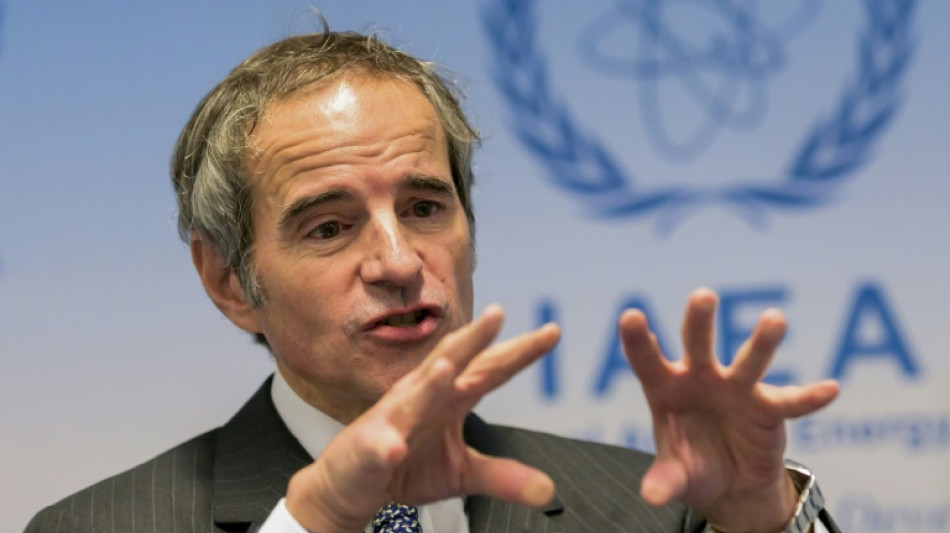
Nuclear power has role to play, atomic energy head tells AFP at COP28 / Photo: Joe Klamar - AFP

 Ed Sheeran returns to stage after Palestinian controversy
 Asian Games to open in Japan after troubled build-up
 Drone owners rush to offload devices ahead of Beijing ban

 Trump's beef policies irk Texas ranchers, testing their loyalty

 Nvidia, OpenAI CEOs to attend Xi dinner at White House

 Anthropic picks Accenture for in-house AI safety evaluation

 Balogun returns as Monaco beat Lens to continue strong Ligue 1 start

 'Pause' on overt repression in Venezuela, but reforms still needed: HRW

 Global stocks mixed as yen falls despite Bank of Japan rate hike

 Cuba hit with seventh major blackout of the year

 Murray out with concussion so Wentz will start for Vikings

 UN chief 'deeply regrets' US visa refusal to Abbas for annual meeting

 England quick Carse to face no charges over alleged nightclub assault

 Mancini brings nine newcomers into the first squad of his Italy comeback

 Czechs level Davis Cup tie against USA as South Korea eye Finals

 New France boss Zidane confirms Mbappe as captain after naming first squad

 California governor signs order to explore AI 'kill switch'

 Head leads run spree as Australia win Zimbabwe ODI series

 In-form Raphinha wants to finish career at Barcelona

 Warren Buffett steps down as Berkshire Hathaway chairman

 Carrick confident Man Utd can 'work through' tough time

 Mbappe ends Nike partnership to join Swiss brand On

 Liverpool boss Iraola puts Bournemouth love affair on hold

 'A disaster' if Man City do not win says Maresca after flawless start

 Kerry James Marshall: American 'blackness' painter celebrated in Europe

It would be a mistake to reject nuclear power because of problems at a handful of projects, Rafael Grossi, head of the International Atomic Energy Agency said in an interview with AFP.
Grossi was speaking at the COP28 conference in Dubai, where on Saturday a group of large countries are expected to call for nuclear power capacity to be tripled by 2050 as part of the fight against global warming.
Supporters of atomic power say it is an essential source of reliable emissions-free energy.
But detractors point to the risks and high costs of massive nuclear projects at a time when the price of renewable energies continues to fall.
"There is work to do," Grossi admitted, citing the financing needs of countries that wish to extend their nuclear fleets, such as Brazil, Argentina, and South Africa.
Grossi said countries tempted to take the nuclear leap, including Morocco, Senegal, Kenya and the Philippines, face similar challenges.
"There are statutes in some international lending organisations that exclude financing for nuclear," the Argentinian director general said.
"I think that is completely obsolete. It does not correspond to any scientific or technological criteria."
The World Bank, for instance, has not financed a nuclear project since 1959.
"I think, and I hope there will be an evolution" in their thinking, Grossi said.
- Proliferation risk 'should not exist' -
Some environmentalists argue that with certain nuclear projects already 10 years behind schedule, they are simply too costly and will not be ready in time to respond to climate challenges.
But rejecting all nuclear projects because of these setbacks would be "an error", Grossi insisted.
"Look, here in the Emirates... there was no nuclear here a decade ago and now there are four reactors," meeting about a quarter of the country's electricity demands.
The nuclear industry is resting much of its hopes on small modular reactors (SMR), which are less powerful but easier to construct.
There are concerns that less developed countries might not have the means to keep these installations safe and avoid proliferation.
"It is a legitimate question, but that is why we were created," Grossi responded, pointing to the flag of his agency, which carries atomic symbols on a United Nations blue background.
"Any country wanting to develop a nuclear programme must follow a full procedure and draw up an agreement with the Agency," he said.
"In principle, that means the risk of proliferation should not exist."
For example, the Emirates had to complete 19 steps while developing its civil nuclear programme, including setting up an independent supervisory body.
Grossi said he does not think the dangers faced by Ukraine's reactors since the start of Russia's invasion are an argument against nuclear power, either.
"The problem is war, not nuclear," he said without hesitation.
However, he could not hide his concern as winter approaches.
"The ground will harden, the tanks can move, the rivers will freeze, we see a lot of military equipment on both sides. Yes, that obviously worries us."
G.Machado--PC